A tenant reports water on an interior wall after the first real rain. The field membrane still looks intact. That is the normal parapet story. The leak started at the perimeter.
Top Pro Roofing SD is a referral service. We do not waterproof commercial walls, and we do not publish leak-repair fees. Call (760) 750-5557. We introduce a licensed independent C-39. You contract with that pro.
Related details: flashing leak repair, ponding on flat roofs, commercial roofing, roof repair.
The wall is the weak point, not the field
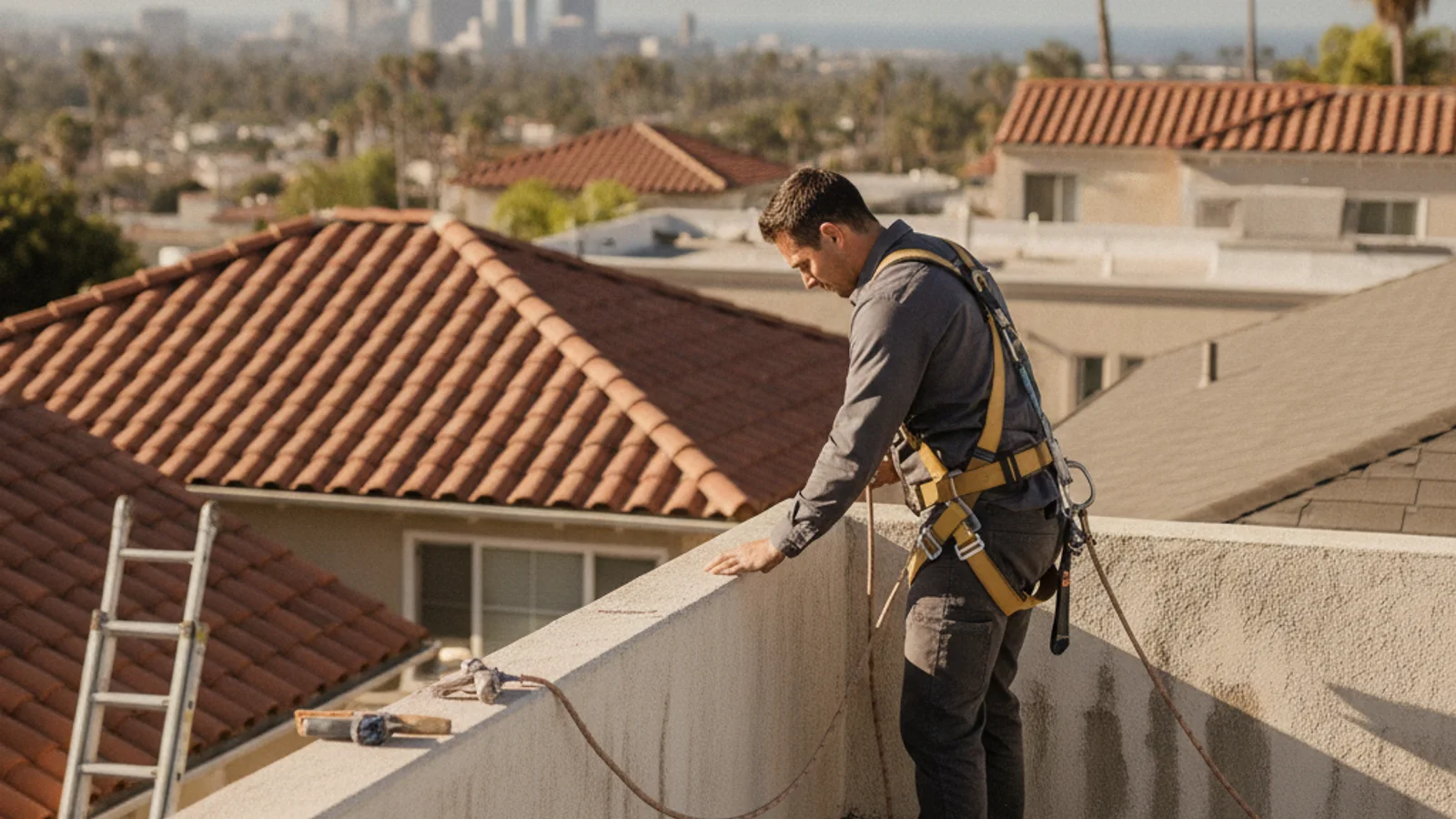
A parapet is a wall that continues above the roof. It hides equipment, can serve fire separation, and gives the street a finished top. Mid-century San Diego commercial stock is full of them: strip retail on El Cajon Boulevard, University Avenue, and Highland Avenue in National City; older office and light industrial in Kearny Mesa and Barrio Logan; smaller downtown inventory.
Geometry does the damage. The roof is no longer a plane that sheds at an eave. It is a plane with a 90-degree upstand all the way around. Water sits against that wall until it finds a drain or a scupper. Wind drives rain up the face and under a cap.
Field failures still happen. They tend to be visible: puncture, split, open seam. Perimeter water enters at the top or at a scupper, travels in the cavity, and shows up on a ceiling far from the entry. That is why owners replace a membrane and keep the stain.
Coping, the cap almost nobody maintains
Coping is the cap on the wall: sheet metal, stone, precast, or stucco troweled over the top on a lot of older buildings. Its only job is to keep water out of the top of the assembly.
Metal coping fails at joints. Sealant and splice plates are consumables. Fasteners back out. Thermal movement opens laps. Coping should slope to the roof, not to the street. Plenty of it does the opposite and feeds the facade.
Stucco-topped parapets are common on this county’s mid-century boxes. Stucco is not waterproofing. A hairline crack on the top of the wall is a path into the cavity. You will not see it from the sidewalk.
Behind or under the cap there should be continuous waterproofing, and on masonry a through-wall flashing that kicks water back out. Whether your building has either, and whether it still works, is an opening, not a parking-lot opinion.
Base flashing, through-wall flashing, counterflashing
At the bottom of the parapet the roof membrane turns up the wall. That upturn is base flashing. It terminates with metal counterflashing, a reglet, or a termination bar and sealant.
Sealant at a termination bar is a maintenance item measured in years. A reglet in stucco can crack around the cut. Counterflashing under coping depends on the coping. Base flashing is bonded to a wall that moves differently from the deck, so shear shows up at the corner. When that corner opens, water enters at roof level and runs into the wall base.
Masonry parapets add through-wall flashing. If it is missing or dead, water in the wall has no exit. On the coast, salt works on embedded metal. Residential cousin of the same idea: roof flashing leak repair.
Scuppers, drains, and water that cannot leave
A parapet blocks the edge. Water leaves through the wall or down through the building. Scuppers are openings with a sheet-metal sleeve and a collector head outside. Interior drains go through the deck into a leader.
Scuppers fail where the sleeve meets membrane and wall, and when the head detaches or clogs. A bad sleeve dumps into the cavity. Palm fronds, eucalyptus, plastic, and gravel block the opening. A blocked scupper turns the parapet into the wall of a shallow pool.
Interior drains fail at the clamping ring, a missing strainer, a settled sump, or a leader leak inside that gets blamed on the roof. Older buildings were often drained to an earlier code cycle. Ask the AHJ whether overflow drainage is required on this reroof or repair. Read the current plumbing and roof-drainage sections they cite. We will not restate those details here.
Ponding against base flashing pushes on a detail meant to shed, not hold. Ponding water on flat roofs covers slope. Rain here often arrives in a few events. Confirm current climate normals on NOAA’s published tables if you need a number. A drain that sat dry for eight months is the one nobody cleared.
Coastal, inland, and downtown
Coast (Imperial Beach, Coronado, Ocean Beach, Pacific Beach, Del Mar, Oceanside): salt aerosol. Coping fasteners, scupper sleeves, collector heads, and drain rings corrode first.
Inland (El Cajon, Santee, Escondido, San Marcos): thermal cycling. Dark or aging membranes run hotter. Sealant and coping joints open. Eucalyptus and pepper trees load scuppers.
Downtown and older mixed-use: party walls. A shared parapet often has no coping and no clear owner. Settle who maintains the top before scaffolding, not after.
What a real inspection should document
A stain says water arrived. It does not name the entry. Expect the hole uphill, often at the perimeter.
A useful report photographs each piece: coping type and every joint, cracks on the top of the wall, base flashing and termination for the full perimeter, each scupper inside and out, each drain ring and strainer, field seams, curbs, and standing water with depth. If a detail cannot be judged without opening, the report should say so. Infrared can find wet insulation. It is an aid, not a verdict.
Detail repair is often right when the field still has life and failures sit at coping joints, one scupper, or a run of base flashing. Replacement is the conversation when insulation is wet across large areas, the membrane is done, or drainage has to be rebuilt. That call belongs to a C-39 on the roof. We will not invent a commercial leak fee.
Verify bidders at CSLB.
When to call us
Parapet leaks are diagnostic work at height. They are not a caulk-gun maintenance task. For commercial roofing or targeted roof repair on a parapet building, call (760) 750-5557.