Top Pro Roofing SD is a referral marketplace. We connect San Diego County homeowners with CSLB-licensed C-39 roofers. We do not hold a C-22 asbestos license and we do not remove asbestos. Call (760) 750-5557.
If your home was built before 1980, treat the roof as possibly asbestos-bearing until a lab says otherwise. Do not break, cut, sand, drill, scrape, or pressure-wash suspect tile, shingles, felt, or mastic. Do not bag it in a regular dumpster. Licensed asbestos abatement handles sampling, notification, removal, and disposal. A regular reroof crew is not a substitute.
This page is not medical or legal advice. Health questions go to your doctor. Compliance questions go to the abatement contractor plus Cal/OSHA, EPA, and the San Diego County Air Pollution Control District (SDAPCD).
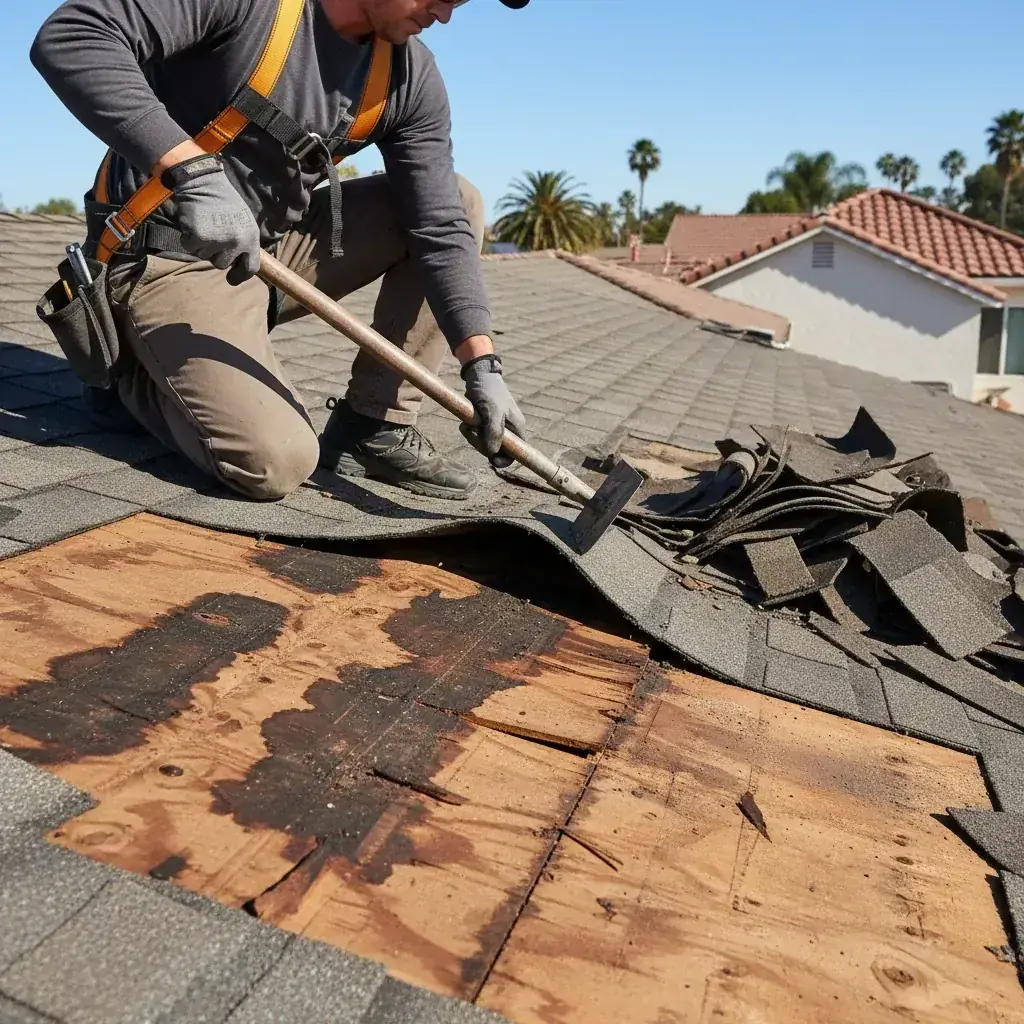
Why pre-1980 San Diego roofs still show up
Mission Hills, Hillcrest, North Park, Kensington, Allied Gardens, Clairemont, La Mesa, and Spring Valley filled in during the post-war boom. That window lines up with heavy residential asbestos use.
Coastal Southern California used a lot of cement tile and composition roofs for sun, salt, and Santa Ana wind. Some of that “cement” tile was transite: cement reinforced with asbestos fiber. It looked like concrete tile. It was lighter. You cannot tell by eye. Best roof material for coastal climates covers modern replacements, not this identification job.
Asbestos-bearing asphalt shingles were also sold as fire-resistant upgrades in foothills and canyon edges. Federal limits on asbestos in roofing products tightened across the late 1970s and 1980s. Pre-1980 remains the conservative cutoff for testing before tear-off.
Where it hides on the roof
You cannot confirm asbestos by looking. These are the usual suspects on older county homes.
| Product | Common era | What you might see |
|---|---|---|
| Transite (asbestos-cement) tile | 1950s to late 1970s | Flat or lightly contoured “cement” tile that feels light vs modern concrete |
| Asphalt-asbestos shingles | 1950s to late 1970s | Old three-tab look, sometimes originally sold as fire resistant |
| Asbestos felt / underlayment | Pre-1980 | Black felt at eaves or under a later reroof layer |
| Asbestos-cement sheathing | 1950s to 1970s | Gray cement-like panels under the covering |
| Black flashing mastic | Pre-1980 | Tar-like sealant at vents, chimneys, and flashings |
Layered roofs are common here. A 1990s shingle overlay can sit on original felt. Tile that looks intact can still have asbestos underlayment. 2026 tile roof replacement cost is a different buying page. Use it after the lab result, not instead of testing.
Genuine clay tile and modern concrete tile are not asbestos. Transite is the mix-up. If you cannot name the product, that is the testing case. Concrete vs clay tile.
Testing first, then the two-license job
A C-39 roofer can flag suspect materials and pause a tear-off bid. They should not improvise samples with a utility knife on your ridge. Hire a Cal/OSHA-registered asbestos consultant or C-22 abatement contractor to collect samples. Polarized light microscopy (PLM) is the usual method for bulk building materials. Rush TEM exists when the lab and the consultant specify it.
We will not invent per-sample fees, visit totals, or an “all-in testing budget.” Ask the sampler for a written scope: how many layers, which materials, which lab, and who files results.
If the result is negative, the C-39 reroof can proceed as a normal roof replacement.
If the result is positive, the tear-off is abatement, not roofing:
- Hire a CSLB C-22 asbestos abatement contractor who also holds Cal/OSHA Asbestos Contractor Registration. Verify both: CSLB license check and Cal/OSHA / DIR.
- The abatement contractor files any required SDAPCD notification before work. Many jobs use a 10-business-day notice. Thresholds and fees are theirs to confirm on SDAPCD.
- They name the worker-protection methods they will use and the current Cal/OSHA rules they follow. Confirm that with the contractor and the agency, not this blog.
- They remove, double-bag or wrap, label, and haul to a landfill permitted for asbestos. Keep the signed manifest.
- After written clearance that the deck is ready, the C-39 roofer installs the new system.
Two licenses, two contracts, two scopes. Some firms hold both. Most do not. Do not hire a roofer who says they will “be careful” without C-22 and Cal/OSHA registration.
Cal/OSHA, EPA, and SDAPCD
Cal/OSHA publishes worker rules for asbestos in construction. Read the current Title 8 text. Registration is how you check the contractor, not a sticker on a truck.
EPA publishes the federal Asbestos NESHAP baseline and homeowner-facing asbestos resources. Single-family NESHAP applicability is a contractor question. It does not authorize DIY.
SDAPCD enforces local notification and disposal tracking in the county. Ask to see the filing and the disposal manifest. Skipping notice is a contractor violation. Improper disposal can still follow the property owner.
Do not DIY, encapsulate as a shortcut, or skip the dumpster rules
Do not take your own samples to “save a trip.” Disturbing the material is how fibers go airborne. A lab that accepts mail-in bulk samples is not permission to scrape your own transite.
Do not roof over a known asbestos layer because a cheap bid called it encapsulation. Covering can be legal in some cases. It leaves the material in place, complicates the next tear-off, and many C-39 installers will not take that liability. Ask the C-22 contractor in writing whether removal or an allowed in-place method applies to this roof.
Do not let anyone put asbestos in a construction dumpster. Wrapped, labeled waste goes to a permitted Class II or Class III facility under a manifest. Keep your copy.
Intact, undisturbed material is a different risk profile from a tear-off. That is not a reason to wait until someone already started ripping. If you need a new roof, test first. If the covering is breaking up now, stop walking it and call abatement.
Timeline without fake dollar adders
We will not publish an abatement premium, a notification fee, or a disposal-per-ton rate. Those lines belong on the C-22 proposal.
What you can plan on the calendar:
- Lab turnaround after a proper sample: often days to a couple of weeks
- SDAPCD notice, when required: commonly 10 business days before start
- Abatement days, then the C-39 install window
Most of the stretch is waiting on notice and lab work, not crew hours. If you are racing the wet months, start testing before you lock a reroof date. Best time to replace a roof in San Diego.
A small repair that still disturbs suspect material can trigger Class III or full abatement rules. Do not thread that needle yourself. The C-22 contractor names the class.
Insurance often treats routine abatement as a pollution or contamination exclusion. A covered sudden loss can be different. Read the policy. Ask the carrier. We do not adjust claims.
FAQ
Does San Diego require a test before every reroof on an older home? The law does not make every homeowner pull a permit for a lab test. Cal/OSHA still expects contractors to treat unidentified suspect material as asbestos or to test it. A responsible C-39 bid on a pre-1980 house pauses for testing.
Can I remove a few tiles myself? No. Do not DIY asbestos roof work. Hire licensed abatement.
Will overlaying a new roof hide the problem for resale? Buyers still ask. A lab report or a documented abatement file beats a shrug. We will not invent a resale discount.
Who leads: roofer or abatement? Before results, the roofer scopes the new roof and the suspect layers. After a positive test, abatement leads demolition. The roofer returns when the deck is cleared in writing.
When to call us
If the house is pre-1980 and anyone is talking tear-off, stop the DIY plan. Call (760) 750-5557. We will connect you with a licensed local roofer who can flag suspect materials and point you toward C-22 abatement for testing and removal. No tear-off bid should outrun the lab.