Hail damage looks like random round dents, knocked-off granules, and bruised soft spots. On tile it leaves crescent cracks and chipped edges. On metal it leaves dents you see at an angle. Many carriers treat hail around 0.75 inch, about penny-sized, as the size that can bruise a roof. Hail is rare in coastal San Diego. Document the storm before you file.
Top Pro Roofing SD is a referral service. We match you with an independent C-39. We do not inspect for insurers, set claim amounts, or repair roofs. Call (760) 750-5557. We will not invent repair or reroof prices. Those belong on a written bid for your address.
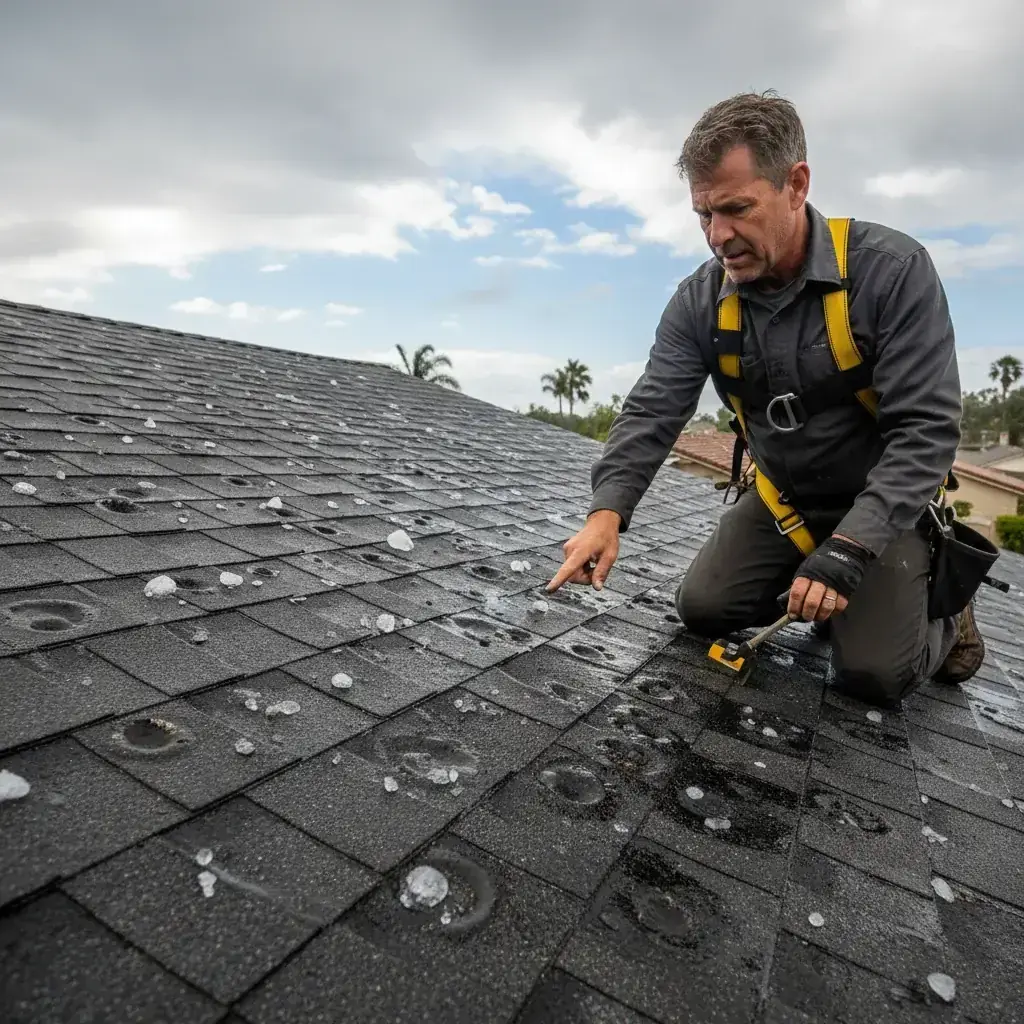
Hail size and what it does to your roof
Stone size is the first filter most adjusters use. A common working threshold is about 0.75 inch, near a U.S. penny. Smaller stones often leave little on a sound roof unless wind drives them sideways. This table is a field aid, not a policy promise.
| Hail size | Common name | Typical risk on San Diego roofs |
|---|---|---|
| Under 0.5 inch | Pea to marble | Often none. Soft graupel can melt on impact. |
| 0.5–0.75 inch | Dime to penny | Cosmetic granule loss possible on older shingles. |
| 0.75–1 inch | Quarter | Bruising and cracked tile edges start showing up. |
| 1–1.75 inch | Half dollar to golf ball | Likely hits across shingle, tile, and metal. |
| Over 1.75 inch | Tennis ball and up | Severe: punctures, shattered tile, deep dents. |
If hail is still on the ground, set a coin next to it and photograph it. That one photo often settles whether a claim even starts.
Visual identification checklist by roof material
Hail is random. Wear and factory flaws line up in rows or follow the sun.
| Roof material | What a hail dent looks like | How to confirm it is hail |
|---|---|---|
| Asphalt shingle | Dark circular spots where granules are gone, exposed shiny asphalt | Press it. A hail bruise feels soft, like a bruise on an apple. |
| Clay or concrete tile | Crescent “impact moon” cracks, chipped corners, shards in gutters | Random hits on the upslope that faced the storm. |
| Metal panel | Round dents visible at a low angle in raking light | Dents have no pattern and match gutters and AC fins. |
| Wood shake | Splits with sharp, fresh orange-brown edges and little weathering | A fresh split has clean corners, not gray rounded edges. |
| Flat or low-slope | Pockmarks or fractures in the membrane, displaced gravel | Soft spongy spots where the membrane fractured. |
The fastest tell: hail also hits gutters, downspouts, screens, and condenser fins. If only the roof “has hail” and nothing else does, an adjuster will push back.
How often hail actually hits San Diego County
Roof-damaging hail is uncommon on the coast and in metro San Diego. We see it far less than Texas or Colorado. A lot of local “hail” is small, soft graupel that melts on impact.
Damaging storms do happen, more often in East County foothills and mountains: Alpine, Ramona, Julian. Those events usually ride intense, isolated thunderstorms when a cold upper-level low moves over the region. A storm that drops hail in La Mesa may miss Carlsbad. Verify the event with local weather reports before you argue with a carrier.
Because the events are rare, many homeowners and some local crews do not know the look. That is why photos of the stones, the property, and the roof matter more here than in a hail alley.
What hail damage looks like on tile, shingle, and metal
The same storm can be cosmetic on one covering and a leak path on another.
On asphalt shingle roofs
Hail rarely punches a hole. It knocks ceramic granules off and bruises the mat. That leaves dark, circular, random spots. The asphalt can look shiny. A bruise feels soft. Exposed asphalt then cooks in UV and can crack. Isolated wind loss is a different pattern: missing tabs in a line, not random bruises.
On tile roofs (clay and concrete)
Tile is durable and brittle. A dense stone can chip an edge, leave a crescent crack, or shatter a piece and dump shards in the gutter. A few broken tiles can look minor from the street. Each one can still wet the underlayment. Severe exposure needs a tarp or other temporary weather-in before the next rain. See emergency roof repair and tile roof replacement.
On metal roofs
Dents are the obvious sign, especially at a low angle. A hard hit can also nick the finish. On coated steel that can start corrosion at the scratch. A hit on a standing-seam rib is uncommon as a leak by itself, but it is still worth photographing. Small dents may not leak. They can still matter for the claim and for resale photos.
Why insurers scrutinize San Diego hail claims harder
Hail is an anomaly here, so adjusters look harder for age, blistering, foot traffic, and bad installs. A national adjuster who spent the year in Dallas or Florida may not know local tile and marine-layer wear. They can call hail what is sun aging, or miss real bruises.
Carriers also pull third-party weather data for the address. If the report shows only pea-sized hail, or your lot sits on the edge of the path, they may deny size. That is why your coin photo and the time of the storm matter. Related reading: what not to say to a roof insurance adjuster and roof storm damage insurance claim.

Documenting damage before an adjuster arrives
Stay off a wet, steep, or unstable roof. If you are not comfortable, leave close-ups to a licensed roofer.
From the ground:
- Photograph the roof, gutters, downspouts, screens, AC fins, and painted wood that took hits. Collateral damage helps prove stone size and density.
- Photograph remaining hailstones with a coin or ruler for scale.
- Write the date and approximate time of the storm.
If you can safely reach a low, dry slope:
- Circle suspected hits with sidewalk chalk so they show in photos.
- Shoot straight down and from a low angle. Shadows make bruises and dents pop.
- Mark a 10-by-10-foot square on each slope. Wide shot first, then each hit inside it. Many adjusters work the same way.
When hail damage means a partial vs. full reroof
Not every hail-marked roof needs a full replacement. Material, age, match availability, and hit density all matter. The matched C-39 should say what they observed, not what they hope the carrier will pay.
Tile. A limited number of cracked or broken pieces can often be swapped if matching profile and color still exist. Faded or discontinued tile is the usual snag.
Asphalt. Spot replacements on an old, brittle roof often damage neighboring shingles. If the color or style is gone, matching rules in the policy may push a slope or a full reroof. That is a policy and product question, not a blog formula.
Test square. Adjusters often count confirmed hits in a 10-by-10-foot square. A common working band is about 8 to 12 hits per square, depending on the carrier. Enough hits on one slope can mean that slope. Similar counts on every slope can mean the whole roof. Isolated spots can stay a repair. Ask the adjuster to write their threshold. Do not treat this page as the carrier’s rule.
We do not invent a dollar range for a handful of tiles, a slope, or a full reroof. Ask for a measured proposal. Compare it to the insurer’s scope before you sign.
Frequently asked questions
What size hail damages a roof in San Diego? Stones around 0.75 inch, about penny-sized, are a common bruising threshold. Smaller hail rarely hurts a sound roof unless wind drives it sideways. Damaging hail is more often reported in East County foothills such as Alpine, Ramona, and Julian.
How can I tell hail damage from normal roof wear? Hail is random. Wear and factory flaws line up in rows or follow the sun. A hail bruise feels soft, like a bruise on an apple. Real hail also dents gutters, screens, and AC fins.
What does hail damage look like on a tile roof? Crescent impact-moon cracks and chipped corners. You may find shards in the gutters. Severe storms shatter tiles and expose underlayment, which needs weather-in before the next rain.
Will my insurance cover hail damage in San Diego? Read your policy and the California Department of Insurance consumer guides. Sudden hail is often a named peril, but the policy, deductible, and weather data for the address still control. This page does not restate coverage holdings. Photos right after the storm are what you can control.
How many hail hits force a full roof replacement? Adjusters often use a 10-by-10-foot test square. Enough confirmed hits, commonly about 8 to 12 depending on the carrier, can mean that slope. Similar counts on every slope can mean a full reroof. Ask them to write the rule they used.
When to call us
A hail claim is easier with a C-39 who will walk the roof with the adjuster and write what they saw. Top Pro Roofing SD does not file claims or argue carriers. We match you with a licensed local roofer.
Before you hire, check the license at the California Contractors State License Board. If you think the house took hail, call (760) 750-5557 before the next rain hides the evidence.