The quote names the panels. The layer that actually keeps the deck dry is the underlayment. On a San Diego house that choice follows deck type, salt air, and how hot the attic runs in September. Steel, aluminum, and stone-coated systems all need that secondary plane. The product family can change.
Top Pro Roofing SD refers. We do not install. Call (760) 750-5557.
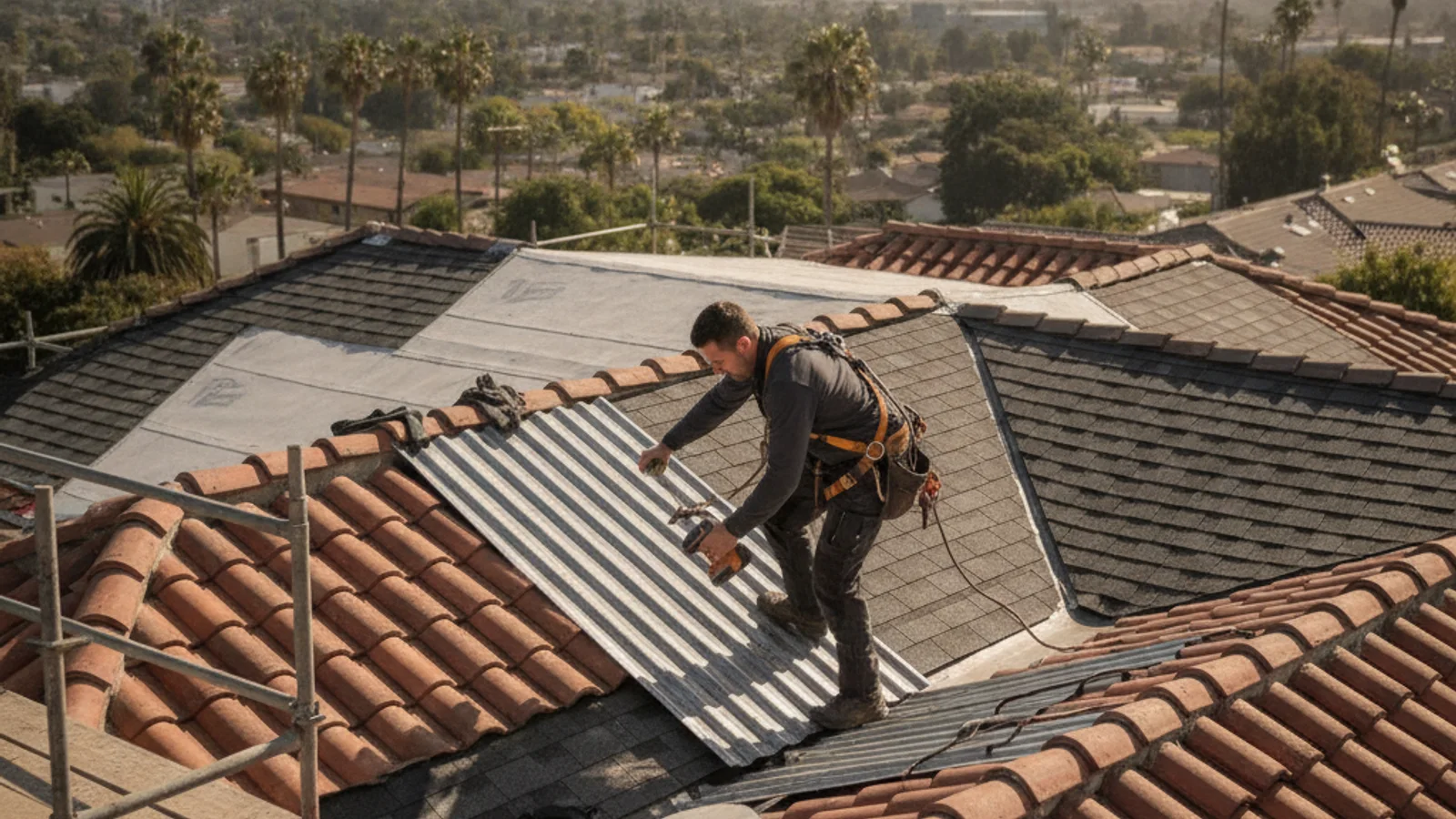
What underlayment does under metal
Metal panels shed water. They do not form a sealed membrane. Wind-driven rain gets under laps and standing seams. Condensation beads on the cold underside of a panel after a clear winter night. Every clip and fastener is a small hole. The sheet on the deck catches that water and sends it to the eave.
That job is not the same as under tile or shingle. Under concrete tile the underlayment is the waterproofing and the tile is a shade screen. Under asphalt it is a backup behind a fairly tight surface. Under metal it is a drainage plane trapped against a covering that heats and cools faster than anything else on the roof. Panels expand in the afternoon and contract overnight. The sheet sits through that cycle for the life of the roof.
Our roof underlayment types guide covers felt, synthetic, and peel-and-stick as families. This page is which of them a metal spec should name on your house, and why two homes eight miles apart can get different answers.
Felt, synthetic, and high-temp self-adhered
Asphalt-saturated felt is the legacy product. It has been used under metal for decades. Heat and time are the weaknesses: it dries, gets brittle, and can bond to the underside of hot panels. If a later crew has to lift panels to chase a leak, brittle felt tears instead of lifting.
Synthetic underlayment is woven polymer. It is lighter, it does not wrinkle when a multi-day job gets dew, and it holds fasteners better. Most synthetics are mechanically fastened. The assembly still depends on cap nails or staples through the deck.
Self-adhered membranes stick to the deck and seal around fasteners. That matters on a roof held by hundreds of clips. The grade that belongs under metal is the high-temperature product. A standard ice-and-water sheet can soften under a hot panel. Asphalt in the adhesive can migrate. Makers publish a maximum service temperature and a UV exposure limit. Ask for the data sheet on the named product, not the word “high-temp” on a line item.
Some crews specify a butyl-based high-temp sheet inland, because asphalt-based ice-and-water is the product that has a reputation for softening on dark metal. That is a product-family question for the bid, not a brand we will pick for you.
The deck decides more than the product
A self-adhered membrane needs a clean, continuous, solid substrate. It cannot bond to a gapped deck. Plenty of San Diego homes built before the 1970s have skip sheathing: spaced 1x boards laid for shake or tile. Those roofs need new sheathing before peel-and-stick is a real option. That is a different job than “new panels on the old deck.”
The City of San Diego treats that as a permit question. Start with Information Bulletin 123. Read the current bulletin. Ask the AHJ and the matched C-39 whether skip-sheathing overlay, deck replacement, or existing layers change the path. Unincorporated county areas and other cities set their own rules.
Soft or delaminated decking feels spongy. Fasteners will not hold torque. No underlayment upgrade fixes that. See roof decking replacement.
Coastal salt vs inland heat
Within a mile or two of the water, from Imperial Beach through Coronado, Ocean Beach, Pacific Beach, Del Mar, Encinitas, Carlsbad, and Oceanside, salt aerosol is the governing condition. That is mainly a metal, coating, clip, and screw problem. Our post on whether salt damages a metal roof covers the panel side. What the underlayment contributes on the coast is a continuous seal at every fastener. A corroding fastener becomes a hole. You want a self-sealing layer under it.
Go inland to El Cajon, Santee, Lakeside, Ramona, Escondido, or Alpine and the driver is heat and fire. Attic temperatures under a dark metal panel in an East County summer are the harshest environment a membrane on your house will see. That is where a documented temperature rating earns its place on the bid. If the parcel sits in a designated wildland-urban interface or fire-hazard severity zone, ask the AHJ, the insurer, and the matched C-39 whether a listed Class A assembly applies to this scope. Metal shingles and sheets can qualify when the listed assembly is what gets installed. Do not treat a Chapter 7A area test or Class A on any covering as a fact this page can certify. Verify the parcel before material selection.
Title 24 cool-roof rules depend on climate zone and slope. Look up the CEC zone for this address. Do not treat typical San Diego steep-slope metal as a cool-roof default. If any plane is low slope, ask the AHJ whether a listed product applies. Confirm the current tables with the permit set.
Penetrations, edges, and what the proposal should say
Leaks on metal roofs cluster at transitions: pipe penetrations, roof-to-wall junctions, valleys, skylight curbs, eaves, and rakes. A careful crew runs the membrane up walls and curbs, laps it into valleys, and sets drip edge in the right order so water leaving the panel lands on the flashing, not behind it. Flashing leak repair is what failure looks like years later.
Ask two things in writing. First, full-deck coverage versus valleys, eaves, and penetrations only. Partial coverage is a real spec. It is cheaper for a reason. Second, how long the membrane will sit exposed before panels go on. Every product has a published exposure limit. A job that stalls waiting on a panel delivery can blow past it. That is a warranty problem the homeowner never hears about.
Name the whole assembly: underlayment manufacturer and product, coverage (full deck vs details only), deck condition and what is being replaced, panel system and gauge, fastener and clip material, and who pulls the permit. A bid that says “synthetic underlayment” and nothing else is not comparable to another bid.
Verify the license of whoever signs it. California’s C-39 classification covers metal roofing systems. License status, bond, and complaint history are public at the CSLB license lookup. Read current Business and Professions Code section 7048 for any minor-work exemption. A metal reroof is not that work.
When to call
Specifying the assembly is a job for a licensed roofer who has been on your deck and in your attic. Deck condition and exposure decide the answer more than a product comparison. It is also permit work in most cases. Whether you are planning metal roofing or a roof replacement where metal is one option, get the assembly written down before anyone orders material. Call us at (760) 750-5557. We will connect you with a licensed local roofer.