Roof sheathing and roof decking usually name the same layer: the wood surface nailed to the rafters or trusses, under the underlayment and the visible roof. A proposal can say “damaged decking” in the notes and “sheathing replacement” in the scope and still mean plywood or OSB, not two products.
The local fork is not the synonym. It is whether you have solid sheets, older skip sheathing, or a plywood overlay, and whether City of San Diego Information Bulletin 123 treats the work as a simple reroof or as structural. Top Pro Roofing SD refers. We do not install. Call (760) 750-5557.
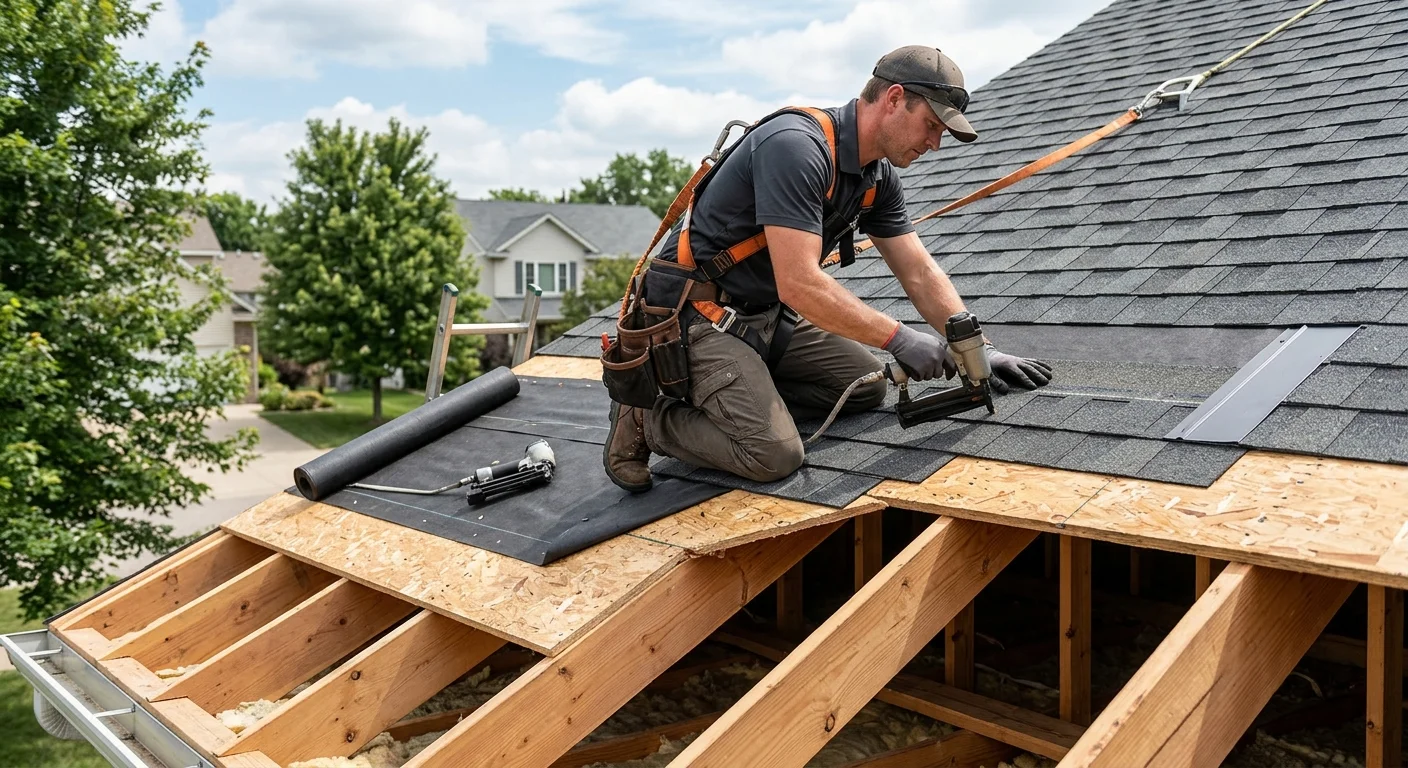
What roof sheathing and decking mean
Sheathing is the surface attached above the framing. Decking is the other common name for that surface. Plywood roof sheathing, roof decking, and “deck replacement” on a San Diego bid are often the same part of the assembly.
The City of San Diego’s reroof guidance talks about plywood and oriented strand board (OSB) as sheathing. Neither word is the tile, shingle, metal, or membrane you see from the street. Those coverings sit above this layer.
Ask the C-39 to define the term in writing. The definition should name the layer, the observed condition, and what is existing vs what they propose to add.
On older San Diego houses that already had a reroof, notes may say skip sheathing, spaced boards, plywood, or OSB. Those labels are observations. They are not interchangeable with a diagnosis. They should say what was seen, where, and how it changes the scope.
Replacement conditions live on roof decking replacement in San Diego. This page stays the vocabulary, the layer stack, and the proposal questions.
How this layer differs from rafters and underlayment
Keep the stack separate:
- Rafters or trusses: the framing
- Sheathing / decking: the wood surface on that framing
- Underlayment: between the wood and the finished covering
- Covering: tile, shingles, metal, or membrane
Do not let a bid mash those into one vague line.
Framing movement is not a sheathing synonym. If notes mention the frame, read rafters vs trusses. Calling failed felt “bad decking” hides whether you need underlayment, wood, or both.
A useful inspection keeps:
- Covering
- Underlayment
- Sheathing / decking
- Framing
A proposal that only says “tear-off and new covering” has not told you how hidden wood will be handled when the old roof comes off.
Questions about structural capacity belong with the project professional who is actually responsible for that determination. A roofing label does not settle it.
What visible damage can and cannot establish
A ceiling stain shows where moisture showed up indoors. It does not prove the sheathing must be replaced. Water travels.
From an attic, staining on the underside of the wood is a reason to look closer. From the street, a dipped plane is a reason to look closer. Neither one names the failed layer by itself.
Some wood stays hidden until tear-off. That is why an exterior walk and the final extra-work ticket can differ. The proposal should say how newly exposed conditions will be photographed and approved. It should not treat unseen rot as already proven.
A roof inspection should tie notes to planes and photos, and separate confirmed from suspected. “The deck is bad” is not a scope.
San Diego County is not one permit office. A City of San Diego parcel is not an unincorporated county parcel, and it is not Chula Vista or Oceanside. Confirm the address and the authority before treating an inspection comment as a permit conclusion.
Skip sheathing: the San Diego distinction that is not a synonym
Many pre-plywood roofs here used skip sheathing: spaced 1x boards, common under tile. The covering sat on those boards. Solid plywood or OSB sheets are a later system.
A reroof can:
- Keep skip sheathing if it is sound and the new covering is allowed on it
- Overlay plywood or OSB over skip sheathing
- Replace boards with solid sheets
Those are different jobs. IB 123 discusses new plywood or OSB over existing skip sheathing and notes that some versions of that work need structural analysis. Read the current bulletin. Do not let a salesperson treat “we will sheet it” as a no-permit extra.
If two bids use “decking” and “sheathing” for this overlay, make them draw the existing boards vs the new sheets.
When broader review may be needed
City of San Diego Information Bulletin 123 says a building permit is required when roof covering renewal involves replacing structural framing members, roof sheathing or decking, support elements, lateral-resisting elements, or the foundation system.
Ask Development Services for that address whether any limited sheathing-replacement exemption applies. Other conditions still apply. Do not treat a blog as a countywide pass.
Chula Vista, Oceanside, El Cajon, and unincorporated East County have their own offices. Confirm there.
If the work stops being a covering job and becomes a roof replacement with framing, the revised scope should say so. Do not hide it in a “wood as needed” allowance.
What the proposal should document
Use one term, or define both.
Before you compare roofers:
- The document defines sheathing or decking
- Confirmed conditions are separate from suspected ones
- Underlayment, wood, and framing are separate lines
- Known areas are tied to locations or photos
- Hidden conditions have a written approval path
- Permit responsibility matches the property’s jurisdiction
- Structural questions have a named professional
- Added work needs writing before it proceeds
Verify the contractor at the CSLB license check. California’s roofing classification is C-39.
Top Pro Roofing SD is a referral service. You contract with and pay the selected licensed roofer directly.
When to call us
Call when notes mention sheathing, decking, skip sheathing, or an unclear hidden-wood allowance. A licensed roofer can inspect and write the roofing scope. Call (760) 750-5557.