TL;DR
- Clay and concrete tile often last 50 years and beyond. The underlayment under it commonly fails much sooner. That is usually the leak, not the tile.
- Lift-and-relay means: remove tile, replace underlayment and flashings, repair the deck as needed, relay the same tile.
- Best candidates: roughly 20-30 year tile roofs, most tiles intact (think under about 10% broken), sheet clearly tired.
- Skip it if a large share of tiles are broken, the profile cannot be matched, or the deck is extensively rotten.
Ask for two columns on one bid: lift-and-relay vs new tile on the same measured roof. We will not invent whole-house prices. Top Pro Roofing SD refers. We do not install. Call (760) 750-5557.
If your San Diego tile roof is 20 to 30 years old and you have a stain or a flagged inspection, you may not need a new tile field. You may need lift-and-relay. A lot of quotes skip that option.
For a full new-tile path, see tile roof replacement cost in San Diego.
What is a tile lift-and-relay?
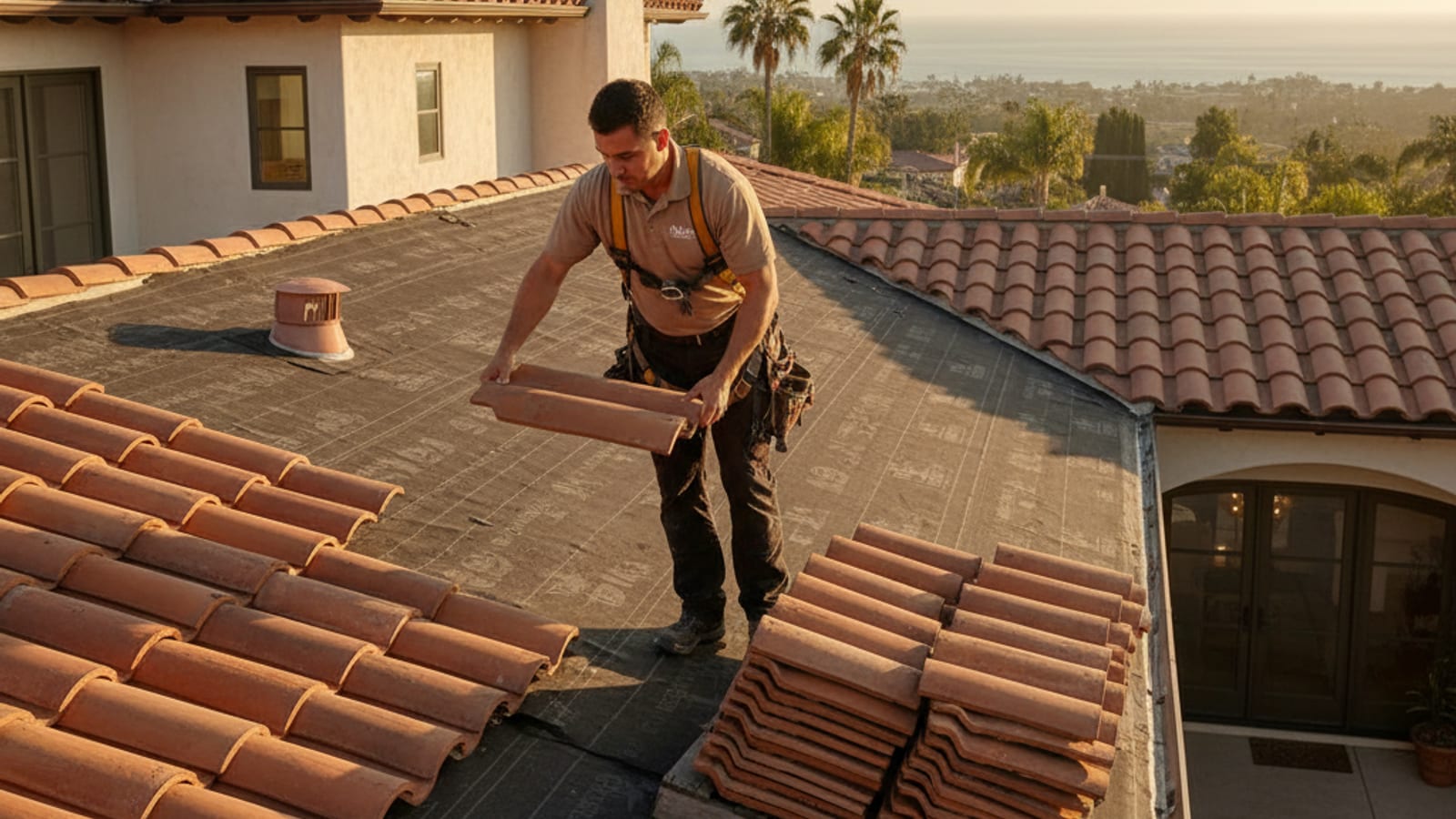
The crew lifts existing clay or concrete tiles, inspects the deck, replaces failed underlayment and flashings, then relays the same tiles. The ceramic or concrete is usually fine. The felt or tired synthetic under it is what opens at 15 to 30 years.
HOA tracts that want to keep the original color and profile (La Costa, Otay Ranch, Westwood) use this instead of a full tile swap when the tile still matches.
The insight: tile does not fail first
What actually ages out:
- Underlayment (often 15-30 years, felt faster inland)
- Flashing at penetrations and valleys
- Ridge and hip mortar
When a 25-year-old tile roof leaks, the covering is usually still doing its job. The sheet or a flashing is not.
How does the job run?
- Photograph layout, mark special cuts, label batches.
- Remove tile in reverse of install order. Broken pieces go to disposal. Good tile is palletized on site.
- Strip old underlayment to the deck.
- Inspect the deck. Replace rotten plywood.
- Ice-and-water (self-adhered) at valleys, eaves, and penetrations.
- New high-temperature underlayment rated for hot inland attics. Tile assemblies need a high-temp listing. Confirm the product name on the bid. See underlayment types.
- New flashing at chimneys, skylights, vents, and valleys. If solar is on the roof, a licensed electrician handles disconnect and reconnect so inverter warranties stay intact.
- Replace deteriorated battens if the system uses them.
- Relay the existing tile in the same pattern, with new ridge and hip mortar.
- Replace broken pieces with matching salvage or new tile from the same profile.
- Permit inspections and sign-off. Confirm the permit path with the AHJ and the contractor. See roof permits in San Diego.
Most houses are several work days, not a one-day patch. Ask the matched roofer for a schedule that includes inspection holds and solar if you have it.
Cost: compare two bids, not a blog number
Lift-and-relay saves money when you reuse the tile. You still pay labor, underlayment, flashings, dumpsters, and any deck sheets. You do not pay for a whole new tile field, which is the expensive part of a new clay or concrete roof.
Ask for:
| Line | Lift-and-relay | New tile |
|---|---|---|
| Tile | Reuse, plus matching replacements | New product, named |
| Underlayment | Named high-temp sheet or peel-and-stick | Named |
| Deck repairs | Sheet count, not a guess | Same inspection |
| Solar handling | Disconnect/reconnect if needed | Same |
| Permit | Who pulls it, which AHJ | Same |
| Warranty | New sheet + workmanship in writing | Tile manufacturer + workmanship |
Pricing moves with pitch, access, broken-tile percentage, and how much plywood is wet. Get both columns on this roof. Do not use a blog’s 2,200 sq ft example as your budget.
When lift-and-relay is the right call
Tile is sound, the sheet is not
- Roof in that 20-30 year window
- Active leak or a recent leak
- From the ground, most tiles look intact (about 5-10% broken or fewer)
- Attic or a lifted tile shows cracked, brittle felt or bare deck
You keep most of the existing tile, replace everything under it, and get a new waterproofing clock.
You are selling and the report flagged underlayment
Buyers’ inspectors and insurance underwriters flag tired tile underlayment even when the street view looks fine. A documented lift-and-relay (new sheet, closed permit, written remaining-life language) is easier to explain than “the tile looks pretty.” What that does to your sale price is a listing conversation, not a number we will invent. Start with a roof inspection.
When to skip it
Too much broken or badly faded tile. Once you are sorting a large share of the field (think 15-20% plus), labor eats the savings. Budget a new tile field.
Discontinued profile, no salvage. Eagle, Boral, MCA, and Monier profiles are often still sourceable. Odd older profiles need controlled-demolition salvage. If neither exists, you are in full replacement.
Extensive deck rot. A few sheets of plywood is normal. A large share of the deck is a structural conversation. Lift-and-relay can still happen. The cost gap versus new tile shrinks.
You want a different look. Concrete flat to clay S-tile, or a new color, is a new-tile job.
What to ask on the quote
If a contractor jumps to full replacement and never mentions lift-and-relay, get a second opinion. Replacement is a bigger ticket. Ask:
- What share of my tiles are actually damaged?
- What is the underlayment condition (attic photos, not only curb photos)?
- Is lift-and-relay on the table, and why or why not?
- Show lift-and-relay and new tile as two columns on the same square count.
A careful roofer answers. A bid that only sells new tile without counting broken pieces is incomplete.
Warranty: what you can actually get
You can get a manufacturer warranty on the new underlayment (read the PDF; terms vary). You can get a workmanship warranty from the roofer, in writing, for a stated term. You generally do not get a new manufacturer warranty on 20-year-old tile.
New-tile jobs add the tile maker’s coverage (often a long material term on clay and concrete). That matters if you will hold the house for decades. It does not make lift-and-relay a bad job when the tile is sound. Ask both warranties to be attached to the contract. Do not treat a blog’s “10-year labor” line as a promise from our network. We refer. The installing contractor’s contract is the document.
FAQ
What is a tile roof lift-and-relay?
Tiles come off, old underlayment comes off, the deck is repaired, new high-temp underlayment and flashing go down, original tiles go back. You replace the part that fails.
How much does it cost versus new tile?
Less, when most of the tile is reusable, because you are not buying a new tile field. The gap depends on broken-tile count and deck repairs. Get two numbered bids.
How do I know which path I am on?
If fewer than about 10% of tiles are broken and the bodies look intact, lift-and-relay is in play. If 15-20% plus are broken, the profile is gone, or the deck is extensively rotten, replacement is the honest path. A walk with photos beats a percentage from a website.
Does it come with a warranty?
On the new sheet and on the labor, if the contractor puts it in writing. Not on the old tile. Tile itself is the long-lived part. The sheet is what you are buying.
Service area
Lift-and-relay shows up across San Diego County, especially older tracts in Chula Vista, El Cajon, Escondido, and coastal tile in Carlsbad, Encinitas, and Del Mar. Contractor vetting in North County: how to find a roofing contractor in Carlsbad.
Related: how long roofs last in San Diego, new roof cost, repair vs replacement, tile roofing.
Call (760) 750-5557 and we will connect you with a CSLB-licensed roofer who will say whether lift-and-relay is honest on your roof.