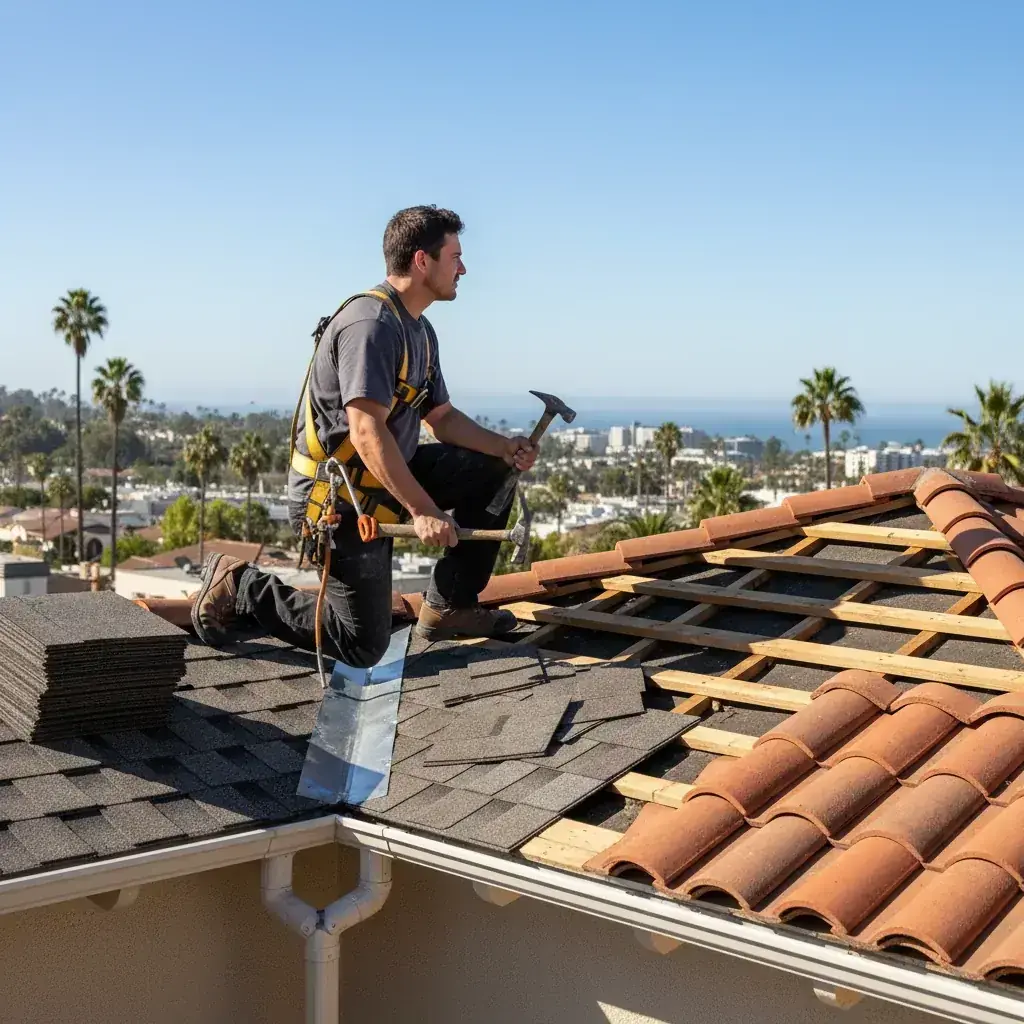
A national “20-30 years for asphalt” line is not a San Diego answer. The county runs from surf to mountain peaks to desert edge. The same product does not age the same on the marine strip as it does inland. We will not publish a year-by-zone table or a cost-per-year spreadsheet. Those are invented precision. Top Pro Roofing SD refers. We do not install. Call (760) 750-5557.
Coastal covering choice: best roof material for coastal climates. This page is what actually ages the roof.
Average life is the wrong starting point
Manufacturers print warranty classes. Service life is the assembly plus the street.
Asphalt shingles (3-tab, architectural, Class 4) age in UV and heat. Inland and East County cook them faster than marine-layer streets. The wrapper year is not a stopwatch. See 50-year shingles vs metal for warranty vs life.
Concrete and clay tile outlast the sheet underneath them. The tile is a hat. Underlayment is the waterproofing. When a 1990s tile roof “fails,” the felt or old synthetic is usually what failed. Tile gets lifted, new sheet goes down, tile goes back. That is tile roofing / lift-and-relay, not a new tile field. Cost context: tile roof replacement cost.
Standing seam and stone-coated steel last when alloy, coating, and fasteners match the exposure. Salt near the water cuts steel life unless the spec is coastal. Will salt damage a metal roof is that fork.
Low-slope (TPO, modified bitumen, BUR) live and die on seams, penetrations, and ponding. They are a different job class than a pitched house.
Ask the matched roofer what they see on this deck, flashing, and ventilation. Do not divide a bid by a blog year.
How San Diego microclimates change the job
| Zone | Examples | What ages the roof |
|---|---|---|
| Coastal | La Jolla, Coronado, Pacific Beach, Encinitas, Del Mar, Imperial Beach, Solana Beach | Salt on fasteners and flashing, marine fog, wet-dry cycles |
| Inland valley | El Cajon, La Mesa, Spring Valley, Santee, Lakeside, Lemon Grove | UV, heat, day-night swing |
| Mountain | Julian, Pine Valley, Alpine, Palomar, Mount Laguna | Freeze-thaw, rare snow, UV at altitude |
| Desert / East | Borrego Springs, Ranchita, Jacumba | Extreme heat, dry air on organic mats, thermal shock |
Salt is hard on steel and galvanized flashing. It is gentler on tile bodies. UV is hard on asphalt mats. Freeze-thaw is hard on water-holding concrete tile. Metal inland is often a finish and fastening story, not a salt story.
IBHS FORTIFIED is a coastal and wind construction program, not a San Diego year chart. Use it as a detailing checklist, not a lifespan promise.
Seven things that cut life short here
1. Salt on flashing (coast)
Galvanized steel flashing rusts from the inside while the field still looks fine. Stainless or copper flashing is the coastal ask. Upcharge is real. We will not invent it.
2. UV on asphalt (inland)
Bitumen and granules. UV breaks the bitumen. Granules show up in gutters. Then the mat cooks faster. East County has more sun-on-roof hours than the marine layer. Same bag, different life.
3. Underlayment under tile
Felt and older synthetics do not last as long as clay or concrete. Plan a lift-and-relay on the sheet’s schedule, not the tile’s.
4. Attic ventilation
A closed attic cooks the deck and the underside of shingles. Intake at the soffit and exhaust at the ridge (or a designed equivalent) is the system. California Title 24 speaks to energy and ventilation in current code language. Confirm the AHJ, not a blog attic temperature.
5. Foot traffic
HVAC, solar, and satellite techs crack tile and bruise shingles. Solar is common here. Put a roofer in that conversation before panels go on. Preparing a roof for solar.
6. Eucalyptus and pine debris
Mission Hills, Kensington, Bay Park, parts of La Jolla. Debris in valleys holds water. Cleaning is cheaper than a valley leak.
7. Deferred flashing and boots
A small penetration leak becomes deck rot, then interior damage. Age is not the only clock. Ignore is.
Cost: how to think, without a fake matrix
A longer-running system can cost less per year of stay and still cost more on day one. We will not print dollars per square or a 2,000 sq ft total. Square count, layers, pitch, access, solar removal, and deck repair move the number.
Ask for: named product, measured squares, tear-off, deck allowance, underlayment, flashing metal, permit, and warranty PDFs. Tile owners should ask lift-and-relay vs new tile as two lines. Coastal metal should name alloy and fasteners.
When to start planning
Inspect after Santa Ana events and before winter rain. Get a written condition report when the covering is no longer “new” and you plan to stay or sell. Asphalt that is visibly at end of life, wet sheathing, or a carrier asking for age documentation is a planning trigger. Tile fields that look fine still need the underlayment question around mid-life. Metal often needs fastener and finish inspection before a full strip.
Insurance age rules are carrier-specific and they change. See California roof insurance claim guide and insurance non-renewal and roof age. Do not treat a year cliff in a blog as your binder.
Visible signs: signs you need a new roof. Repair vs strip: repair vs replace.
How to extend life
- Visual checks, more often on the coast.
- Gutters before and after the winter rain window.
- Trim eucalyptus, pine, and pepper off the roof.
- Treat algae streaks as a maintenance item, not a new roof by themselves.
- Low-slope recoats are a product-specific decision. Ask, do not assume a year.
- Do not let solar crews walk tile without protection.
- Fix flashing and boots while they are still small.
FAQ
How long does a tile roof last in San Diego?
The tile body can last a very long time. The underlayment does not. Most San Diego tile conversations at mid-life are lift-and-relay, not new tile. Tile roofing.
How much does a roof replacement cost in San Diego?
Enough that you should get a measured quote. We will not invent a county range here. New roof cost is the bid-reading page.
Does coastal salt really shorten roof life?
On steel fasteners, galvanized flashing, and the wrong metal substrate, yes. Tile bodies care less. Asphalt loses some life to salt and wet-dry, more to UV inland. Spec the metals.
Will homeowners insurance still cover an old roof in California?
Carriers look at age and condition. Some non-renew. Ask your carrier and read the insurance pages above. A blog cannot bind coverage.
What lasts longest on a San Diego house?
Clay tile with a modern underlayment on a deck that can take the weight is the long-stay covering on many Spanish houses. Coastal homes that cannot take tile weight often ask for aluminum standing seam with stainless fasteners. “Longest” still depends on HOA, structure, and stay.
When should I start planning for replacement?
When inspections, leaks, insurance letters, or a sale timeline make waiting the expensive choice. Do not wait for a round number on the calendar.
Working with Top Pro Roofing SD
We connect homeowners across San Diego County, from Imperial Beach to Fallbrook, La Jolla to Borrego Springs. Call (760) 750-5557 or request an estimate. We connect you with a licensed independent roofer. Verify the license at cslb.ca.gov. We do not install, set prices, or issue warranties.
Related: signs you need a new roof, repair vs replacement, insurance claim guide, solar prep, tile leak causes, roof replacement, roof repair, flat roof repair.