A useful tile roof repair proposal identifies the damage, the repair area, the materials, and the exclusions. It also separates visible tile work from anything involving concealed roof layers. That is how you compare independent roofers on equal terms.
Top Pro Roofing SD refers work. We do not repair tile, set contractor prices, or issue warranties. Call (760) 750-5557. The homeowner contracts with the matched C-39.
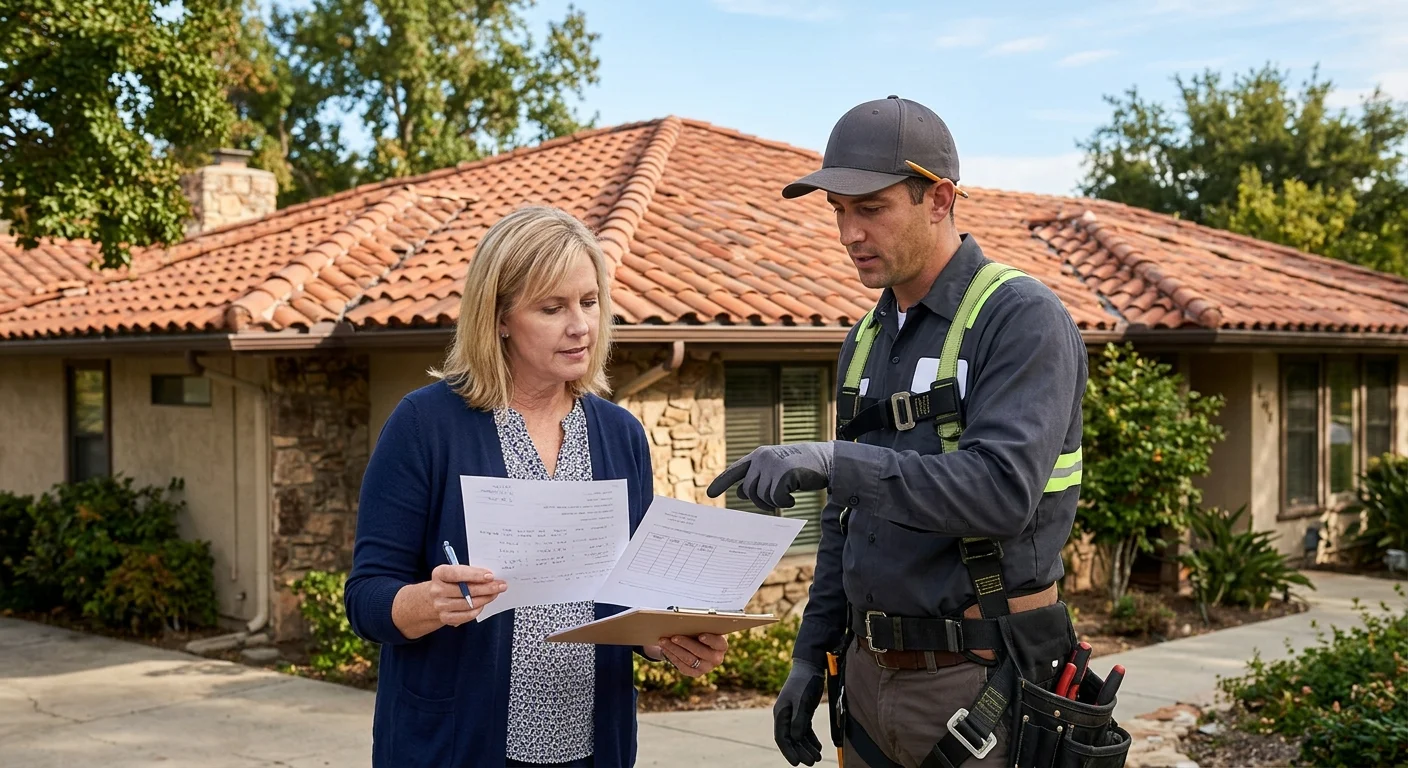
Start with the documented leak or damage
The proposal should begin with what the roofer actually observed. A ceiling stain, cracked tile, or homeowner report is context. It does not define the complete repair scope by itself.
Look for an inspection record tied to specific locations. Useful descriptions identify the roof slope, room, penetration, wall, valley, or edge. Photos should have labels that connect them to those locations. A wide photo gives context. Closer photos document the reported condition.
A clear evidence section should include:
- The damage or symptom reported by the homeowner
- The areas the independent roofer inspected
- Visible conditions found in each area
- Photos or a simple roof sketch
- Areas that were not accessible or were not inspected
- The repair boundary connected to each finding
If several areas need attention, each should have its own label. That prevents one broad line item from hiding several different scopes.
Pay attention to how the proposal handles uncertainty. Concealed conditions may not be visible during the initial inspection. The document should identify that limitation instead of presenting an unsupported conclusion. It should also explain what happens if the proposed work reveals another condition.
Two roofers may interpret the same stain differently. Ask each one to separate observations, conclusions, and recommended work. Our guide to common causes of tile roof leaks in San Diego can organize the questions without diagnosing the roof yourself.
Location matters within San Diego County. Coastal salt, inland heat, and mountain communities do not share one microclimate. The proposal should identify the property and observed conditions, not a countywide assumption.
Separate tile condition from hidden roof layers
A surface photo can document tiles. It cannot document an inaccessible layer beneath them. The estimate should separate visible tile from concealed or partly accessible components.
Start with the tile description. Identify clay or concrete when known, plus profile, color, and affected locations. If matching information is not confirmed, the document should say that.
For the remaining assembly, look for separate findings covering:
- Accessible underlayment
- Exposed sheathing or decking
- Fasteners, mortar, foam, or related accessories when relevant
- Flashing within the proposed repair area
- Components that were not visible during the inspection
Each line needs a stated action: remove, retain, replace, or leave undisturbed. It should also give a quantity, measured area, or marked boundary. “Repair tile area” is hard to compare without those details.
This distinction matters on clay. One proposal may address damaged tiles only. Another may describe work involving felt, battens, or decking beneath those tiles. Those are not equivalent scopes, even when both say “repair.”
Do not accept an unsupported statement about hidden materials. Ask how the roofer reached that conclusion: an accessible edge, an opening, previous documentation, or another observed area. If the condition remains unknown, the proposal should show it as unknown.
Review tile roof underlayment warning signs before comparing inspection notes. Material context: clay and Spanish tile roofing. If the felt is the real failure and the tile is intact, the honest job may be lift-and-relay, not a handful of replacement tiles.
A useful proposal also explains how discoveries affect the written scope: who documents the new condition, how you approve a change, and whether work pauses first.
Matching tile, mortar, and coastal metals
San Diego tile repairs fail in paperwork as often as they fail in the field.
Matching. Discontinued clay on Mission Hills, Kensington, and older North County streets is a salvage problem. Ask where replacement units come from, how many extras they will leave, and what happens if the color lot does not match. Concrete S-tile is easier to stock. It is still not “close enough” if the HOA board photographed a specific blend.
Mortar vs dry systems. Some original roofs used mortar at ridges, hips, and bird stops. Others are dry-set with foam or mechanical fasteners. The proposal should say which system they will restore. Mixing them without a reason is a leak path.
Metals. Tile itself does not rust. Flashings and fasteners do. Within a few miles of the water, ask whether repair metals match the surviving field (often copper or stainless on better coastal work) or whether the bid is swapping in galvanized that will streak first. See best roof material for coastal climates.
Solar and equipment. A tile repair next to an array is not a tile-only job if the crew cannot walk the field. Ask who disconnects, who resets, and who is excluded.
Check how flashing and penetrations are addressed
Flashing and penetrations deserve named line items. “Repair flashing as needed” does not show which feature was priced or inspected.
Ask the roofer to identify every relevant feature within the repair boundary: wall intersection, chimney, valley, skylight, vent, pipe, or roof-mounted equipment. The list should reflect this property.
For each included feature, the proposal should show:
- Its location on the roof
- The observed condition
- The work included
- The adjacent materials affected
- Any part that remains excluded
- Any access limitation during the inspection
The written scope and photos should use matching labels. “Rear slope vent” is more useful than “roof penetration.” If several similar features exist, a numbered sketch prevents confusion.
Watch for gaps between sections. A tile line item may stop at a wall while a flashing line excludes that intersection. Ask who handles adjoining stucco, siding, skylight curbs, or equipment when those items touch the proposed area.
A proposal should distinguish current findings from nearby observations. An unrelated condition elsewhere should not quietly become part of the repair. An affected adjoining component should not disappear behind a broad exclusion.
If an area could not be inspected, request a direct note. Missing documentation is not proof the area is fine. A separate roof inspection helps when two proposals conflict or leave major areas undocumented.
Ask what completion records you will receive. Before-and-after photos should use the same location labels as the proposal.
Compare included work and stated exclusions
Compare written scopes before comparing totals. A lower total does not help if the proposal omits work included elsewhere. Build a side-by-side sheet with the same categories for every roofer.
Include rows for:
- Documented repair locations
- Tile-related work and matching plan
- Accessible concealed materials
- Flashing and penetrations
- Property protection and cleanup
- Disposal of removed materials
- Completion photos or other records
- Permit responsibility, when applicable
- Stated exclusions
- Written change procedures
Mark each row as included, excluded, unclear, or not applicable. Send unclear items back. Keep the written reply with the original proposal.
Exclusions deserve the same attention as included work. Common categories: interior finishes, adjoining roof areas, gutters, skylights, solar, stucco, landscaping, concealed conditions. Do not assume an omitted category is included.
The change process should be written: how a newly observed condition is documented, how you approve it, and whether original work continues while that decision is open.
Permitting is property-specific. For homes inside the City of San Diego, start with Information Bulletin 123 and read the current bulletin. Do not restate its triggers, structural conditions, historic rules, or exemption classes from this page.
Other San Diego County jurisdictions write their own counters. Ask each roofer to identify the governing jurisdiction and who will confirm the current permit requirement. If it could not be confirmed during proposal preparation, the document should say which department must decide it.
A large “repair” can still be treated as a reroof once the AHJ applies its area test. Confirm the current trigger. Do not treat a percentage on this page as the rule. Related: 25 percent rule.
Confirm product and workmanship documents
A complete proposal identifies the contractor and the documents behind the scope. Verbal descriptions can change between inspection, contract, and job.
Contractor information should include the legal business name and license number. California’s C-39 classification covers roof tile and other roofing, waterproofing, and weatherproofing materials. Check the current record through the California Contractors State License Board.
The CSLB record can show license status, complaint history, and bond information. Confirm workers-compensation status on the live CSLB record. Read current Business and Professions Code Section 7125 rather than this blog. Confirm the current record for the exact business named in the proposal.
Product descriptions should match the proposed work. Ask for manufacturer, product line, profile, color, or other identifying information when available. If a matching product is not confirmed, that uncertainty should stay visible. Substitutions should require your approval.
Review the attachment list. Photos, sketches, product sheets, exclusions, and later revisions should carry names or dates. The version you sign should include every written clarification you accepted.
Do not assume warranty terms from a conversation or a product label. If the independent roofer offers product or workmanship coverage, request the actual documents: who issues each one, what work it applies to, exclusions, and any registration steps. If no written coverage is offered, the proposal should say so.
Top Pro Roofing SD does not perform roofing work, set contractor prices, or issue warranties. The homeowner contracts with and pays the matched independent professional. That contractor’s proposal controls the agreed scope.
Before choosing, read each proposal once for included work and again for unanswered items. The strongest comparison is not the longest document. It is the one that lets you identify every repair area, exclusion, product, responsibility, and unresolved condition.
When to call us
Bring in a licensed roofing pro when tile damage, leaks, flashing, or concealed materials need evaluation. Top Pro Roofing SD can match you with an independent local professional serving San Diego County. Call (760) 750-5557.