TL;DR
- Concrete and clay tile shed rain. The underlayment is the waterproofing layer.
- Felt under older San Diego tile often reaches the end of useful life while the field still looks fine from the street.
- A ceiling stain is late. Lift a few tiles on purpose, with a tile specialist, before the deck is soft.
- Patching aged felt in one bay is not a continuous water plane. Lift-and-relay is the usual honest repair when the sheet is done and the tile is still reusable.
- Top Pro Roofing SD refers. We do not install. Call (760) 750-5557.
A composition roof announces itself. Granules in the gutter, curled tabs, wind-lifted courses. Tile does not. From the driveway, a decades-old concrete field in Scripps Ranch can look like last year’s install. The failure is usually the sheet, not the rock on top.
We do not invent inspection fees, lift-and-relay totals, or per-foot deck prices. Compare written scopes from licensed independent tile roofers. Cost context without a number from this page: 2026 tile roof replacement cost in San Diego.
Why tile hides the failure
Tile is the rain-shedding layer. Wind-driven rain, capillary water at laps, a cracked unit, and night condensation all land on the underlayment. That continuous sheet over the plywood (or plank) deck is what keeps the house dry. NRCA steep-slope guidance treats underlayment under tile as the primary water barrier, not a decorative backup.
So the trap is visual. The owner sees an immaculate field. The attic or a lift tells a different story.
What is usually under San Diego tile
On many tract and custom tile roofs built before synthetics became common, the field sheet is asphalt-saturated organic felt. Roofer shorthand is often “30-pound felt,” aligned with products such as ASTM D226 Type II. It is tar-impregnated paper. It works until it dries, cracks, and stops sealing at fasteners.
Newer roofs more often use synthetic underlayment or self-adhered modified bitumen at valleys, eaves, and penetrations. Product life still depends on UV at laps, fastener pattern, and how long the tile field has been leaking onto the sheet. The bulk of older tile inventory in Scripps Ranch, Carmel Valley, 4S Ranch, Rancho Santa Fe, Mission Hills, and Kensington was not built on today’s synthetics.
Pull permit records or original specs if you can. “Looks like tile” does not name the sheet.
How failure usually progresses
Underlayment does not fail on one Tuesday. It dries and cracks on a curve.
Early. Felt loses flexibility. Hairline cracks at nails and flashing transitions. Most of the field still sheds. No interior stain yet. A lift shows it. A sidewalk glance does not.
Intermediate. Cracking spreads. Nail holes that once self-sealed stay open. Valleys wear first because water concentrates there. Intermittent leaks after a long storm may dry before they show on a ceiling.
Late. The sheet is brittle, fragmented, sometimes powder. Water that always got past tile now sits on the deck. Interior stains appear. By then you are often buying deck repair on top of a lift-and-relay.
Exact year counts vary by product, slope, trees, and marine vs inland exposure. Do not treat a blog year chart as a laboratory life. Age plus original felt is a reason to inspect, not a diagnosis by ZIP code.
Signs you can use
From the ground and the attic
- Age plus original felt, no prior lift-and-relay. If the tile is original to an older tract and nobody has reset the field over new sheet, put a lift inspection on the list.
- Stains or rust streaks at the eaves. Water that should have hit the gutter is finding random exits. Darker tile edges, rust at metal, or white mineral deposits on the underside of eaves tiles.
- A wavy ridge or eave. Tile is heavy. Soft deck from long wetting lets the field settle. A crisp line becomes a ripple.
- A pattern of slipped tiles. One unit after a wind event can be isolated. A scatter across a slope often means the substrate is tired.
- Black streaking on fascia, especially below valleys. Long wetting leaves residue and growth on wood trim.
- Attic staining or daylight at the deck. This often beats a living-room stain. Flashlight after the first real rain.
From a lift
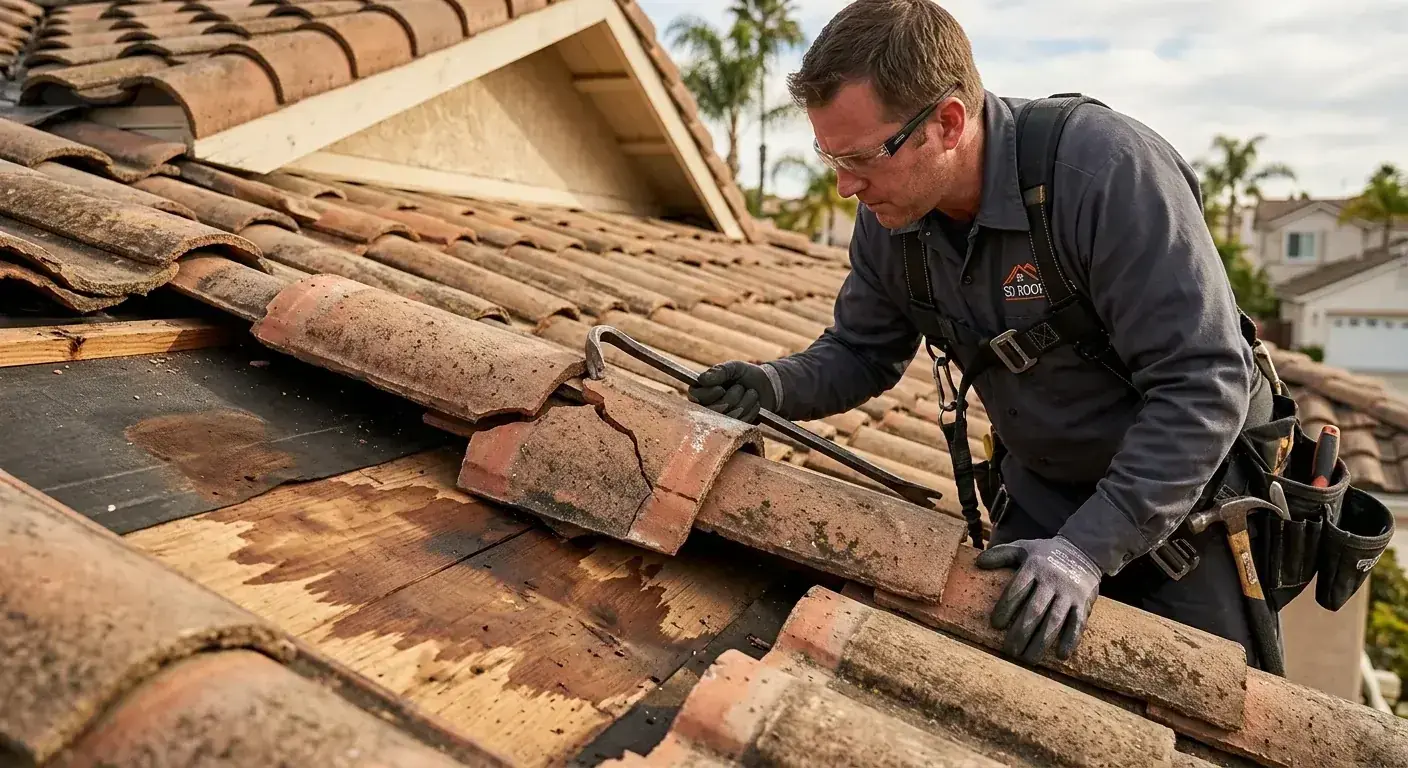
A tile specialist lifts a few representative units: field, valley, penetration, hip or ridge, eave. They photograph the sheet. Healthy felt still bends. Failed felt crumbs. Nail holes that gape are not sealing. Dark, soft, or delaminating plywood means the job has moved past “sheet only.”
Tiles go back. Done right, you should not see a missing course from the street.
| Check | What it is asking | Where you see it |
|---|---|---|
| Original felt, no relay | Are you in the failure conversation yet | Records, age |
| Eave streaks, fascia staining | Is water leaving the system in the wrong place | Ground |
| Wavy lines, slipped patterns | Has the deck started to give | Ground |
| Crumbling sheet, open nail holes | Is the waterproofing actually gone | Lift |
| Stained or delaminating deck | Is this now structure plus sheet | Lift |
A general roofer who never lifts tile and says “looks good” has inspected the rocks. Get a tile-specific second look if the roof is older felt construction. Related leak paths: common causes of tile roof leaks.
What a lift inspection should include
Time on a typical house is often about an hour to an hour and a half, not a five-minute curb glance. Ask for:
- Several lift points, not one decorative tile at the garage.
- Photos of the sheet at fasteners and in a valley.
- Extra attention at vents, skylights, and chimneys.
- Visible flashings, valley metal, ridge and hip mortar or foam, cracked or slipped units.
- A written note on deck clues if they saw staining or softness.
We do not publish inspection price bands. Ask what is included: lift count, photos, written report, moisture readings if they use them. A free walk that never lifts a tile is not the same deliverable as a documented lift.
When the answer is lift-and-relay
You cannot restore a continuous water plane by sliding new felt under three courses in a leak bay. The new piece still laps aged, failing sheet. That is how “we patched it” becomes a callback.
Lift-and-relay, in order:
- Tile removed and staged, sorted for reuse.
- Old underlayment stripped to the deck.
- Deck inspected. Damaged panels replaced.
- New underlayment. In current work this is usually synthetic field sheet, often with self-adhered modified bitumen at valleys, eaves, and penetrations. Confirm the actual product on the bid.
- New flashings, valley metal, and pipe boots.
- Original tile reset. Broken units replaced from matching stock or salvage.
- Ridge, hip, and rake details to current code for that jurisdiction.
Procedure: tile roof lift-and-relay. Service overview: tile roofing. The result, when the field is still sound, is new waterproofing under tile that can keep working. We do not invent a remaining-life number for your profile.
Clay breaks more easily than concrete on a lift. Two-piece barrel is fussy. Discontinued fiber-cement profiles make matching hard. Those are labor and salvage issues. They show up as line items, not as a blog total.
Compared with a full new tile system, reuse of sound tile is why lift-and-relay exists. Ask for both columns on one roof: relay vs new tile. The most expensive part of a roof replacement is the right framing question. This page will not fill in dollars.
Insurance language, without a coverage promise
Age-related underlayment failure is usually wear and tear on a standard homeowner policy. We are not your insurer. Sudden damage from a named peril (wind, hail, falling tree) is a different conversation, and interior damage may be treated separately from the roof. Read your policy and talk to the carrier. A claim adjuster who calls field-wide felt failure “wear and tear” is often matching common policy language. Planning the relay before the deck is rotten is still the homeowner’s job.
San Diego pattern: whole streets, same vintage
Phases of tract tile went on in the same years with the same felt. When one house on a Scripps Ranch or Carmel Valley street starts staining, neighbors with the same elevation are often close. HOA match rules still apply. Scripps Ranch HOA roof requirements, Carmel Valley HOA roof requirements. Tile type: concrete versus clay. Sheet types: roof underlayment types.
FAQ
No leak at 25 years. Do I still need a relay?
Absence of a stain is not a lab test. Get a lift. Flexible, intact sheet can wait, with a date to recheck. Crumbling sheet should not wait for the next atmospheric river.
Can I replace underlayment only where it leaks?
Not as a lasting plane. Overlaps onto failed felt fail again. Sectional “felt patches” on an aged tile roof spend money without resetting the system.
How long does a lift-and-relay take?
It depends on squares, access, tile type, and how much deck comes out. Many mid-size houses are measured in working days to a couple of weeks, staged so the home is not wide open overnight. Ask the matched roofer for a written duration range on your roof, not a county slogan.
Will my tile survive the lift?
Much of a concrete field usually does. Clay and old barrel break more. A specialist plans salvage and match, which HOAs notice.
Felt vs synthetic?
Felt is asphalt-saturated organic sheet. Synthetics are typically coated polyolefin or similar engineered membranes: lighter, more tear-resistant, different fastening rules. Ask for the spec sheet on the bid. In current San Diego relays, independent tile roofers often specify synthetic field sheet plus self-adhered details at high-risk lines. Confirm, do not assume.
Does a relay reset warranties?
New underlayment has a manufacturer document. Workmanship terms come from the contractor you hire. Original tile does not get a new factory warranty for being reused. Top Pro Roofing SD issues neither. Read both documents before you vote with a signature.
How do I tell a real relay from a shortcut?
Ask: which underlayment product, and may I see the spec? What happens when you find bad plywood? What is the breakage and match protocol? Vague answers are a reason to keep shopping. Verify the C-39 at CSLB.
Get a tile specialist, not a sidewalk glance
If the field is older felt construction, the next useful step is a documented lift, not an emergency tarp after the ceiling fails. Top Pro Roofing SD matches San Diego County homeowners with independent C-39 tile roofers. We do not lift tile. Call (760) 750-5557 or request an estimate.