La Jolla commercial roofs fail at the metal first. Girard Avenue retail, Prospect offices, UC San Diego-adjacent medical, and the Village parking structures all sit in salt-laden marine air. Flashings, fasteners, HVAC curbs, drains, and parapet caps corrode faster than the same details in Kearny Mesa or Escondido. The membrane color is the easy conversation. The coastal hardware spec is the one that decides whether you are in maintenance or in a leak during February rain.
Top Pro Roofing SD is a referral marketplace. We connect La Jolla and San Diego County property owners with independent CSLB C-39 roofers. We do not hold a contractor license, we do not pull Coastal Development Permits, and we do not publish commercial unit prices. Call (760) 750-5557. You pay the contractor.
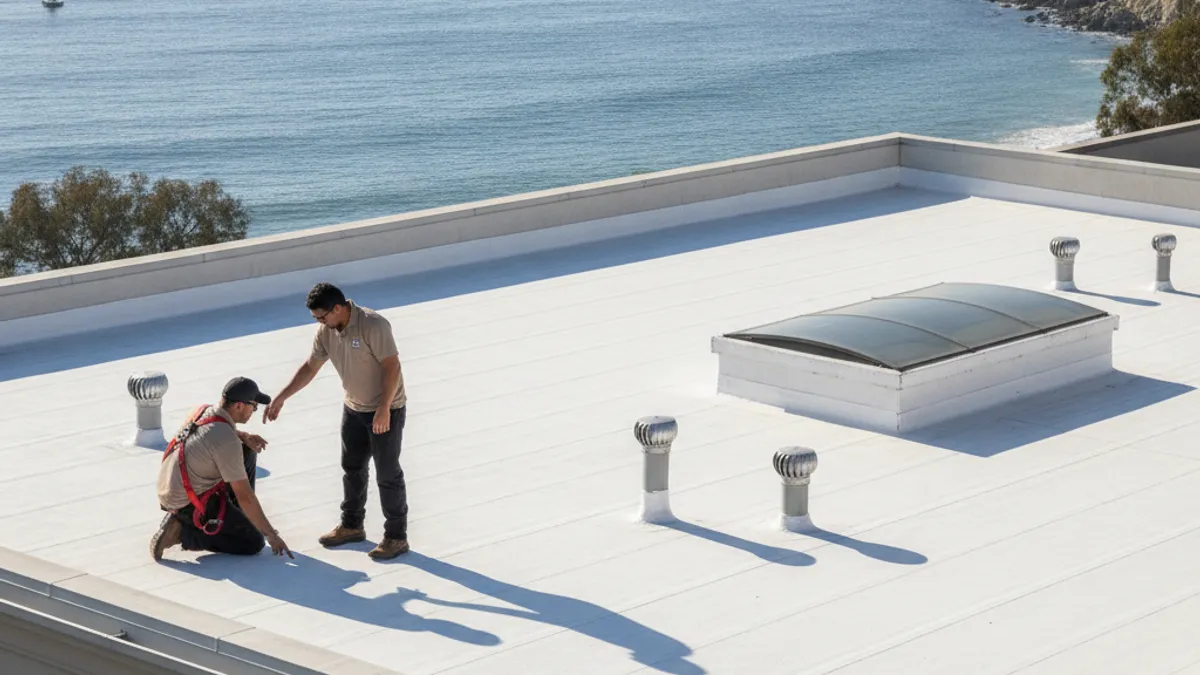
Why the coast changes the spec
Morning marine layer plus onshore wind puts salt on every exposed edge. Commercial low-slope has more of those edges than a house: long parapet caps, overflow scuppers, equipment rails, gas lines, and walk pads that get skipped to save a line item. Inland bids that copy an El Cajon TPO spec onto a Coast Boulevard building are how you get orange screw heads after a few coastal summers.
Salt and fastener data for the county: coastal roof salt damage. Ask the bidder, by name, what fastener coating and flashing metal they will use within a mile of the water, and how that differs from their inland sheet.
Systems we connect owners to: commercial roofing.
TPO vs modified bitumen on this stretch of coast
TPO is the usual new commercial sheet here. Heat-welded seams, white field that many bidders use when a cool-roof path applies, easy visual on dirt and salt crust. Wind-driven moisture at laps is a workmanship issue. Coastal fastening patterns in the manufacturer’s guide are not optional if you want the warranty to mean anything.
Modified bitumen stays on older Village and medical buildings where a full tear-off is not in this year’s capex. Granulated cap sheets can hold salt at laps. Maintenance on those seams is more frequent than on a healthy TPO weld. If the existing mod-bit is still serviceable, a recover may be honest. If it is alligatored and the drains sit in ponds, you are buying a new system either way.
PVC shows up where kitchen exhaust or chemicals sit on the roof. EPDM still exists on older boxes. Neither erases the metal-corrosion problem.
Permits, Coastal Zone, energy code
La Jolla is inside the California Coastal Zone. A like-for-like reroof on a building well inland of the bluff often stays on a standard City of San Diego commercial permit. Visible new rooftop equipment, changes to parapet height, or work on the immediate shoreline can trigger extra coastal review. That is a city and Coastal Commission question for this parcel, not a rule of thumb you should bet a tenant opening date on. Confirm before you lock a start.
Cool-roof energy-code rules are a California Energy Commission question for this slope, climate zone, and permit path. Do not treat cool-roof TPO as a default on every La Jolla commercial reroof. If the AHJ says a cool-roof path applies, confirm the actual product’s aged solar reflectance on the CRRC list the energy code wants, not a brochure adjective.
City of San Diego Development Services is the counter for building permits. Coastal questions belong with them and, when they say so, with coastal staff. We do not file those packets.
What a serious bid lists
- Fasteners and flashings by spec (stainless, coated, or the manufacturer’s coastal kit), not “standard”
- Drain and overflow path, including how they will kill ponding (taper, crickets, new bowls). Ponding plus salt is a leak schedule, not a stain.
- Equipment curbs, pitch pans, and who owns HVAC disconnects during the tear-off
- Walk pads at every service path
- Manufacturer wind and fastening criteria for a coastal exposure, in writing
- Warranty: what voids it (ponding, unauthorized coatings, wrong fastener)
- Staging: Girard and Prospect have no room for a full tear-off dumpster fantasy. Night or weekend work, parking, and dust for tenants belong in the contract.
Ongoing leak and maintenance path: flat roof repair. Ponding mechanics: ponding water on flat roofs.
We will not invent a “10 to 15 percent coastal premium.” Access, union vs open shop (if it applies to that crew), after-hours, hazardous tear-off, and stainless hardware move commercial numbers more than a ZIP code multiplier.
Keeping the business open
Adhesives and some hot processes wait on marine-layer burn-off. A crew that works La Jolla already knows they may start late on gray mornings. A crew that drove in from inland and packed a 6 a.m. torch schedule will stand around, then rush. Ask how they sequence around fog, tenants, and HOA or Village association noise rules.
How to pick the C-39
Ask how many low-slope commercial roofs they finished within a couple miles of the water in the last few years. Ask for a fastener spec that changes between La Jolla and El Cajon. Ask for a reference on a similar building: medical vs restaurant vs office, because grease, hours, and rooftop units are not the same job.
Verify the license: CSLB check. Confirm workers’ comp and liability with the contractor. We introduce. We do not bond the work.
Neighborhood hub: roofing in La Jolla.
FAQ
Does La Jolla commercial roofing cost more than inland? Often, because of hardware, access, hours, and staging. Get two scopes on the same building. Ignore a percentage you read on a blog.
How often should we inspect a coastal commercial flat roof? At least before the rainy season and once in dry weather, plus after a Santa Ana or a named storm. Salt does not wait for your fiscal year.
TPO or modified bitumen? New work is usually TPO if the deck and budget support a proper system. Existing mod-bit in decent shape can be maintained. Neither one saves a rusted parapet cap.
Do I need a coastal development permit for a reroof? Sometimes. Scope and location decide. Ask the city and the C-39 before you assume a five-day permit.
When to call
Corrosion at flashings, clogged scuppers, or a lease coming due with no roof file: that is the time, not the first interior stain on a Girard tenant.
Call (760) 750-5557. We connect La Jolla owners with licensed independent commercial C-39s. Ask for coastal commercial addresses in writing. They bid the building. We do not.