Three proposals come back on a large low-slope roof in Kearny Mesa. The totals do not match. That spread is almost never a pure markup contest. It is usually scope, exclusions, drainage, and who is taking permit and warranty risk.
Top Pro Roofing SD is a referral service. We connect San Diego County owners with licensed, independent local roofers. We do not install commercial membranes, and we do not invent a per-square commercial rate. Call (760) 750-5557.
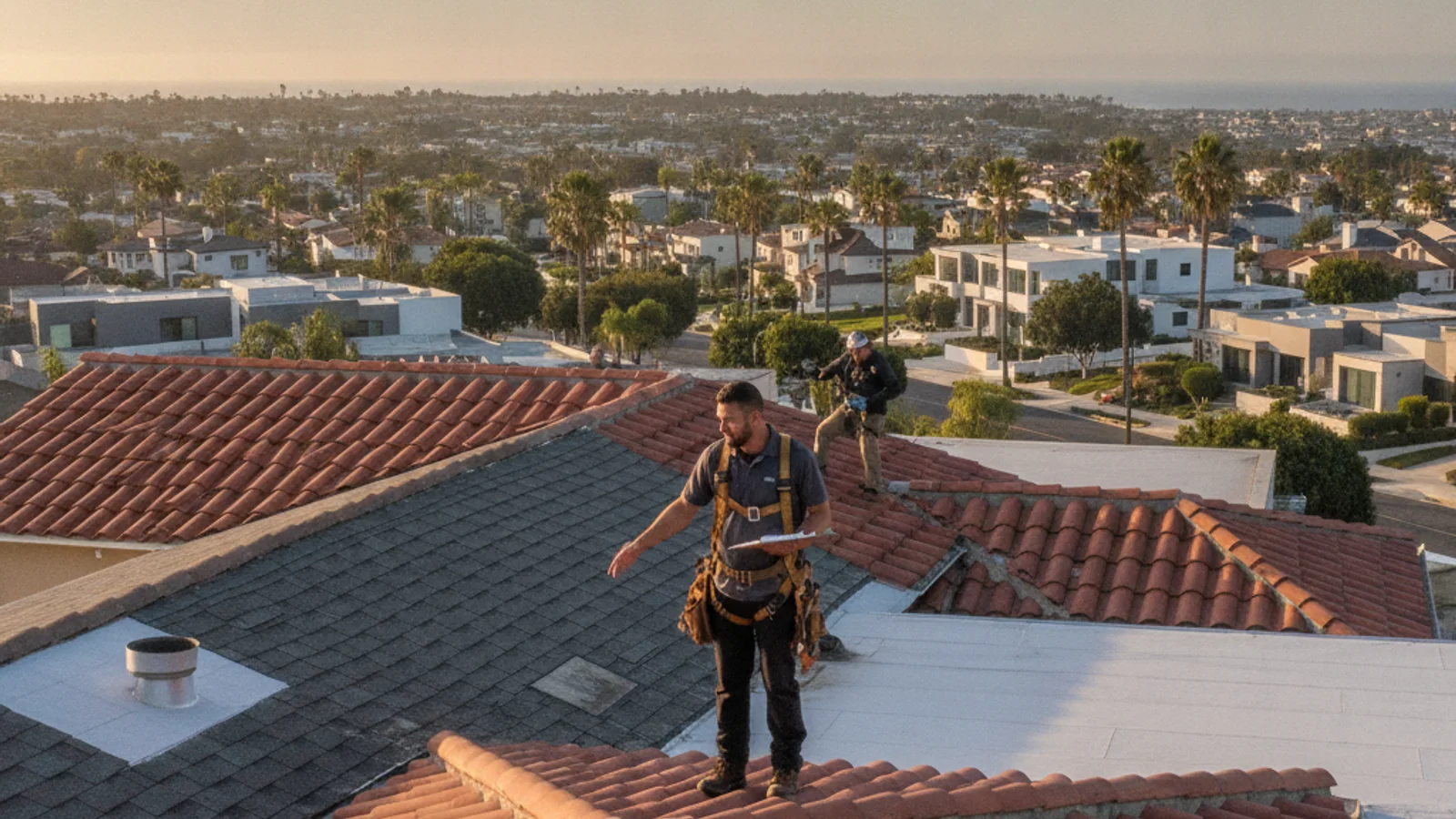
Start with the building, not the bidders
Before you compare contractors, write down what you own. Roof area and how it was measured. Number of sections and their slopes. Existing membrane type and how many layers sit on the deck. Deck construction. Insulation type and whether anyone has checked it for saturation. Every penetration: HVAC curbs, exhaust fans, vents, conduit, skylights, smoke vents. Drain type and count. Parapet and edge condition. Access route and whether a crane is needed.
That document is what makes bids comparable. Without it, each contractor measures and assumes differently, and you price three different projects against each other.
The code path differs by building type. City of San Diego roofing standards route multi-family and non-residential work through California Building Code Chapter 15. Single-family and residential work typically routes through California Residential Code Chapter 9, with local amendments in San Diego Municipal Code Chapter 14, Article 5, Division 15. Limited like-for-like reroof permit exemptions that exist for some single-family, duplex, and townhouse properties do not extend to a commercial building. Assume a permit and confirm it with the jurisdiction that holds the address. Each incorporated city runs its own counter. Unincorporated county rules must be confirmed at that counter. We will not invent them.
Before anyone quotes a recover, ask the AHJ how existing layers are treated. For City of San Diego jobs, start with Information Bulletin 123 and read the current bulletin. A bid that ignores that path is not a cheaper option. System types: commercial roofing.
Verify the license before you read the total
California’s roofing classification is C-39. It covers installing and repairing products that seal, waterproof, and weatherproof a structure against water. Confirm workers-compensation status on the live CSLB record. Read current Business and Professions Code Section 7125 rather than this blog.
License status, complaint history, and bond information are public. Run every bidder through the CSLB license check. Confirm the license is active, that the classification covers the work, and that the name on the license matches the name on the proposal. A license held by a related entity is not the same as a license held by the bidder.
Ask for certificates of insurance naming your entity as additional insured, and confirm them with the carrier rather than accepting a PDF alone. Coverage limits belong to your insurance professional. We will not prescribe them. The California Department of Insurance publishes consumer guidance if storm damage becomes a claim mid-project.
Read current Business and Professions Code Section 7048 for any minor-work licensing exemption. That exemption is not a commercial-roof bid. Anyone bidding a commercial building without a license is not a cheaper option.
Read the scope for what it leaves out
The lowest total is often cheapest because it excluded something. Look for these specifically.
Tear-off versus recover. Is the existing system coming off, or is a new membrane going over it? Those are different projects with different weights and different code exposure.
Insulation and deck. Does the scope include moisture surveying the existing insulation, and does it name a unit method for replacing saturated insulation and damaged deck found once the roof is open? A bid with no method for hidden conditions will produce a change order later, at whatever figure the contractor then names. We will not invent that unit price here.
Cool roof compliance. Look up the CEC climate zone for this address. Confirm with the AHJ whether the proposed product must meet aged solar reflectance, thermal emittance, or Solar Reflectance Index thresholds for that permit. Do not treat typical steep-slope San Diego work as a cool-roof default. The Cool Roof Rating Council weathers products to produce aged values. Confirm each proposed product’s aged numbers, not only initial ones. Product sheets, not this page, are the source.
Solar-ready rules and fire-code array clearances can shape sequencing if the building has arrays or plans them. Title 24 solar-ready provisions apply to defined nonresidential and hotel or motel occupancies that do not install a PV system. Fire-code access and vent clearances around arrays are a separate check. Put existing and planned arrays in the bid package.
Fire rating. If the parcel sits in a designated wildland-urban interface or fire-hazard severity zone, ask the AHJ, the insurer, and the matched C-39 whether a listed Class A assembly applies to this scope. Do not treat Chapter 7A, a 50 percent area test, or Class A on any covering as a fact this page can certify. Verify the parcel. Do not assume the whole county is WUI.
Drainage, penetrations, and access differ by submarket
San Diego County’s commercial stock is not uniform. Kearny Mesa and Miramar hold a lot of mid-century single-story industrial buildings on large low-slope roofs, often with heavy rooftop mechanical loads and interior drains sized for an older code cycle. Otay Mesa and the South Bay skew toward newer high-clearance distribution buildings where roof area per penetration is high.
Sorrento Valley, UTC, and the Del Mar Heights corridor mix multi-story office with structured parking, which turns access and staging into a real line item. Downtown adds street closures and crane logistics. Coastal buildings in La Jolla and along the Oceanside to Encinitas stretch see salt exposure on fasteners, edge metal, and mechanical curbs. Inland Escondido, San Marcos, and El Cajon put roofs through hotter daily cycling, where thermal movement at seams and terminations shows up first.
Ask each bidder to walk the drains with you, count penetrations against your list, and state the access plan in writing. La Jolla commercial roofing and Escondido commercial roofing describe how those two conditions differ in practice. They still are not a rate card.
Tenant occupancy and phasing
An occupied building is a scheduling problem before it is a roofing problem. Ask how the work is phased, section by section, and what the daily tie-in is if rain arrives overnight. Ask about odor and fume control if the system involves hot work or adhesives, and whether tenant HVAC intakes get shut down or filtered. Ask about noise windows. A medical tenant’s lease may limit hours.
Ask who notifies tenants and how far in advance, whether interior protection is included beneath work areas, and how a leak into a tenant space gets handled during construction. Then ask what happens to the schedule if a section opens and the deck underneath is bad. A phasing plan that does not contemplate that is not a plan.
Read the warranty documents, not the warranty pitch
Warranty is where proposals diverge most and get compared least carefully. Two structures come up: a manufacturer program that may cover labor and material under named conditions, and a material-only warranty covering the product alone. Those are different instruments with different obligors. Separate from either is the contractor’s own workmanship warranty.
We cannot tell you what any specific program covers. Neither should a brochure. The only authority is the actual sample document from the issuer. Ask for the full sample before you sign, not a summary. Read who the obligor is, what triggers coverage, what voids it, what maintenance and inspection you must perform and document, whether ponding or unrelated trades void coverage, whether it transfers on sale, and what happens if the installing contractor goes out of business.
Manufacturer certification tiers work the same way. Programs are administered by the manufacturers. Eligibility for certain warranty types is often tied to them. Verify a claimed certification with the manufacturer, not from a logo on a proposal. Vocabulary: roof warranty explainer.
When to call us
Commercial roof decisions turn on the condition of the existing assembly. That needs someone on the roof with a moisture survey, not a bid built only off satellite measurements. A documented roof inspection is what makes competing proposals comparable, and it is the record you will want if a warranty or insurance claim comes later.
Call (760) 750-5557. We will connect you with a licensed local roofer. You contract with them. Check any C-39 at CSLB before you sign. Related: commercial roofing.