A coating bid usually arrives at the worst moment. The roof leaked twice, a replacement quote landed, and here is a proposal for a fraction of that with a fresh white surface. Sometimes that is a real restoration. Sometimes it is a film over a roof that has already lost, and the money disappears with the same leaks.
Top Pro Roofing SD is a referral service. We connect San Diego County owners with licensed local roofers. We do not coat roofs, we do not inspect them ourselves, and we do not certify assemblies. Call (760) 750-5557. We will not invent a per-square-foot coating price. Ask the matched contractor to walk this roof before anyone names a product.
What an elastomeric coating is and is not
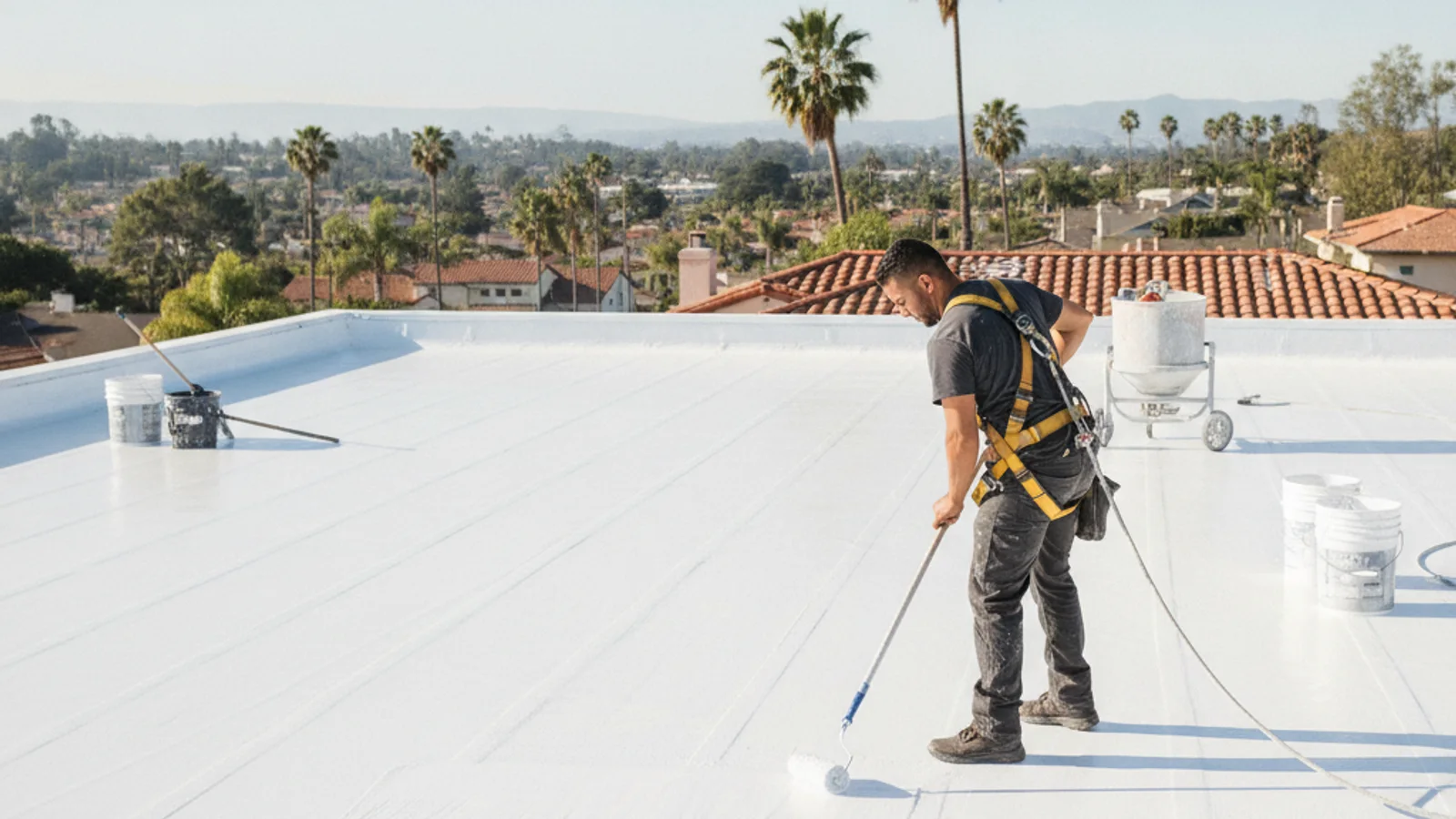
Elastomeric describes a behavior, not a single SKU. These are liquid-applied coatings that cure into a flexible film that stretches and returns as the roof below moves. They are rolled or sprayed over a prepared surface. Once cured they form a continuous layer with no seams of their own. The family includes acrylic, silicone, polyurethane, and hybrid chemistries. Those families differ enough that the category name tells you little. Where two common options split: silicone versus acrylic coatings.
A coating is a surfacing and weatherproofing layer on an existing roof system. It is not a roof system by itself. It does not add structural capacity, it does not correct slope, it does not replace wet insulation, and it does not fix a detail that was built wrong. It restores the top surface and it can bridge small imperfections. Everything below the coating stays as it was on the day it was applied.
So the useful question is not whether elastomeric coating is “good.” It is whether the roof underneath is worth preserving. A sound membrane that is weathered, chalked, and losing its surface is a strong candidate: the assembly is intact and only the top has aged out. A membrane with saturated insulation, widespread failed seams, or field blisters is a poor one, because the coating seals the problem in. Trapped moisture does not leave. It moves, expands with heat, and eventually pushes the new coating off. Broader choice: coating versus replacement.
When roof condition matters more than product choice
Owners spend most of their attention on which product to buy. Most of the outcome is decided before the product is chosen. Condition first, chemistry second.
The first thing a roofer looks for is moisture in the assembly. A visual walk finds soft spots underfoot, sponginess at drains, and staining on the deck from inside. Moisture surveys exist for this question, using infrared, capacitance, or nuclear methods to map wet areas. On a large roof that survey is cheap relative to coating over wet insulation. Wet insulation has to come out before anything goes over the top. If enough of the roof is wet, replacement is the honest answer.
Second is the existing surface, because coatings need something to grip. Granulated cap sheets, gravel-surfaced built-up roofs, existing silicone, and chalked or contaminated surfaces all change what can be applied and what has to happen first. A previously coated roof is its own puzzle. Some combinations do not bond. Manufacturers publish compatibility and preparation requirements. The specifying roofer should be reading those for the actual product in the proposal, not a generic “elastomeric” label.
Third is the building’s plan. If it sells in eighteen months, a restoration that buys clean, dry years can be reasonable. If the owner holds it for twenty and the deck already shows fastener backout and seam failure, the coating often defers the same expense. That is a business decision. It belongs with the inspection findings in front of you, not with a brochure.
How drains, seams, and penetrations affect the decision
The field of a flat roof is the easy part. Roofs fail at their interruptions. Those are exactly where a liquid-applied product is either a strength or a liability.
Drains and scuppers come first, because they govern whether water leaves. Low-slope roofs here spend most of the year dry, then take annual rainfall in a few concentrated storms. A partly blocked drain shows up as ponding all at once. Coating around a drain does not improve the drain. A crushed sump, a loose clamping ring, or a settled low area with no outlet gets corrected as its own line item first. Ponding is also a chemistry filter. Some coating families tolerate standing water and some are damaged by it, so ponding can eliminate products before price comes up. How those low spots form: flat roof ponding water.
Penetrations are next. Every pipe, curb, HVAC unit, conduit run, skylight, and hatch is a place the waterproofing was interrupted and rebuilt by hand. On a building with rooftop equipment that is dozens of details. Coatings are genuinely useful here: a liquid product can be reinforced with fabric and worked into shapes no sheet wraps easily. That advantage exists only if each detail is prepped and reinforced as its own step. A coating rolled thin over a cracked pipe flashing is cosmetic.
Then seams. On a modified bitumen or single-ply roof, open, fishmouthed, or delaminated laps get repaired before coating, not covered with it. On a metal roof, panel laps and fasteners move, and movement needs reinforcement rather than film thickness. The pattern is the same: the coating is the last layer. It earns its money only after everything underneath is watertight on its own.
What a coating does for heat gain
A light-colored coating changes how much solar energy the roof surface absorbs. That is a real effect and often the first thing tenants under the roof notice. Reflective surfacing is also part of California’s energy code. Here the specifics matter, and they change by cycle.
Under Title 24, Part 6, San Diego County is not one climate zone. Coastal parcels are often Climate Zone 7. Inland parcels can sit in other CEC zones. Low-slope cool-roof rules apply in many of those zones when the reroof or recover crosses the code trigger. We will not invent aged solar-reflectance, thermal-emittance, or SRI cutoffs here. The Cool Roof Rating Council tests products new and after outdoor weathering. The AHJ reads the aged values for the listed product, not the number off a freshly applied surface. Current standards: California Energy Commission. Local trigger language: cool roof Title 24 in San Diego.
We will not quantify what a coating saves you on a utility bill. Energy savings depend on insulation, occupancy, mechanical systems, and use pattern. Anyone handing you a percentage should hand you the calculation behind it. Whether the work triggers Title 24 at all depends on scope and slope. That determination belongs to the roofer and the plan reviewer for your jurisdiction, not to a coating brochure.
One maintenance note: reflective coatings get dirty, and a soiled surface reflects less than a clean one. That is part of why aged values exist, and why a roof expected to perform gets inspected and cleaned rather than left alone for a decade.
What the proposal should say before you sign it
Read the scope, not the cover page. A defensible coating proposal names things a weak one leaves vague.
It should identify the existing roof system by type and the surface being coated. It should list the repairs happening first: drain work, wet insulation removal with square footage, seam and lap repair, penetration detailing, and which reinforcing fabric goes where. It should name the preparation method: cleaning, pressure washing, primer if required, and the manufacturer’s requirements it is following. It should state the product by name, the number of coats, and the coverage or thickness the manufacturer specifies for the warranty being offered. Coverage rate is where a low bid usually hides: the same product applied thin costs less and performs differently. We will not invent a “typical San Diego” coverage rate or a coating total.
On warranties, ask two separate questions. What does the manufacturer warrant, for how long, and what conditions void it? Manufacturer warranties on restoration systems commonly depend on an approved applicator, an inspection, and documented preparation. Separately, what does the contractor warrant on their own labor? Terms vary by product and by roofer. Get both in writing and read the exclusions, especially around ponding water and pre-existing moisture. Verify the contractor’s license and status on the CSLB license check before any of it is signed. This site does not certify applicators.
Then ask what happens next time. A restored roof is on a maintenance cycle. Recoating intervals, inspection frequency, and responsibility belong in the conversation before you sign. On flat and low-slope roofing and larger commercial roofing projects, that documentation is normal to ask for.
When to call
A coating decision should follow a real inspection of the existing assembly, including a moisture check. That means a licensed roofing pro on the roof before any product is named. The same is true for the repairs that have to happen first, since those determine whether coating is a restoration or a cover-up. Call (760) 750-5557 and we will connect you with a licensed local roofer. You contract with that roofer. We do not issue a coating certification or a remaining-life stamp.