When a San Diego flat or low-slope roof is tired on the surface but still a roof, the restoration conversation often splits into silicone and acrylic. Those families behave differently under ponding, UV, and rain during cure. The manufacturer’s data sheet for the named product still wins. Top Pro Roofing SD is a referral service. We connect County owners with licensed C-39 roofers. We do not coat roofs and we do not publish a per-square-foot coating price. Call (760) 750-5557.
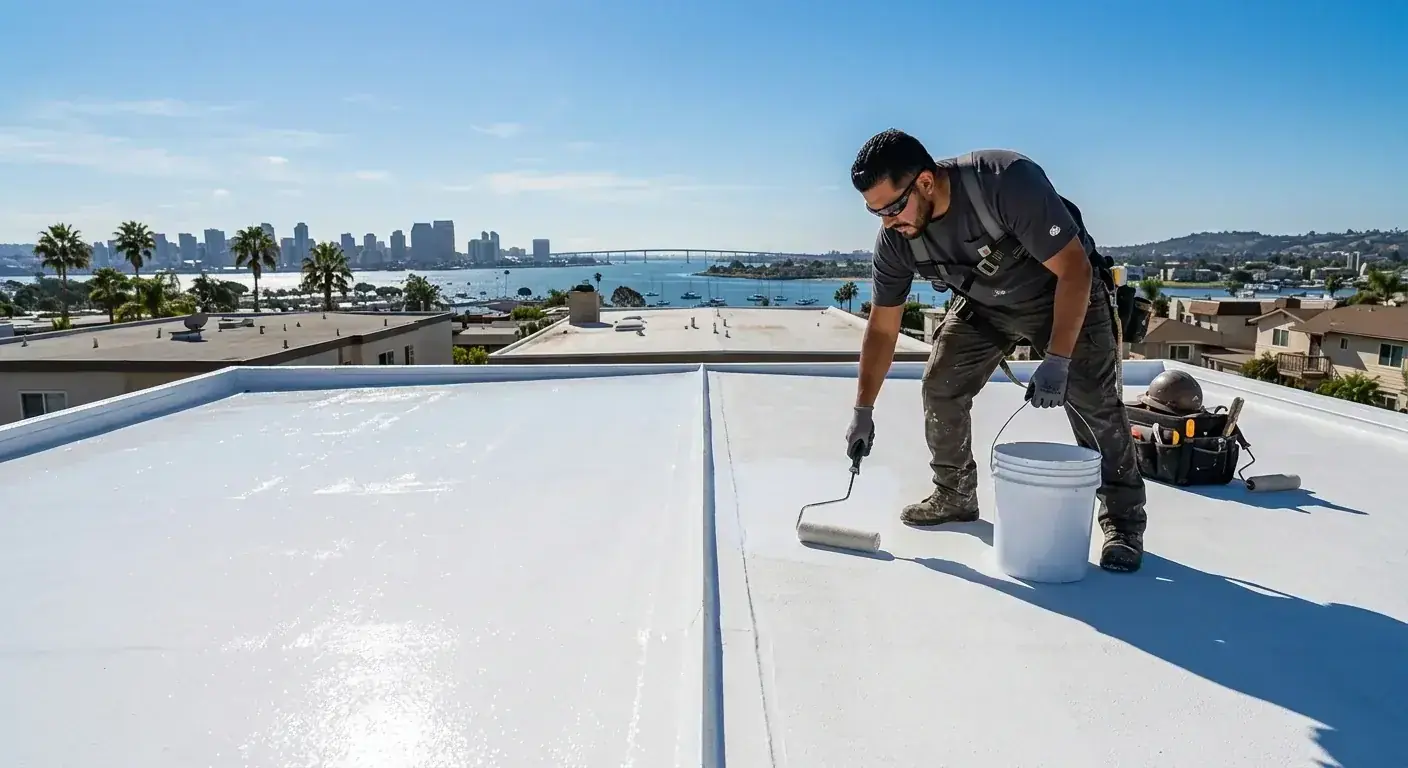
Coat vs replace is a different page: roof coating vs replacement. Replacement path: 2026 flat roof replacement cost.
What roof coatings do (and do not do)
Liquid-applied coatings (often sold as elastomeric systems) form a continuous film over a prepared existing roof. Used correctly they add a waterproofing and reflective layer. Reflective “cool roof” products are rated by the Cool Roof Rating Council for the listed SKU. We will not invent a temperature drop or a utility-bill credit. Confirm with the AHJ whether Title 24 applies to this coating. Read the current California Energy Commission text. Primer: cool roof Title 24.
A coating is restoration, not a new assembly. It does not repair a failed deck, soaked insulation, or a field that is already a quilt of patches. The existing surface has to be sound, attached, and dry. Coating a deteriorated roof is paint over rot. Moisture survey and cores belong before chemistry choice. Flat systems: flat and low-slope roofing. Ponding: flat roof ponding water.
For commercial and other low-slope buildings, coating can defer a tear-off when the cores say the deck is worth keeping. That deferral is a survey result, not a 10-to-20-year promise from this website. Elastomeric framing: when elastomeric coating fits.
Silicone: ponding-tolerant, UV-stable, usually the higher material conversation
Silicone’s useful trait on San Diego flats is ponding tolerance. Many acrylic warranties exclude standing water. Silicone products are commonly specified where water sits after rain because of minor drainage limits. Confirm that claim on the product bulletin. Ponding that is really a slope problem still wants tapered insulation or drain work, not a thicker film. See flat roofs with ponding.
Silicone also holds UV better than acrylic in inland heat (Otay Mesa, Santee, El Cajon) and still works on coastal salt and fog if thickness and prep match the sheet. It stays flexible instead of chalking as fast. Cool-roof performance follows the CRRC listing as the film weathers, not a “90 percent reflectance” marketing line.
Typical application after cleaning and primer is often a single heavier coat. Prep still has to be meticulous and dry. Moisture under the film blisters. Dirt pickup can dull a white field; wash rules live in the warranty. Once silicone is on, later recoats are usually silicone. Acrylic over silicone is commonly not allowed. Confirm the bulletin.
Commercial path: commercial roofing.
Acrylic: water-based, breathable, rain-sensitive while curing
Acrylic coatings are water-based, which makes cleanup simpler and vapor more able to leave the substrate when the system is designed that way. They are often the lower material conversation on a dry, well-drained roof. Initial reflectivity can be high on a listed white. Ponding is the usual exclusion.
Uncured acrylic can wash off in rain. San Diego’s dry stretches help, but the crew still needs a forecast window. Cured acrylic is a film, not a pond lining. Prolonged standing water can soften, blister, or delaminate it.
Under hard inland UV, acrylics chalk and lose elasticity faster than silicone. Two or more coats are common to hit the specified dry-film thickness. That is labor and mils, not a reason we can print a San Diego installed rate. EPDM is a frequent miss for acrylic; that membrane often wants silicone. Follow the substrate map on the data sheet.
Cost: compare named systems, not a blog spreadsheet
Coating is usually a smaller check than a tear-off with new insulation and membrane. That is not a license to coat a wet roof. Ask for line items: cleaning, primer, wet-area tear-out if any, fabric at details, specified mils or coverage rate, and whether a manufacturer inspection is included.
We will not invent San Diego acrylic or silicone totals, a per-square-foot band, or a “lower total cost of ownership” dollar. Get those numbers from an on-site bid. Flat roof repair cost also refuses a fabricated coating rate.
Which chemistry fits this roof
| Condition | Usual first conversation | Why |
|---|---|---|
| Repeated ponding, drainage only fair | Silicone (if the bulletin covers ponding) | Acrylic often excludes standing water |
| Dry field, good drains, budget-sensitive | Acrylic, if the substrate bonds | Lower material conversation when the roof is actually dry |
| EPDM field | Often silicone | Acrylic adhesion is a common miss |
| Already coated in silicone | Silicone recoat | Acrylic over silicone is commonly blocked |
| Wet insulation or soft deck | Neither coating | Replace. Cores first. |
If you want the longest film life and will fund the silicone system, silicone is usually the specifying answer on ponding-prone San Diego flats. If drains are honest and the survey is dry, acrylic can still be a real restoration. Neither family is a DIY weekend on a commercial roof.
A qualified flat and low-slope C-39 inspects drainage, maps moisture, names the substrate, and then names a product. We connect you. We do not pick a SKU from this page.
When to call us
Choosing and applying a coating is prep, mils, and warranty paperwork. Call (760) 750-5557. We will match you with a licensed independent local roofer for a written, surveyed bid. Verify the license at CSLB.