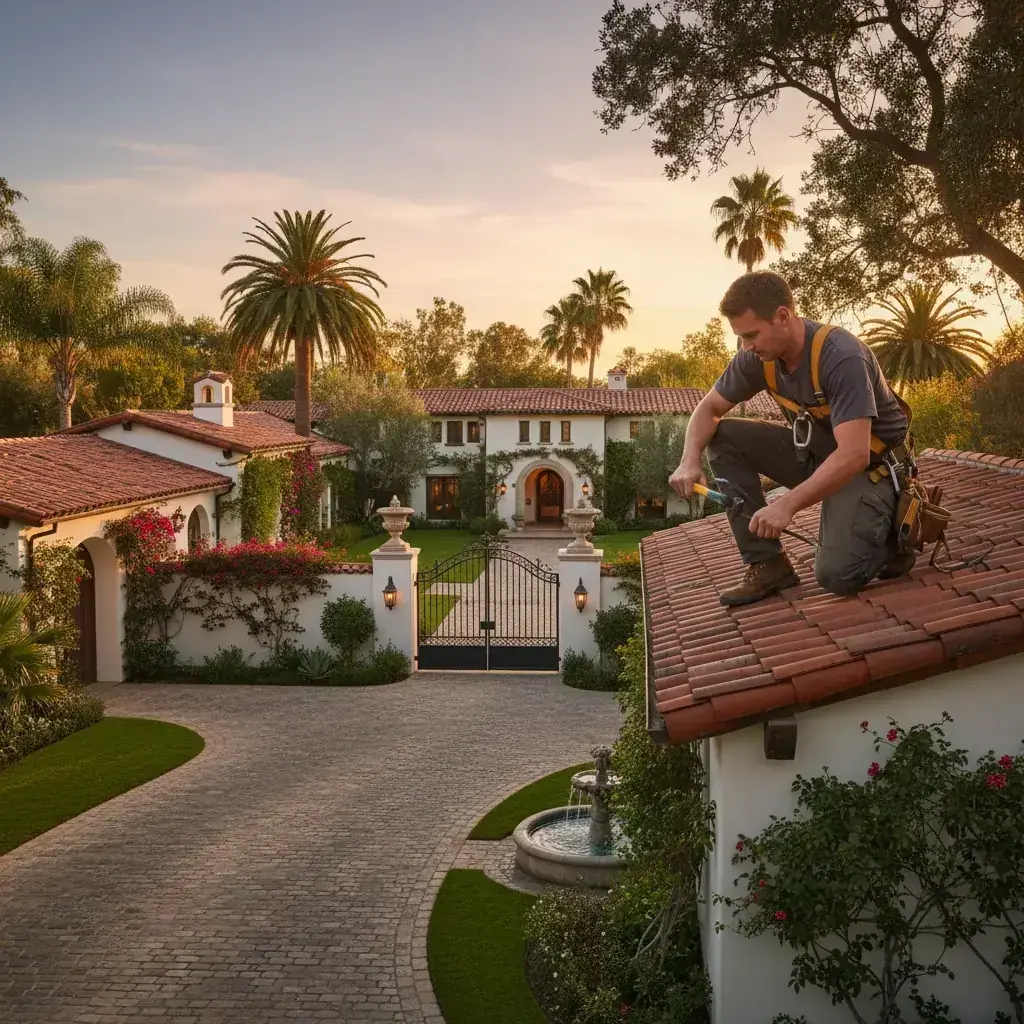
On a lot of 92128 single-family streets, the tile still looks like tile. The leak is often the underlayment. First-generation concrete tile from the original Rancho Bernardo build-out can still be sound while the felt or older membrane under it is not. Ceiling stains after rain or a damp attic smell are underlayment clues, not proof you must buy new tile. A lift-and-relay (salvage and reset over new underlayment and flashing) is the usual conversation. Full tile replacement is a different job. We will not invent a typical-home total or a percent cheaper claim.
Top Pro Roofing SD is a referral service. We connect Rancho Bernardo homeowners with independent C-39s. We do not roof houses, set HOA fees, or publish a 2026 rate card. Call (760) 750-5557.
Rancho Bernardo is a North County master-planned community that started in the 1960s and was largely built out by the mid-1980s. Later plans in Carmel Mountain Ranch, Scripps Ranch, 4S Ranch, and parts of Rancho Penasquitos followed similar HOA and tile habits. ZIP 92128 covers much of the community: Westwood at the core, Oaks North to the north, The Trails and Lomas Verdes on the south, Bernardo Heights, High Country West, and the Rancho Bernardo Country Club area.
What roofs look like in Rancho Bernardo
The dominant single-family covering is concrete tile: Eagle, MonierLifetile, US Tile, Boral, and older profiles that are now hard to match. Composition shingle shows up on smaller-format houses. Clay barrel appears more on original semi-custom inventory in Westwood and the Country Club area than on later tract blocks. We will not invent an 80/20 split. Walk the street and read the CC&Rs.
Attached and multi-family stock (condos, townhouses, retirement blocks, Seven Oaks) runs largely on low-slope membranes: built-up roof (BUR), modified bitumen, and TPO or PVC. Original 1970s-80s BUR is old enough that a moisture survey belongs on the board’s list. Remaining life is an inspection call, not a year stamp from this page. Material choice is the HOA’s, not the unit owner’s. Broader low-slope reading: TPO commercial roofing.
Westwood and Oaks North tile from the early 1970s, and Trails and Bernardo Heights inventory from the early 1980s, are the streets where underlayment, not the tile face, is the usual inspection question. Remaining felt or membrane life is what the C-39 sees after they lift a few pieces, not a year count from this page. The standard single-family conversation is tile lift-and-relay: existing tile salvaged and reset over new high-temp synthetic underlayment with new flashing. The tile often salvages. The underlayment is the layer that failed.
Neighborhood breakdown: what to expect by sub-area
Westwood (92128 core). Oldest stock, mostly mid-1960s to mid-1970s. Semi-custom and tract side by side. Original clay barrel shows up here more than elsewhere in 92128. Westwood architectural review is among the stricter color gates.
Oaks North. Primarily 1970s tract. Low-profile concrete tile in original tan and brown palettes. Seven Oaks senior housing has its own management path for multi-family roofs.
The Trails and Lomas Verdes. Late 1970s to mid-1980s. S-tile and flat profiles more common than in older Westwood. Ask the inspector what the underlayment looks like on the earliest of this wave. Do not treat a first-service-life year count as settled.
Bernardo Heights. Mid-1980s. Larger hillside lots and more valleys. Lift-and-relay here is more flashing work, not a different material story.
High Country West. Hillside, steeper pitches, Santa Ana channeling in canyon corridors. Ridge and hip fastening deserve more attention than on the flatter blocks.
Fringe toward 4S Ranch and Poway. Southern and eastern 92128 can sit near 92127 rules. Confirm HOA affiliation before any visible roof work.
Rancho Bernardo HOA roof requirements
The community master association sets community-wide standards. Neighborhood associations add another layer. Westwood, Oaks North, The Trails, Lomas Verdes, Bernardo Heights, and smaller sub-associations each have architectural committees.
For work visible from the street or a neighbor, committee review is required before start. A typical packet includes:
- Manufacturer, product line, profile, and color
- Samples
- Photos of comparable installs
- Underlayment type, flashing metal, fastening pattern
- Timeline and who will be on site
Ask the association for the current clock. We will not invent two-to-four-week or six-to-eight-week guarantees. A roofer who already has like-for-like approvals on file for this profile can shorten the packet. A color or profile change is a longer argument.
Practical notes:
- Color matching is strict in Westwood and Oaks North. Original 1970s palettes are narrow. If you replace instead of relay, expect a short approved list.
- Profile substitutions are often refused. Low-profile stays low-profile. Barrel or S-tile is not a silent swap.
- Multi-family goes through management. The HOA owns the roof. You raise condition with the board or manager. You do not typically hire a roofer as a unit owner.
If you are unsure you are under review, read the CC&Rs or call the master association. Nearby process: Scripps Ranch HOA roof requirements.
How to read 2026 Rancho Bernardo roofing bids
Your number depends on squares, valleys, HOA packet, broken or discontinued tile, and access. We will not print repair, relay, replacement, ridge, boot, skylight, or condo-building totals.
Ask every bidder to separate:
- Tile repair of slipped or cracked pieces versus a leak that is really failed underlayment
- Pipe boots as their own line
- Tile lift-and-relay versus full new tile
- Ridge and hip reset (mortar-set versus modern dry-set)
- Low-slope TPO or PVC when the building is attached housing
Full replacement is usually for a color change the committee will allow, a large share of broken or unmatchable tile, or a profile change that already has approval. Broader context: new roof cost 2026 and tile lift-and-relay.
Santa Ana winds, inland heat, and Rancho Bernardo roofs
Rancho Bernardo sits inland, well northeast of downtown. Coastal marine layer is weaker. Summer heat and canyon winds are stronger.
Inland heat. Summer days in the high 80s and 90s are normal. Tile attics run much hotter than the street. Repeated thermal cycling is a real reason first-generation underlayment fails sooner than the same tile would on Encinitas or Point Loma. We will not invent a 140 to 150 degree attic as a measured fact for your house. Ask the inspector what they saw.
Santa Ana winds. Canyon corridors channel gusts. Original mortar-set ridge and hip tiles loosen after decades of expansion and contraction. One event can drop a ridge piece. The 2007 Witch Creek Fire burned through parts of Rancho Bernardo on Santa Ana winds. That history is why inland canyon lots should confirm mapped fire-hazard status, listed assemblies, and ember-aware vents with the AHJ. Do not treat Class A as a community-wide fact. Patterns: Santa Ana wind roof damage.
In High Country West, Bernardo Heights, or any canyon-facing lot, ridge and mortar condition are worth checking on a schedule, not only after a ceiling stain.
Common Rancho Bernardo repair calls
Slow underlayment leaks on first-generation tile. Water in the attic or on the ceiling after a hard rain. Tile looks fine. A patch on failed felt buys little. The honest scope is lift-and-relay on the affected area or the whole field, as the C-39 maps it.
Ridge tile and mortar failure. Original mortar-set ridges crack. Modern dry-set with foam closures is a different detail. Scope is usually a full ridge run, not one loose cap.
Pipe boot UV failure. Original rubber boots crack in this sun. Lead or other long-life boots are a common upgrade during a relay. We will not invent a year count. Look at the actual boot.
Skylight curb and flashing. Many houses still have original acrylic domes. Yellow plastic, failed seals, and curb leaks travel together. Replacement with integrated flashing is a separate line from tile work.
Repair versus replace thinking: roof repair vs replace.
Multi-family considerations
A large share of Rancho Bernardo housing is attached. The HOA owns the roof and contracts the work. If you live in a condo or townhouse, raise the leak with the board or manager. Do not hire a roofer against the CC&Rs.
For boards: assessment, written spec, multiple bids, board vote, resident notice, construction, inspection. Multi-building calendars run in months, not a weekend. Ask counsel and the manager for the process this association actually uses.
How to vet a Rancho Bernardo roofer
- Active C-39 in the company name, no surprise disciplinary hits: CSLB license check
- Recent 92128 tile lift-and-relay addresses, not only shingle photos
- Who prepares the HOA packet
- For HOA-owned roofs, prior multi-family membrane work through management
Red flags: roofing contractor red flags in San Diego.
Frequently asked questions
How much does roof leak repair cost in Rancho Bernardo?
It depends on whether the leak is a discrete cracked tile or failed underlayment under a whole field. We will not invent a patch or partial-relay total. Get a diagnostic inspection first.
Do I need HOA approval for a free roof estimate in Rancho Bernardo?
No. An inspection and a written quote are not visible construction. Architectural review starts when you schedule visible work: relay, replacement, or a color or profile change. Ask the association for their current review time before you lock a start date.
What’s the difference between a tile lift-and-relay and a full roof replacement in 92128?
A lift-and-relay removes the tile, installs new underlayment and flashing, and resets the original tile. Full replacement removes tile and underlayment and installs new tile. In Rancho Bernardo, relay is often the job when the original Eagle, US Tile, or similar field is still matchable and the committee wants the same look. Full replacement costs more because you are buying new tile and a new HOA argument. We will not invent a percent gap.
Are there specific HOA roof rules for Westwood and Oaks North?
Yes. Those neighborhoods are known for tight original-palette color rules and for refusing casual profile swaps. Your roofer should show prior packets for the profiles actually on those streets.
How does Rancho Bernardo’s inland location affect my roof?
More heat on the underlayment than the coast, and more Santa Ana load on ridges and hips, especially on canyon lots. Check ridge mortar on a schedule in High Country West and Bernardo Heights even if the ceilings look dry.
How do I get a roof estimate in Rancho Bernardo?
Call (760) 750-5557 or request a quote. We will match you with a licensed roofer who works 92128. The roofer inspects and writes the estimate. Top Pro Roofing SD does not perform the work.
Get connected with a licensed independent Rancho Bernardo roofer
Ask on the call for a current CSLB license lookup, insurance, first-generation tile relay, HOA packets, discontinued profiles, and HOA-owned low-slope membranes. No obligation.
Call (760) 750-5557 or request a quote.
Nearby: Rancho Bernardo roofing service hub and Rancho Penasquitos roofing guide.