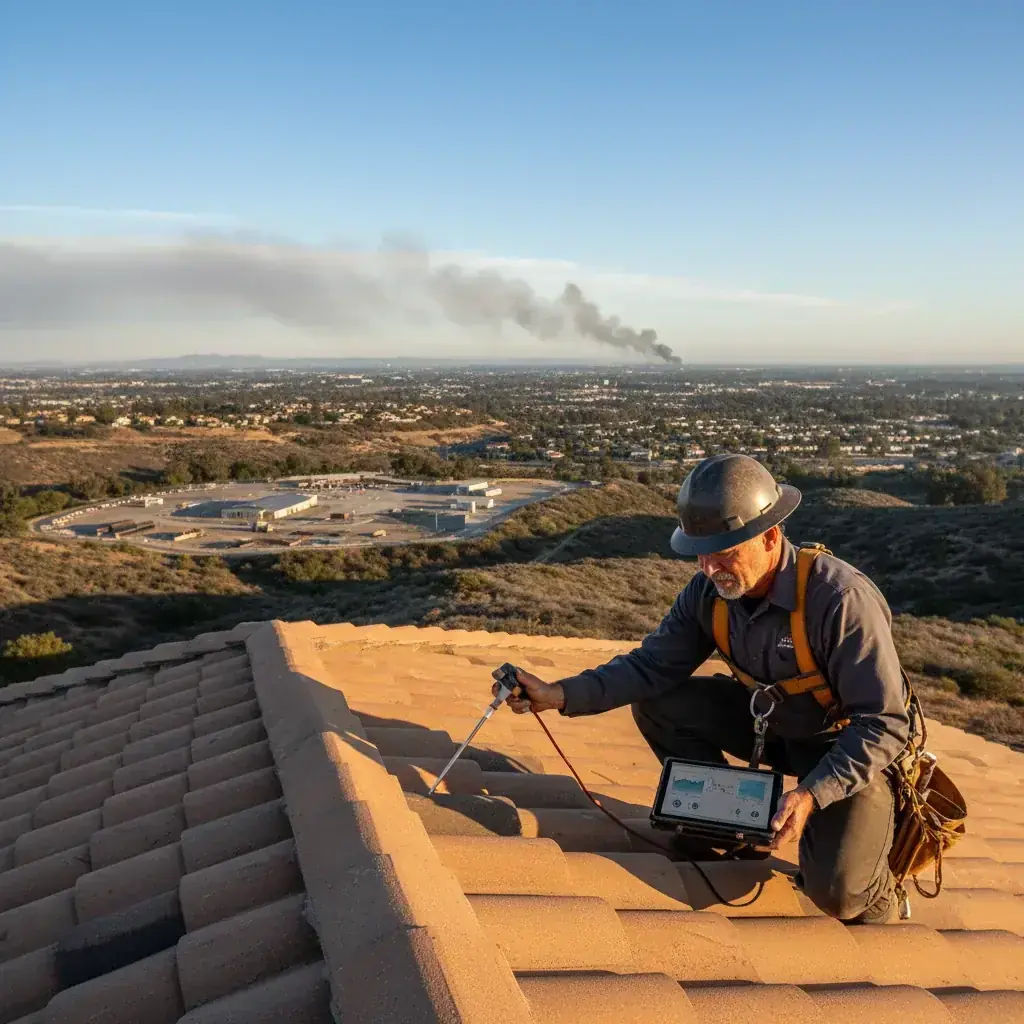
If the house sits in Julian, Palomar, Pine Valley, Mount Laguna, Cuyamaca, Descanso, or Mesa Grande, the Encinitas spec is the wrong starting point. Elevation can put snow load into the structural calculation. Mapped fire-hazard or WUI overlays can change covering and vent details. Wind and access are harder than a coastal ranch. Confirm snow, fire mapping, and permit path with the county or tribal desk that owns the address. Do not treat Chapter 7A or Class A as automatic.
Top Pro Roofing SD refers licensed independent C-39 roofers. We do not install, engineer, or set prices. Call (760) 750-5557. The homeowner contracts with the matched professional. Verify the license: CSLB lookup.
Coastal material context: best roof material for coastal climates. Fire-side materials: wildfire-resistant roofing. City starting point: Julian roofing.
San Diego mountain communities, by elevation
Most of the county’s housing sits well below the snow band. These communities do not.
| Community | Approximate elevation | Snow expected | Notes |
|---|---|---|---|
| Descanso | ~3,500 ft | Occasional dusting, rare accumulation | Edge of the snow-design band |
| Pine Valley | ~4,000 ft | Light snow most winters | High fire severity mapping is common |
| Julian | ~4,200 ft | Measurable snow most winters | Snow planning and WUI detailing are routine |
| Cuyamaca | ~4,500 ft | Regular snow, deep events possible | Burn-scar terrain, ember exposure |
| Mesa Grande | ~3,500–4,500 ft | Light to moderate snow | Rural, tribal, and county parcels |
| Mount Laguna | ~5,500 ft | Heavy snow events common | Highest sustained winter cold in the county |
| Palomar Mountain | ~5,000–6,000 ft | Heaviest snow loads in SD | Observatory road sees regular closures |
A Julian roof and a Mount Laguna roof are not the same project. Mount Laguna and Palomar take the deepest snow. Julian and Cuyamaca see real snow with less of it. Descanso and Pine Valley are the transition, where snow load becomes a parcel conversation.
Elevations are approximate. The permit load comes from the plans examiner for the address, not this table.
Snow load (CBC structural design)
San Diego County adopts the California Building Code. Chapter 16 structural design incorporates ASCE 7 snow provisions. Read the current adopted text rather than this blog. At the coast, ground snow load is often treated as zero. That can stop being true at elevation. The county uses site-specific ground snow values. A structural engineer or plans examiner sets the design load on the permit. We will not invent an elevation cutoff. In Mount Laguna and Palomar, snow often dominates the roof structure conversation.
A covering swap that adds dead load (asphalt to concrete or clay tile, or a heavier assembly) on rafters sized for the original roof can exceed capacity once snow is included. That is an engineer letter problem, not a color choice. Sistered rafters or other reinforcement, if required, happen before the new covering. Tile on unreviewed mountain framing is a job a careful C-39 will refuse. Tile scope: tile roof replacement. We do not invent that adder.
Pitch matters. Steeper slopes shed snow faster. The code allows reduced design snow load on steeper roofs. Low-pitch additions on older cabins are a recurring problem. The examiner, not a blog pitch rule of thumb, sets the number.
Technical references: CBC Chapter 16 and the ASCE 7 provisions it adopts. Your design load is the permit, not a national map screenshot.
Fire: Class A assemblies in the WUI
Cal Fire Fire Hazard Severity Zone maps are the lookup for each parcel. Do not treat the mountain communities as automatically Very High, and do not treat Chapter 7A as automatic. Confirm the parcel on the Cal Fire FHSZ viewer. Ask the AHJ whether Chapter 7A items and a listed Class A assembly apply to this reroof. Class A is covering, underlayment, deck, and the listed system as installed. A brochure for the shingle alone is not the listing.
Edges, valleys, and penetrations may need ember-resistant detailing where the map and the official say so. Open eaves and unboxed rafter tails are common entry paths. Gutter debris is a common ignition vector in WUI fire reviews.
Attic vents, when required to be ember-resistant, need listed products (mesh size and listing as the product specifies). A Class A field over noncompliant vents is a partial roof. Unincorporated mountain addresses typically permit through San Diego County Planning & Development Services, not a city counter.
Wood shake is often refused as a new WUI covering. Existing shake is a replacement and insurance conversation. Confirm with the building official and the carrier.
Wind is not only Santa Ana season
Ridge and canyon flow hits Palomar and Mount Laguna in winter as well as during Santa Ana events. Coastal nailing patterns and unlisted ridge caps show up as failures after those winds. Follow the manufacturer’s high-wind fastening pattern and the assembly listing. Mechanically fasten flashings. Sealant-only edge metal is not a wind detail.
Santa Ana background: Santa Ana wind roof damage. At elevation, treat that exposure as the floor.
Materials that usually survive the conversation
| Material | Snow | Wind | Class A path | Notes |
|---|---|---|---|---|
| Standing seam metal | Sheds when detailed | Strong with listed clips | Assembly listing required | Common mountain spec; plan snow guards where people and tanks sit |
| Stone-coated steel | Holds more snow than standing seam | Depends on fastening | Assembly listing required | Heavier than thin standing seam |
| Concrete tile | Heavy; engineering first | Good when fastened to listing | Yes when the assembly is listed | Dead load plus snow is the gate |
| Clay tile | Same structural caveat | Good when fastened to listing | Yes when the assembly is listed | Matching and access add complexity |
| Class A architectural asphalt | Needs pitch and ice-dam detailing | High-wind pattern required | Yes when rated and installed as listed | UV and thermal cycling are harder at elevation |
| Wood shake | n/a | n/a | Confirm with the AHJ | Do not specify until the official and the carrier speak |
Standing seam is often specified because it sheds snow, takes listed clamps for solar, and can meet Class A as an assembly. Tile works after structure is proven. Asphalt is allowed when the assembly is Class A; field life at elevation is typically shorter than on the coast because of UV, thermal cycling, and freeze at the edges. We will not invent a year count.
Low-profile exposed-fastener metal holds snow more than standing seam and depends on washers that age in UV and freeze. In Palomar and Mount Laguna accumulation, that is a different product conversation than a coastal patio roof.
Very dark colors can increase melt-refreeze at eaves. Medium tones and a correct ice-barrier detail matter more on the highest parcels. That is detailing judgment, not a code color chart.
Countywide material list: best roof types for Southern California. Mountain work is a subset: metal roofing or tile after a site walk.
Details that are not optional at elevation
Ice and water membrane. Where ice damming is a risk, self-adhered membrane at eaves is a code and plan-check item. How far it runs inside the warm wall is a permit and manufacturer question for that roof. Ask what the county wants on this parcel.
Snow guards. Standing seam that sheds cleanly can dump a slab onto a walkway, door, propane tank, HVAC, or array. Layout follows the panel run and the design snow load in the manufacturer’s instructions. Coordinate with any solar layout.
Ventilation. Attic ventilation still manages deck temperature and ice-dam risk. In the WUI, vents have to be the listed ember-resistant products. Size to net free area, not vent count.
Flashings. Each penetration is a leak path and an ember path. One-piece flashings where possible, mechanical fasteners, compatible sealant, step flashing at walls, cricket above wide chimneys.
Permits in unincorporated county (and tribal land)
Julian, Palomar, Pine Valley, Mount Laguna, Descanso, Mesa Grande, and Cuyamaca generally permit through the county, not a city. Plan check takes longer when snow load and, if mapped, Chapter 7A are in the packet. Have assembly listings, vent listings, and fastening patterns on site for inspection.
Overlay versus tear-off is a question for the AHJ. Ask which the permit allows. Read current layer limits in the adopted code, not this blog. Tear-off is the only way to see the deck.
Parts of Mesa Grande and other tribal lands permit through the tribal government. Ask early. County paperwork will not cover it.
We will not invent a mountain “premium” percentage or a Palomar bid. Drive time, engineering, listed WUI parts, snow guards, and access (small trucks, two trips, steep drives) show up as lines on a real quote. If a bid looks like a flat coastal composition job, ask which of those lines is missing.
FAQ
Do I need an engineer’s letter for a Julian reroof?
Like-for-like covering with the same dead load is often a plans-examiner call without a new letter. A heavier covering usually needs structural review. The county decides.
A neighbor still has wood shake. Is that allowed?
Existing covering can remain until replacement thresholds and insurance force the issue. A full reroof in a mapped WUI area often needs a listed Class A assembly. Confirm with the building official and the carrier. Do not treat Class A as a countywide fact.
Can solar sit on Palomar standing seam?
Often yes, with listed seam clamps and a snow-guard layout around the array. Coordinate C-39 and C-46. See preparing a roof for solar.
What pitch should a snow-band roof have?
Steeper sheds more and can reduce design snow load. Low-pitch additions are the problem cases. The examiner sets the number for the permit.
Are insurance rules different in the mountains?
Carriers in California have tightened on WUI exposure. Class A assembly, listed vents, and defensible space are the usual floor. Wood shake is often declined. Ask the carrier. This page is not an insurance opinion.
How a mountain quote should be built
A useful C-39 walks the parcel. Drone-only quotes miss eaves, access, and staging. Engage an engineer when dead load changes or framing looks light for snow. Spec listed assemblies, not a shingle nickname. Design where shed snow lands. Work through county plan check instead of around it.
If you are planning a reroof in those communities, call (760) 750-5557 and we will connect you with a licensed independent roofer who will look at the actual roof.