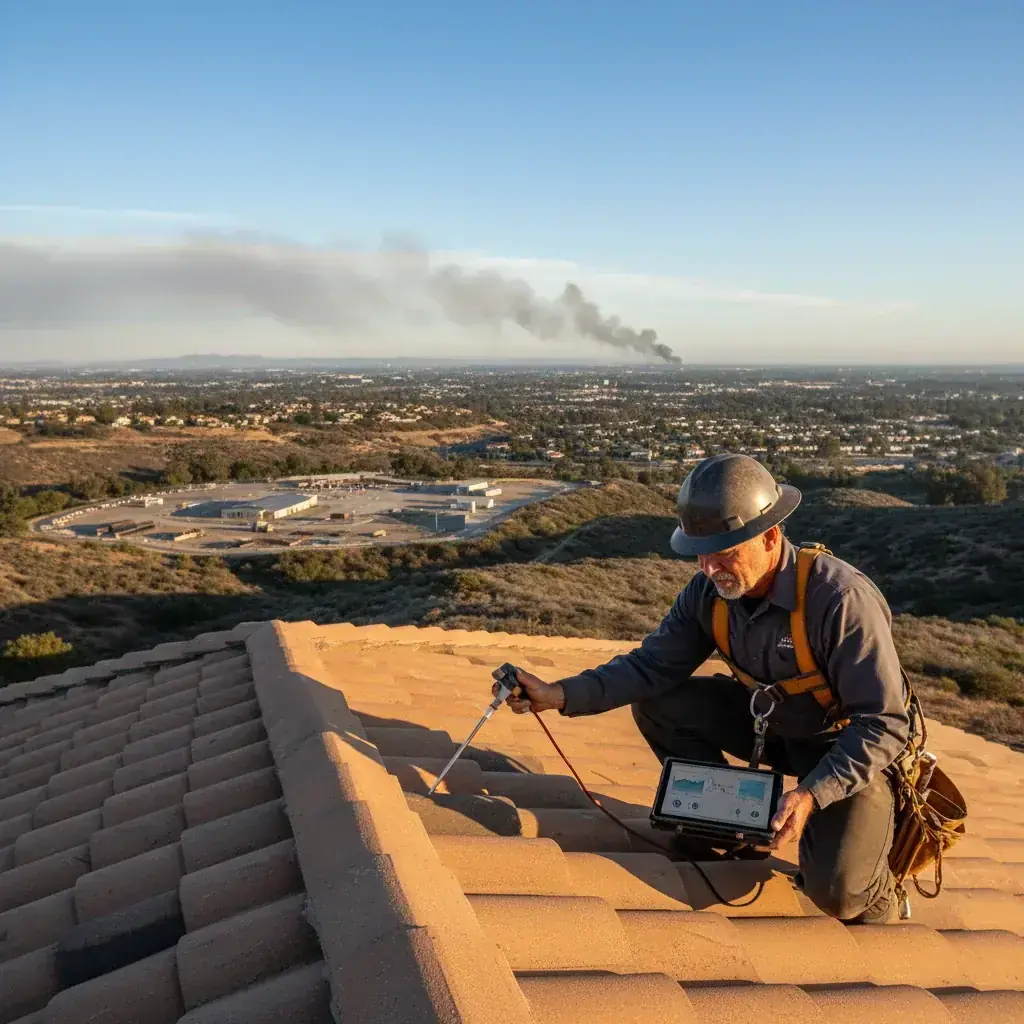
If you live in San Diego County’s backcountry, foothills, or any Wildland-Urban Interface zone on Cal Fire’s hazard map, the roof is the largest horizontal surface embers can land on. The California Building Standards Commission publishes WUI construction rules for exterior wildfire exposure. Read the current chapter and the local building department notes for this parcel. A reroof permit in Ramona is reviewed differently than one in Pacific Beach.
This guide explains what wildfire-resistant roofing means in code, which materials can qualify, and where homeowners pay for a “Class A shingle” and still fail inspection because underlayment or vents were not in the listed assembly. We will not invent per-square-foot prices or whole-house reroof totals.
Top Pro Roofing SD is a referral service. We connect homeowners with licensed local roofers. We do not install, we do not hold a C-39, and we do not write insurance. Call (760) 750-5557.
TL;DR
Class A is the highest fire rating a roof assembly can earn under ASTM E108 and UL 790. Do not treat Class A as a countywide San Diego fact. Ask the AHJ whether WUI construction rules and a listed Class A assembly apply to this parcel and this reroof. Concrete tile, clay tile, standing seam metal, and many architectural asphalt shingles can qualify, but only as a complete listed assembly: rated covering plus listed underlayment plus a code-compliant deck. Wood shake is a separate product-and-permit question. The common mistake is buying a Class A top layer and getting a non-Class A install. For tile context see tile roof replacement.
Why fire resistance matters here
San Diego County has burned in living memory. The 2003 Cedar Fire killed 15 people and destroyed more than 2,200 homes, mostly East County from Lakeside through Ramona toward Julian. The 2007 Witch Creek Fire burned into Rancho Bernardo, Poway, and Escondido and destroyed well over a thousand structures. Later seasons (including the 2017 Lilac Fire in Bonsall) keep the same pattern: Santa Ana winds, drought-stressed chaparral, and canyon geometry.
Post-fire research from NFPA and the Insurance Institute for Business and Home Safety keeps landing on embers, not always a wall of flame. Wind-driven embers can travel a mile or more, then pile in valleys, gutter debris, attic vents, and deck gaps. A combustible roof loses the house. A Class A assembly with screened vents and clean gutters is a different outcome even when the neighbor’s roof is not.
That is why OSFM and the Building Standards Commission publish WUI construction methods. It is not a paperwork hobby. Read the live chapter for this job.
What WUI zones are and how San Diego is mapped
WUI is where developed land meets wildland fuels. Cal Fire publishes Fire Hazard Severity Zone (FHSZ) maps for State Responsibility Areas (mostly rural backcountry) and Local Responsibility Areas (incorporated cities). Parcels are Moderate, High, or Very High. Look yours up on the OSFM viewer at osfm.fire.ca.gov.
The zones that matter most here are East County and North County backcountry: Ramona, Julian, Alpine, Jamul, Lakeside, Valley Center, Fallbrook, Bonsall, Pine Valley, and parts of Poway, Escondido, El Cajon, and San Marcos. Some canyon-backed coastal-leaning neighborhoods (Encinitas canyons, Rancho Santa Fe, parts of La Jolla) sit in High zones because brush funnels wind.
| FHSZ designation | Where in San Diego County | What to confirm |
|---|---|---|
| Very High Fire Hazard Severity Zone | Julian, parts of Ramona, Pine Valley, Cuyamaca, much of unincorporated East County | Ask the AHJ whether WUI construction rules and a listed Class A assembly apply |
| High Fire Hazard Severity Zone | Alpine, Jamul, Lakeside, Valley Center, Fallbrook, Bonsall, canyon-adjacent parcels in Poway, Escondido, San Marcos | Ask the AHJ whether WUI construction rules and a listed Class A assembly apply |
| Moderate Fire Hazard Severity Zone | Transitional parcels at the edges of urbanized areas | Confirm WUI construction rules with the AHJ |
| Outside FHSZ | Coastal urban San Diego, downtown, Mission Valley, most beach communities | Ask the insurer and the AHJ what they want in writing |
If your parcel is in an FHSZ tier, ask the AHJ what area test and assembly listing apply to this reroof. Do not treat a blog area-share figure as the rule. Confirm the exact trigger with your AHJ, your insurer, and the matched C-39. Do not assume a “match the existing wood shake” waiver. Older pre-2008 homes may still wear shake until a reroof or a carrier force-out.
What Class A, B, and C ratings actually mean
Fire ratings for roof coverings follow ASTM E108 and UL 790. Both run tests on a complete assembly on a test rig:
- Spread of flame. How far fire travels across the surface.
- Intermittent flame. Repeated ignition, closer to ember cycling.
- Burning brand. A burning wood brand on the assembly, to see if the deck ignites.
Class A survives the highest exposure. Class B is moderate. Class C is light. Untreated wood shake is unrated.
| Class | Burning brand size used in the lab test | Resists flame spread | Typical materials | What to confirm with the AHJ |
|---|---|---|---|---|
| Class A | Largest brand in the ASTM/UL series | Most resistant | Concrete tile, clay tile, standing seam metal, Class A asphalt shingle, slate | Whether a listed Class A assembly is the permit path for this parcel |
| Class B | Medium brand in that series | Moderate | Some treated wood products | Whether this class is accepted for this FHSZ job |
| Class C | Smallest brand in that series | Light | Older asphalt, some legacy composition | Whether this class is accepted for this FHSZ job |
| Unrated | None passed | None | Untreated wood shake, untreated wood shingle | Whether new work or a reroof can keep an unrated covering |
The rating applies to the assembly, not the material alone. Concrete tile on the wrong underlayment is not Class A. A “Class A architectural shingle” over an unlisted cheap synthetic is not Class A either. Manufacturers publish listed assemblies. Inspectors can ask for them. Reroofs have failed final inspection in Alpine and Ramona for exactly this.
Class A material options for San Diego homes
No installed-price column. Cost is a bid after pitch, tear-off, deck repairs, and access. Compare assemblies, lifespan, and ember behavior.
| Material | Class A as assembly? | Expected lifespan class | Ember resistance | Common SD use case |
|---|---|---|---|---|
| Concrete tile | Yes, with listed underlayment | Long on the tile; underlayment is the consumable | Excellent, non-combustible | Tract homes in Poway, Rancho Bernardo, Carmel Valley |
| Clay tile | Yes, with listed underlayment | Very long on the tile | Excellent, non-combustible | Spanish/Mediterranean, La Jolla, Rancho Santa Fe |
| Standing seam metal | Yes, with listed Class A underlayment | Long | Excellent, non-combustible | Custom and mountain homes in Julian and Alpine |
| Class A architectural asphalt shingle | Yes, when the full listed assembly is used | Shorter than tile or metal; ask the manufacturer sheet | Good when the listed mat and underlayment are used | Common East County reroof path |
| Slate | Yes | Very long | Excellent, non-combustible | Rare, high-end custom |
| Wood shake (treated, Class B at best) | No, not Class A | N/A in WUI | Poor | Ask the AHJ and the carrier whether new work or a reroof can use it |
Concrete tile
The default Class A look in a lot of San Diego suburbia. Non-combustible, widely available, matches 1980s-onward tracts. Maintenance is valleys, debris, and underlayment replacement on a shorter cycle than the tile. See tile roofing.
Clay tile
Same non-combustible profile, more fragile to walk. Common on older Spanish revival coastal and central San Diego. The clay outlasts the membrane under it.
Standing seam metal
Common now in Julian, Alpine, and Valley Center. Non-combustible, fewer gaps for embers, burning debris can slide off instead of breaking a tile. Details: metal roofing.
Class A architectural asphalt shingle
Often the lower-cost path to a listed Class A assembly. Fire resistance comes from the fiberglass mat and mineral granules plus the listed underlayment. Lifespan is shorter than tile or metal in this sun. For non-fire comparisons see best roof types for Southern California. UV aging: what deteriorates asphalt shingles in San Diego.
Why wood shake is a hard conversation here
Untreated wood shake is unrated. Treated shake may carry a different class. Do not treat either as a countywide Class A covering. Read the current WUI construction rules text, the local building department notes, and your carrier letter for this parcel. Existing shake often stays until a reroof or an underwriting force-out. Many carriers will not write or renew wood shake in California fire zones, which has been pushing replacements since the post-2018 market.
The underlayment matters as much as the top material
The Class A listing names a specific underlayment, often a fiberglass-reinforced felt or a high-temperature synthetic. Unlisted synthetics can drop the rating even with tile on top. The inspector cares about the listing.
Ask the contractor for the manufacturer’s listed Class A assembly document. It names underlayment, deck (often a minimum plywood or OSB thickness), and valley/eave membranes. If they cannot produce it, that is a flag.
Ember-resistant detailing, not just the roof field
Embers attack edges and openings. A perfect Class A field can still lose the house through a gable vent or open eave. WUI construction rules and the IBHS Wildfire Prepared Home standard name those weak points. Read the live code section and the IBHS listing for mesh size, vent type, eaves, and gutters. Do not copy a mesh dimension from this page.
| Component | Ember vulnerability | What to confirm on this job |
|---|---|---|
| Roof field | Moderate (Class A handles direct ember exposure) | Listed assembly per ASTM E108 / UL 790 if the AHJ asks for Class A |
| Eaves and soffits | High | Current WUI construction rules and product listing, not a blog eave rule |
| Attic vents | Very high | Mesh or listed ember-resistant vents from the current code sheet |
| Roof valleys | High | Metal valley flashing, no debris traps |
| Roof-to-wall flashing | Moderate | Continuous metal flashing, sealed terminations |
| Gutters | High | Non-combustible gutters, guards, regular cleaning |
| Skylights | Moderate | Glazing the listing and the AHJ name |
| Chimneys | Moderate | Spark arrestor details from the current code sheet |
Ember research: wildfire roof ember data. Code picture: San Diego fire-code roof requirements.
Combining a Class A roof with defensible space
The roof is one part of a system. Cal Fire Ready, Set, Go and current CAL FIRE defensible-space rules (read the live Cal Fire and LegInfo text) describe defensible space around structures in SRA. Read the current Cal Fire and statute text for zone names and distances. We will not restate those feet here. Confirm current enforcement for your parcel with Cal Fire and your AHJ. The idea is no combustible material against the house: no wood mulch, no woody shrubs on the wall, no firewood under the eaves.
A Class A roof with a wood fence butted to the siding is still a vulnerable house. Insurance questions after the 2018-2023 non-renewal wave often cover all of this, not just the roof.
Cost without a fake total
If the house were outside a mapped fire zone, a lower fire class might still be a permit path. Ask the AHJ. The step from mid-tier asphalt to a listed Class A architectural shingle is often a product-line choice more than a different building. Tile or metal vs asphalt is a different building, lifespan, and weight conversation. We will not print a whole-house package price.
Ask the matched roofer to price the listed assembly, tear-off, vents, and edge metal as one scope. Compare those scopes, not city-average blogs.
Insurance, fire rating, and non-renewal
Major carriers have non-renewed fire-zone policies, capped new business, or left California. The FAIR Plan has absorbed many of those homes, often with different premiums and limits. Carriers still writing in WUI almost always ask about roof material and age.
| Carrier requirement | What they typically ask | Why it matters |
|---|---|---|
| Roof fire rating | Class A confirmation | Direct underwriting factor in WUI |
| Roof age and condition | Age, recent inspection | Older roofs may be downgraded or non-renewed |
| Roof material | Tile, metal, asphalt, shake | Wood shake often disqualifies coverage |
| Defensible space | Zone 0, Zone 1, Zone 2 status | Asked on many fire-zone policies |
| Ember-resistant vents | Yes/no | Increasingly asked in Very High FHSZ |
| Gutter type and condition | Metal vs plastic, debris | Asked on some applications |
| FAIR Plan eligibility | Documented Class A roof | Often required for FAIR Plan acceptance |
Insurance and leaks: homeowners insurance and roof leaks in California. We do not bind coverage.
How to verify your existing roof’s fire rating
- Pull permit history. County and city records often note material at last reroof.
- Check original plans if the house is post-2008 in an FHSZ. They should specify a Class A assembly.
- Identify the material. Tile, slate, and metal are non-combustible. Asphalt needs the wrapper or manufacturer listing. Wood shake is almost never Class A.
- Get an inspection. A licensed roofer can check underlayment and whether the install matches the listed spec. Roofers in our network do this when homeowners need a written description for insurance. We do not issue that letter ourselves.
FAQs
Does a Class A roof guarantee my house will not burn?
No. It cuts the chance of roof ignition from embers, the common path. The house can still ignite through vents, windows, attached decks, or combustibles against the walls.
Can I keep my wood shake roof if it is already on the house?
Often until you reroof, or until the AHJ or the insurer treats the repair as a replacement. Ask them what area test they apply. Do not treat a blog area-share figure as the rule. Insurance may force the issue before code does.
How can I tell if my asphalt shingle is actually Class A?
Wrapper, listed assembly document, or manufacturer site. If the shingle is Class A and the underlayment is not the named one, the assembly is not Class A.
Is metal actually safer than tile in a wildfire?
Both can be excellent Class A assemblies. Tile has thermal mass and a long California history. Metal has fewer gaps and sheds burning debris. Aesthetics, cost, and geometry usually decide.
Will a cool roof also be Class A?
Independent ratings. A roof can be one, the other, or both. energy-code cool-roof rules are a California Energy Commission question for this slope, climate zone, and permit path. Do not treat the California energy standards as a default on every San Diego reroof. Energy side: the California energy standards cool roof.
Does an HOA override WUI construction rules?
Read the current WUI construction rules text and ask the AHJ. An HOA packet does not replace the building department. Some HOAs have updated CC&Rs to allow metal in formerly tile-only tracts. Confirm both the association and the permit set.
How long does a Class A roof last in San Diego’s climate?
Depends on the material. Asphalt is a shorter cycle. Concrete and clay tile last much longer if underlayment is maintained. Metal is a long cycle. Coastal salt shortens metal and asphalt hardware. Inland sun is the bigger asphalt story.
What to do next
If you are in Ramona, Julian, Alpine, Jamul, Valley Center, Fallbrook, Lakeside, or another fire zone and thinking about reroofing:
- Look up the parcel on the OSFM FHSZ viewer.
- Pull permit history.
- Have a contractor walk flashings, vents, and edges and name a listed Class A assembly.
- Get that listing in writing before you sign.
- Address vents, defensible space, gutters, and fence-to-house clearance.
Call (760) 750-5557 and we will connect you with a licensed independent local roofer. We do not pull permits. Availability is the contractor’s calendar. Verify the C-39 at cslb.ca.gov.
Sources and further reading:
- California Office of the State Fire Marshal, Fire Hazard Severity Zone maps: osfm.fire.ca.gov
- California Building Code, WUI construction rules: Materials and Construction Methods for Exterior Wildfire Exposure (California Building Standards Commission)
- ASTM E108 / UL 790 fire test standards for roof coverings
- NFPA wildfire research and Firewise USA
- Insurance Institute for Business and Home Safety (IBHS) Wildfire Prepared Home standard
- Cal Fire Ready, Set, Go and current defensible-space rules (read Cal Fire and LegInfo; we will not restate a code number here)