A permanent San Diego patio roof is a weather assembly, not a sheet you order from a photo. The panel, slope, joints, fasteners, drainage, and house connection have to be one plan. The manufacturer’s current documents for the named product settle performance claims. A blog cannot.
Top Pro Roofing SD is a referral service. We connect homeowners with licensed independent local roofing professionals. We do not install patio covers or set product prices. Call (760) 750-5557. The homeowner contracts with and pays the selected professional. Confirm C-39 status on the CSLB lookup. Patio framing can also involve a C-5 or general contractor. Ask who holds which part of the job.
Broader cover types: patio cover roof in San Diego. More open structures: pergola roof choices.
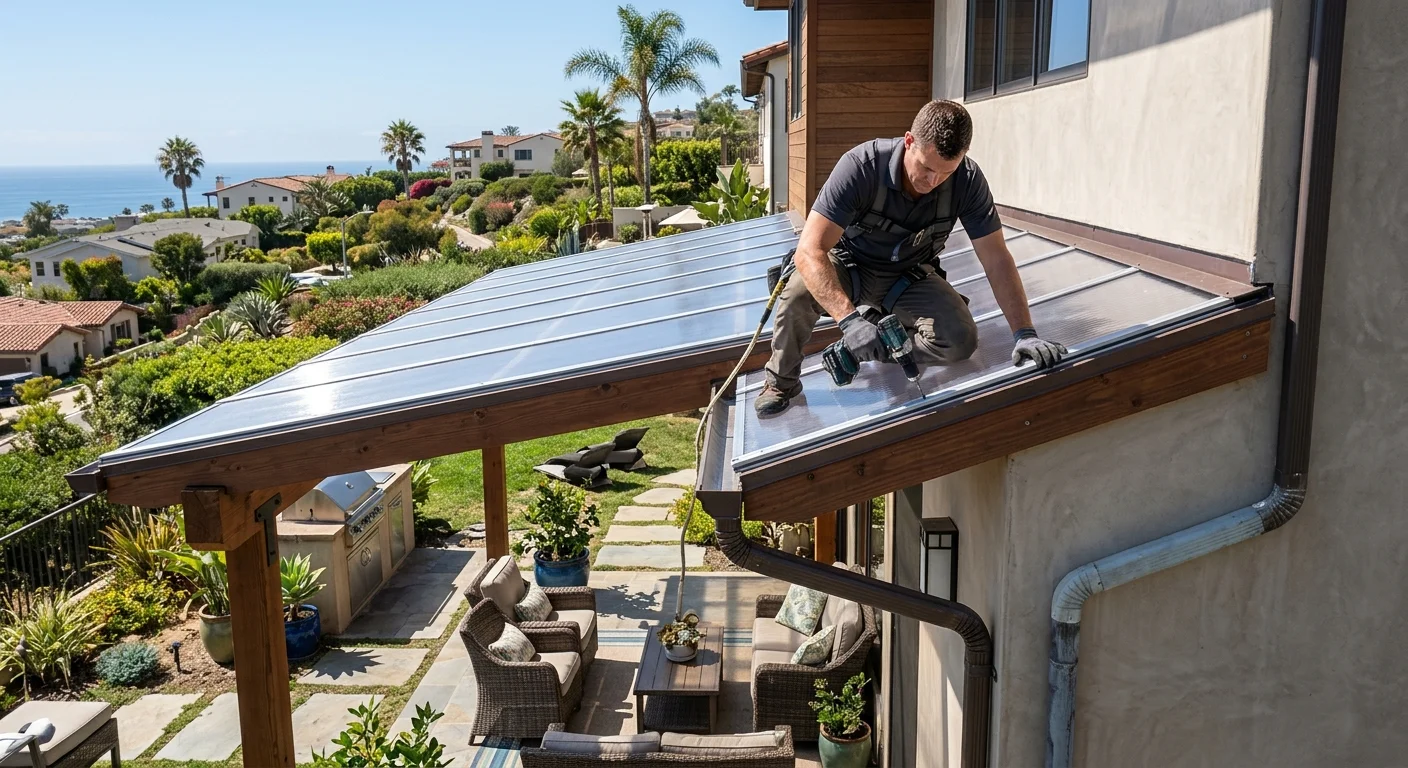
What the panel is actually covering
Define the space first. Where does the cover start and stop. Which doors, windows, walkways, cooking areas, and planters sit under it. Does the roof stand alone or meet a wall, eave, fascia, or existing roof edge.
Coastal, inland valley, mountain, and South Bay exposures are not one climate. A La Jolla patio sees salt. An El Cajon patio sees heat. A Julian patio can see snow and WUI rules. The matched roofer should inspect the property, not copy a countywide sketch.
Bring a simple drawing: covered area, openings you want to keep, existing house roof, and where water should leave. That is the question the product has to answer.
Multiwall, solid, and “clear” are different products
Polycarbonate patio sheets are usually:
- Multiwall (twin-wall or more): lighter, more insulating air spaces, visible flutes from below if the finish is clear or opal.
- Solid / compact sheet: more glass-like, different spanning and fastener rules.
- Corrugated profile: different laps, closures, and closures at ridges.
“Clear” is a catalog word. Ask for a physical sample of the exact model. View it from below, next to stucco, trim, and the house roof. Joints, screws, and purlins will show. Decide how much of that you want from the kitchen window.
Do not accept sales claims about glare, heat, yellowing, hail, or fire from a generic photo. Those live in the data sheet for the named thickness, UV cap, and color. A UV-protected face is usually one-sided. Installing it upside down is a common failure. The install manual should say which face is sky-side.
Thermal movement is large compared with metal or tile. The manual’s hole sizing, slot direction, gasketed washers, and end-closure details are the leak path if someone treats the sheet like plywood. Ask the proposal to cite those pages.
Drainage and the house connection
Map water from the panel surface to the outlet before you pick a color. The drawing should show slope direction, joints, gutters or chains, splash at doors, and neighboring roof planes.
A patio that meets the house is a flashing problem. Ledger, counterflashing, kickout at the wall, and how that detail relates to existing stucco or the main roof all belong in writing. Do not treat the wall meeting as an accessory. If the house roof is already in trouble, a roof inspection belongs in the same visit. A patio plan that dumps water behind a failing eave is a new leak, not shade.
Ask the proposal:
- Where water leaves the panels
- What component receives it
- Where that component discharges
- How doors and walkways stay out of the splash
- Which of those details come from the manufacturer versus field judgment
Permit path is address-specific. The City of San Diego’s reroof bulletin is not an automatic permit answer for a new patio structure. Confirm with Development Services for city addresses. Unincorporated parcels go through the county. A designated WUI parcel may bring California Building Code Chapter 7A into the conversation. Confirm the map and the fire AHJ. Do not treat Chapter 7A as automatic. Appearance does not prove fire classification. Ask for the listed rating on the exact product if the authority requires it.
Look up the CEC climate zone for this address. That does not by itself mean a patio roof must meet a cool-roof rule. Confirm slope, occupancy, and scope with the reviewing desk. Current energy standards: energy.ca.gov. Do not copy a climate-zone number from this blog.
What the site review should record
Product choice follows inspection.
The roofer should document planned footprint, existing attachments, visible rot or prior add-ons, trees, and the likely drainage route. Existing posts and ledgers should be examined before anyone relies on them. If a structural engineer must size the frame, that should be stated.
When the main roof also needs substantial work, ask whether the patio belongs inside a roof replacement conversation so the two weather planes are not fighting.
Ask for written notes: surfaces reviewed, visible concerns, unresolved items, proposed product name, and the documents used. Top Pro Roofing SD does not diagnose from a photo you text.
What the product file has to settle
Request the current installation manual and data sheet for manufacturer, product line, thickness, profile, finish, and accessories. The project drawing should not contradict those pages.
Treat every rating as model-specific:
- Light transmission and color
- UV cap and which face is exposed
- Approved span and support spacing
- Approved fasteners, washers, and sealants
- Edge and ridge closures
- Maintenance (abrasive pads and some solvents haze the sheet)
- Fire classification if the permit asks for it
- Warranty terms versus the independent roofer’s workmanship language
Do not copy a rating from a thicker sheet in the same catalog. Do not treat a lifespan marketing line as a local climate fact. Read manufacturer terms and the contract separately. Ask who handles which claim.
Before you approve materials, keep a short record: product name, finish, documents, site drawing, drainage plan, permit path, and open items. If a performance claim is not in that file, it is unconfirmed.
When to call
Call when a permanent patio needs panel selection, drainage planning, or a reviewed house connection. Top Pro Roofing SD can match you with an independent professional who inspects the site and documents the system. Call (760) 750-5557.