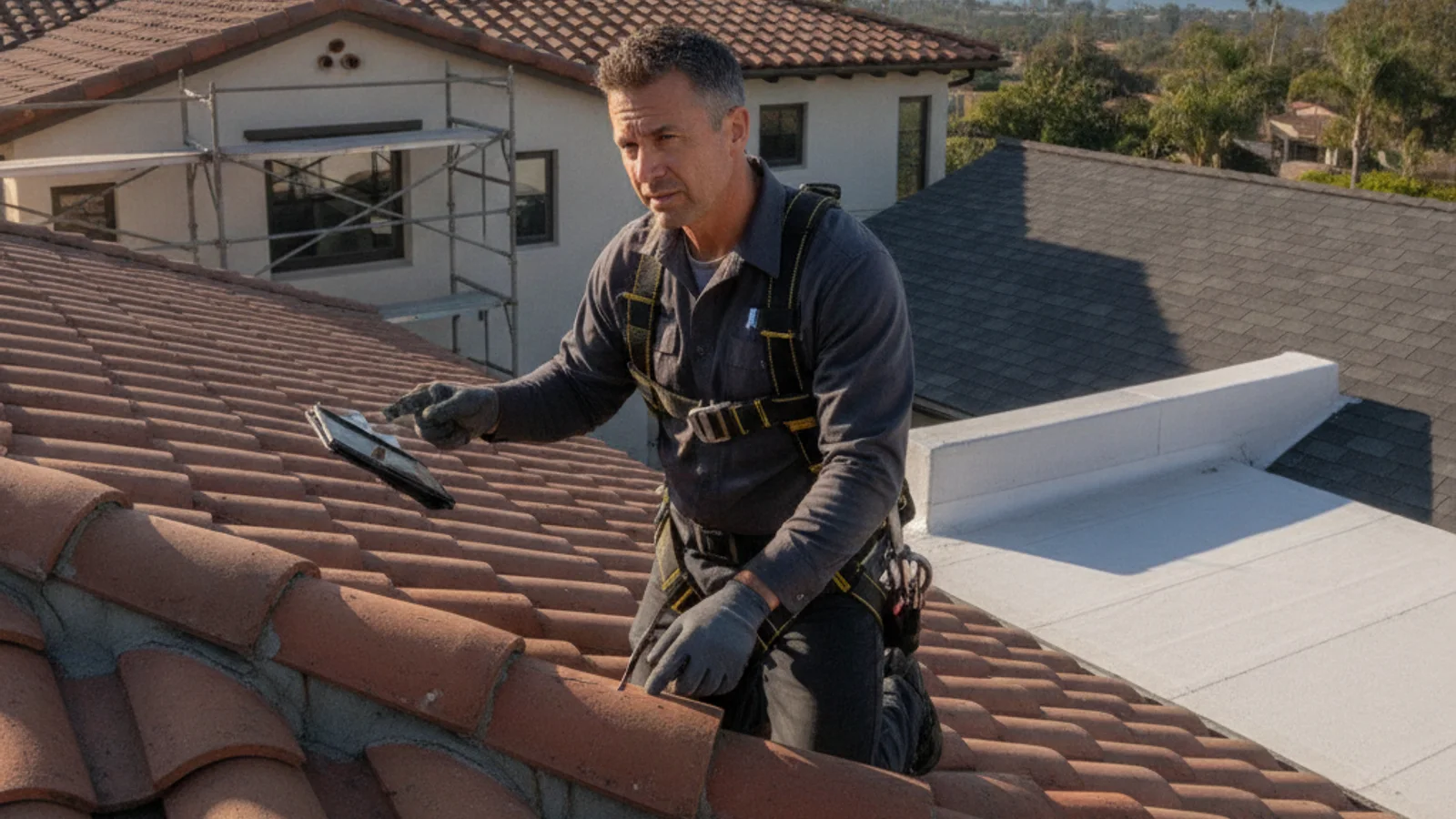
A general home inspector looks at the whole house. A roofing contractor’s inspection is a roof assessment: covering, flashings, drainage, attic, and what those findings mean for repair or replacement. In San Diego escrow, you need the second opinion when the first report leaves the roof open.
Top Pro Roofing SD is a referral service. We do not inspect, certify, or warrant roofs. Call (760) 750-5557 and we match you with a licensed independent C-39 professional. You contract with that person.
Quick comparison
| General home inspector | Roofing contractor (C-39) | |
|---|---|---|
| Job | Whole-property snapshot | Roof-focused assessment |
| Roof walk | Only if the signed agreement says so | Ask in writing before they arrive |
| Output | Report section on the roof, often with access limits | Photos, locations, cause vs maintenance vs replace |
| Certification | Not their document | Only if they agree to issue one, in their words |
| When it is enough | Clear scope, surfaces viewed, no open roof item | When the general report defers the roof or a lender asks for a roof document |
Use our San Diego roof inspection checklist to see what is still unanswered. It is a discussion list, not proof that a particular inspector skipped required work.
What the general home inspector actually does with the roof
Read the inspection agreement before you assume they will walk the roof, enter every attic, or name a leak cause.
The written report beats a hallway summary. Look for notes on surfaces, drainage, penetrations, flashing, ceilings, and accessible attic. Photos should show where. A photo proves what they saw. It does not prove what they could not reach.
Access language is the confidence rating. “Viewed from ground,” “viewed from ladder,” “not walked,” and “limited visibility” mean large parts of the roof were not inspected. The report can still be accurate for what was visible.
Read recommendations literally. “Further evaluation by a licensed roofing contractor” means this inspection did not close the roof. It is not a diagnosis, a repair bid, or a certification.
California sources we used for this page do not set one universal roof scope for every home inspector. The signed agreement and the finished report control what you bought. Ask the inspector to list excluded areas and unresolved findings in writing.
Scan attic, ceiling, exterior, and drainage sections too. Moisture notes often sit outside the heading labeled “roof.” If those notes conflict, ask before you treat the roof as clean.
What a C-39 roof assessment covers that the general pass does not
California’s C-39 classification covers work that seals, waterproofs, and weatherproofs structures. That is the trade you want when the general report leaves a roof question open.
Do not assume every “roof inspection” is the same. Ask how they will view the covering, edges, gutters, flashing, penetrations, and the underside. Confirm attic access, photographs, a written report, repair vs replace language, and whether anyone asked for a certification.
Ask what is out. Weather, tile that should not be walked, and the contractor’s judgment on site can limit access. Material lifts, cores, moisture meters, and opening assemblies are extra unless they are in the scope.
The useful difference is diagnosis. The general report may show staining, a slipped tile, or an area they could not see. The roofer should say whether that looks like an active leak, an old event, maintenance, a repair, or a replacement talk.
Findings should tie the symptom to the next step. Photos need locations. Repair items should be separate from “monitor.” If they cannot confirm a cause without opening the roof, the report should say so.
Tile is a special case. The visible tile is not the whole assembly. If the report hints at a failed sheet underneath, read tile roof underlayment failure signs before you approve destructive access.
Permit talk needs a jurisdiction. City of San Diego reroof rules can turn on framing, sheathing weight, covering weight, and historic status. Those rules do not automatically apply in the unincorporated county or in another city. The building department decides permits. The contractor describes recommended work. Keep those roles apart.
Service page: roof inspection.
What a roof certification is, and is not
A certification is not automatically the same as an inspection report. We did not find a single statewide form, duration, or warranty behind every document with that name. The contractor’s exact wording controls.
If a lender, insurer, buyer, or seller wants a “certification,” ask that party what paper they mean. Then ask the roofer what they will sign, what inspection supports it, and what is excluded. Same nickname, different scopes.
Read address, roof areas, stated condition, exclusions, term, and who signed. Ask whether repairs must happen first. Ask whether it covers the whole roof or only named planes.
Do not treat the word “certification” as a warranty. Ask whether any warranty exists, who issues it, what it covers, and whether it transfers. Top Pro Roofing SD issues none. We are not the inspecting contractor.
A short condition letter is not a substitute for photos, access notes, and repair detail when you are deciding on a contingency. Ask for the supporting inspection report. More on the document itself: roof certification for a San Diego home sale.
When the general home inspection is enough
It can be enough when the roof scope was clear, the relevant surfaces were viewed, and no roof item is left open. That call is yours. Use the report, disclosures, invoices, and any lender or insurer demand.
Match old permits and invoices to the roof you are looking at. A paper on file does not mean it covers every plane or today’s condition.
If access language is vague, ask the inspector to clarify. Silence is not a clean finding.
Climate is context, not a diagnosis. NOAA normals for this county are often cited from Lindbergh Field. Coastal, inland valley, and mountain roofs take different weather. Tie questions to this address and what you can see.
You can also accept remaining uncertainty on purpose. A roof visit is not mandatory just because it exists. It is useful when missing roof facts could change your price, your repair request, or whether you stay in the deal.
When to bring in a roofer before you drop the inspection contingency
Bring a C-39 in when the general report defers the roof, limits access, notes moisture, or says “further evaluation.” Those lines mean the roof file is not done.
Same if records and the roof disagree: a partial reroof invoice, a repair with no location, a disclosure that does not match a stain.
Mixed roofs need a map. Sloped tile plus a low-slope addition, a patio cover, or a solar array may not have been equally visible. Ask which areas were examined and which were not.
Book early enough to read the write-up before your deadline. A conversation on the ladder is not the record.
If someone already asked for a certification, say so when you book. Inspection, certification, or both are different deliverables.
Wildfire rules can matter. California Building Code Chapter 7A applies in designated Wildland-Urban Interface areas. Confirm designation with the local authority. Do not guess from the view.
If the talk turns to replacement, confirm address-specific permit and product rules before you accept a scope. City of San Diego is not the same as every other city in the county.
How to verify the person on the roof
Get the legal name and C-39 number. Look them up on the CSLB license check. Status, complaints, and bond information are public.
California Business and Professions Code Section 7125 requires C-39 contractors to keep workers’ compensation or self-insurance on file with CSLB. Check the board, not only a verbal “we’re covered.”
Match the license record to the name on the inspection scope. Ask who will be at the house, who writes the report, and who would sign a certification. Keep those names with the escrow file.
How to read the record: licensed roofing contractor CSLB guide. Sales-pressure patterns: roofing contractor red flags.
Get terms in writing: areas, access method, deliverables, exclusions, certification if any. Ask how they will describe conditions they could not open. Confirm their charges with them. We do not set inspection prices.
When to call us
Call when the general inspection leaves the roof unresolved: a contractor referral, limited access, a stain nobody explained, records that do not match, or a requested roof certification.
Have the address and the exact report language ready. Mention access limits, visible concerns, any certification request, and your contingency date.
Call (760) 750-5557. We connect San Diego County buyers and sellers with licensed independent roofers. The matched professional confirms scope, timing, and charges with you.