The short answer
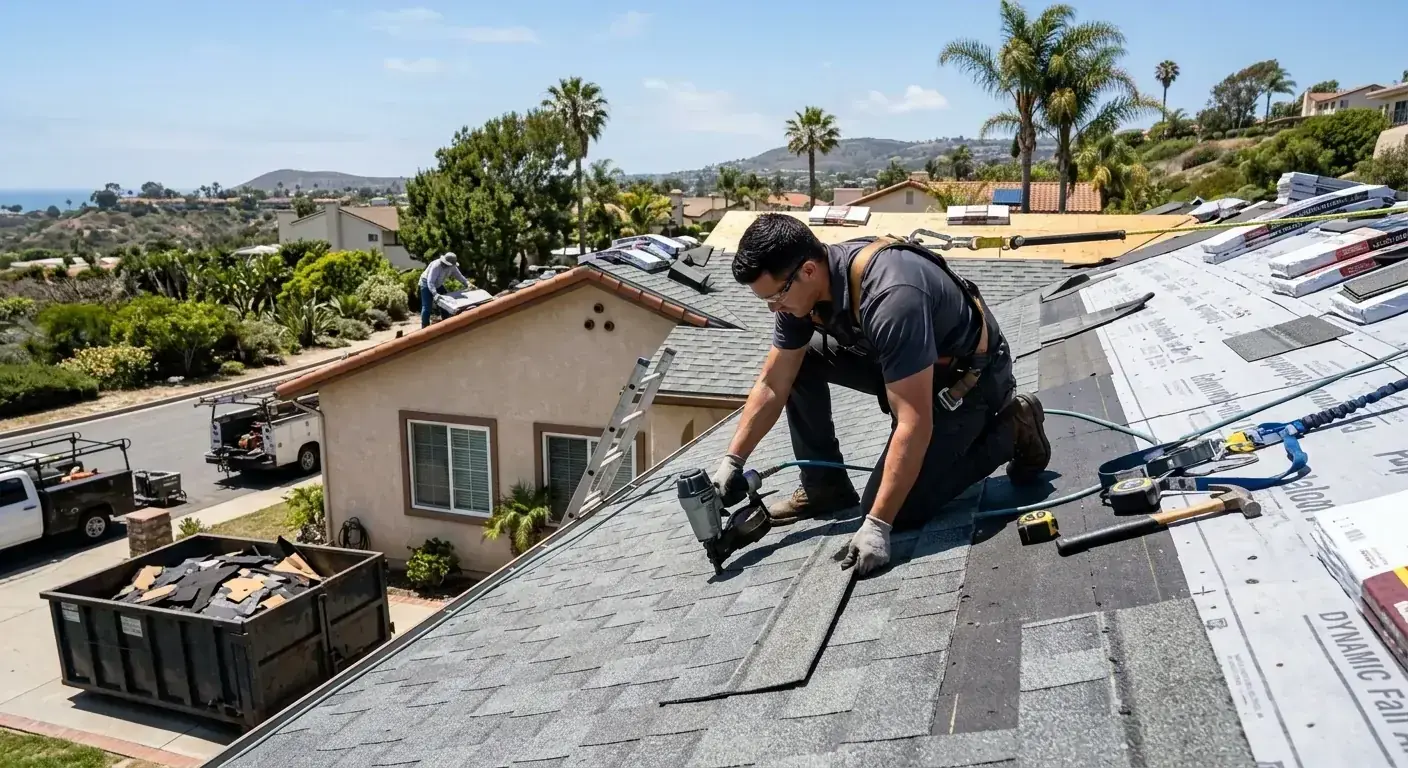
Overlay (a roof recover) means new covering over the old one. Tear-off (roof replacement) means the old layers come off down to the deck. In the California Residential Code, those two paths are CRC Section R908. The commercial analog lives in California Building Code Chapter 15.
Confirm layer limits with the authority having jurisdiction (AHJ) for the parcel: City of San Diego Development Services, another incorporated city, or the County for unincorporated areas such as Spring Valley. Local amendments, fire-hazard maps, and the adopted code cycle can be stricter than the statewide baseline. A blog cannot sign your permit.
Under CRC R908.4, a recover is not permitted where the existing roof is water-soaked or too deteriorated to be a base, where the covering is slate, clay, cement, or asbestos-cement tile, or where the existing roof already has two or more applications of any type of roof covering. Other recovers can be allowed when the manufacturer’s instructions and the rest of R908.4 are met. Standing-seam systems that carry load to the structure without relying on the old covering are a listed recover path, not a free pass to skip the AHJ.
Even when overlay is legal, tear-off is usually the better roof: you see the deck, you replace flashings honestly, and manufacturer warranties are less likely to shrink. We will not invent a dollar gap. Top Pro Roofing SD refers. We do not install. Call (760) 750-5557.
Shingle aging: what deteriorates asphalt shingles in San Diego. Permits: roof permit process in San Diego.
If a quote leads with overlay as the cheap option, ask why. The right answer names code eligibility, manufacturer permission, budget, and the warranty trade. The wrong answer is that it is easier for the crew.
What California code actually says (baseline, not your permit)
Read the edition your AHJ has adopted. California is on a Title 24 cycle. Cities and the County adopt and amend. The 2025 CRC R908 text is the current statewide residential baseline as published; your job may still be on an earlier adopted cycle until the local adoption date.
Replacement vs recover
R908.3 Roof replacement. Replacement includes removal of existing layers of roof covering down to the roof deck, with narrow underlayment exceptions in the code text (ice barrier or self-adhered underlayment that is still sound).
R908.4 Roof recover. Installing a new covering over an existing covering is permitted where the listed conditions occur, including installation per the roof covering manufacturer’s approved instructions. Separate complete systems (the code names standing-seam metal as an example) that do not rely on the old covering for support shall not require removal of existing coverings. Metal panel, metal shingle, and concrete or clay tile over wood shake have their own recovering rule in R908.4.1, including combustible concealed-space protection. Some coatings over existing membranes are also listed.
When a recover is barred (CRC R908.4 exceptions)
A roof recover shall not be permitted where:
- The existing roof or covering is water-soaked or deteriorated so it is not an adequate base for more roofing.
- The existing covering is slate, clay, cement, or asbestos-cement tile.
- The existing roof has two or more applications of any type of roof covering.
That third item is why people say “two layers max.” It is the CRC recover stop. It is still not a substitute for the AHJ. A fire-zone jurisdiction may require a listed Class A assembly that you cannot prove with an overlay. A city may demand tear-off documentation. The inspector on your street is the one who signs.
Manufacturer permission is a second gate
Code can allow a recover while GAF, Owens Corning, CertainTeed, or a metal producer restrict or void the system warranty on overlay. Ask for that in writing. A recover that kills the warranty is a different product than the brochure.
Structure still has to take the load
R908.2: the structure must support the covering and the installation loads. Two layers of shingle add dead load. Pre-1970 framing in Mission Hills, Kensington, Talmadge, Hillcrest, and Old Town was not designed as a stacking exercise. Solar, HVAC curbs, and tile conversions make that worse. The matched roofer and, if needed, a design professional own that call.
Permits
Reroof work that needs a permit is pulled in the jurisdiction of the property. Fees, inspection sequencing, and whether they want photos of the deck vary. We will not invent a fee table. Start with the city’s building portal or, for unincorporated parcels, County Planning & Development Services. The installer of record should be a C-39 you can check at CSLB.
Why tear-off is almost always the right call
Legal overlay is not the same as a good roof.
You bury what you cannot see
Aged flashings, cooked pipe boots, tired valleys, and soft deck do not improve under a second layer. A year later the leak is harder to find because you have two coverings. Sometimes the repair is a partial tear-off of the new layer. Age context: is a 20-year-old roof too old.
Heat and an uneven base shorten shingle life
Two layers hold more heat. Old shingles are not a flat nailing surface. Fastener pull-through is worse. Ventilation details can get messier. You trade a lower first check for fewer years. We will not invent a 25-35 percent chart. The matched roofer can compare warranties and expected service on your actual roof.
Warranties often shrink
Major shingle producers commonly limit overlay to material-only terms or refuse the full-system program. Some want an installer attestation most careful C-39s will not sign. Read the current warranty, not a 2018 PDF.
Insurance and resale
Carriers ask about layer count. A two-layer roof can mean a harder renewal or a buyer who prices in a future tear-off. California insurance context: does homeowners insurance cover roof leaks. Confirm with your carrier. Do not use this page as a coverage opinion.
When overlay can still make sense
- You are selling soon, the deck is sound, the AHJ will permit the recover, and the buyer will inherit the next decision.
- The building is short-hold (pending demolition or a known conversion).
- Budget is hard-capped and the alternative is an active leak with no covering.
- The existing asphalt is young, flat, one layer, manufacturer-approved, and the AHJ agrees. Rare, and still a warranty conversation.
Otherwise, tear off.
How to compare quotes without a fake price
Ask both bids to line-item:
- Permit and inspections
- Layer count found on the roof
- Tear-off vs recover, with the code section they are using
- Deck repair unit price
- Underlayment, flashings, boots
- Material and warranty form (full system vs material only)
- Haul-away
If overlay is cheaper, it is because labor and dump fees dropped, not because physics improved. Cost-per-year only works if the overlay actually lasts. Many do not.
Countywide replacement drivers: 2026 new roof cost in San Diego. Repair vs replace: repair vs replacement.
Frequently asked questions
Can I overlay tile, metal, or wood shake as if they were shingles?
Do not assume yes. CRC bars recover over slate, clay, cement, and asbestos-cement tile. Wood shake recovering has extra fire-safety rules. Some metal systems can go over an existing covering when they are a complete system per R908.4. Your AHJ and the manufacturer still have to agree. Tile lift-and-relay is not an asphalt overlay. It is a different scope.
How do I know if the roof already has two layers?
Look at the drip-edge thickness from the ground. In the attic you may see stacked edges. The certain way is a licensed roofer lifting a course and counting. Roof inspection.
Does the City of San Diego require tear-off every time?
The City adopts California codes with local procedures. Overlay is not automatically banned, and it is not automatically approved. Fire-zone assembly verification is harder with a recover. Ask DSD and the inspector of record. Other cities (Chula Vista, Carlsbad, Oceanside, Encinitas, Del Mar, Solana Beach) and the County each run their own counter.
Will my HOA care?
CC&Rs usually police color and profile, not layer count. Transfer inspections and insurance can still trip on a two-layer roof. Read the CC&Rs.
Does overlay save money on the permit?
Usually no. Permit cost follows the job and the jurisdiction, not the dumpster.
The bottom line
CRC R908 is the statewide residential starting point: replacement to the deck, recover only where R908.4 allows it, and no recover over two or more existing applications. Confirm the layer limit and recover eligibility with the AHJ for that address. Then read the manufacturer warranty. Then decide if burying the old roof is actually cheaper.
If overlay is on the quote, ask the roofer to write lifespan, warranty, layer count, and resale implications next to the tear-off bid. The honest version of that conversation usually ends at tear-off.
Call (760) 750-5557 and we’ll connect you with a vetted local roofer. Top Pro Roofing SD does not pull permits and does not install.