Most San Diego ceiling stains trace to a flashing or a penetration, not the shingle or tile field. Start at pipe boots, step flashing, and tiles that took foot traffic. Then work down the list. Top Pro Roofing SD is a referral service. We do not diagnose from photos as a licensed contractor, and we do not publish repair prices. Call (760) 750-5557 for a match with a licensed independent roofer.
Coastal salt and inland attic heat change which item fails first. They do not change the rule: water enters where the roof meets something else.
Related: best roof material for coastal climates.
The ten causes at a glance
Fix difficulty is for a licensed C-39, not a homeowner on a ladder. Stay off tile.
| Rank | Cause | What usually fails | Typical difficulty |
|---|---|---|---|
| 1 | Pipe boot and vent flashing | UV-cracked rubber collar | Isolated boot swap |
| 2 | Step flashing or chimney counter-flashing | Salt-corroded metal, open sealant | Wall or masonry work |
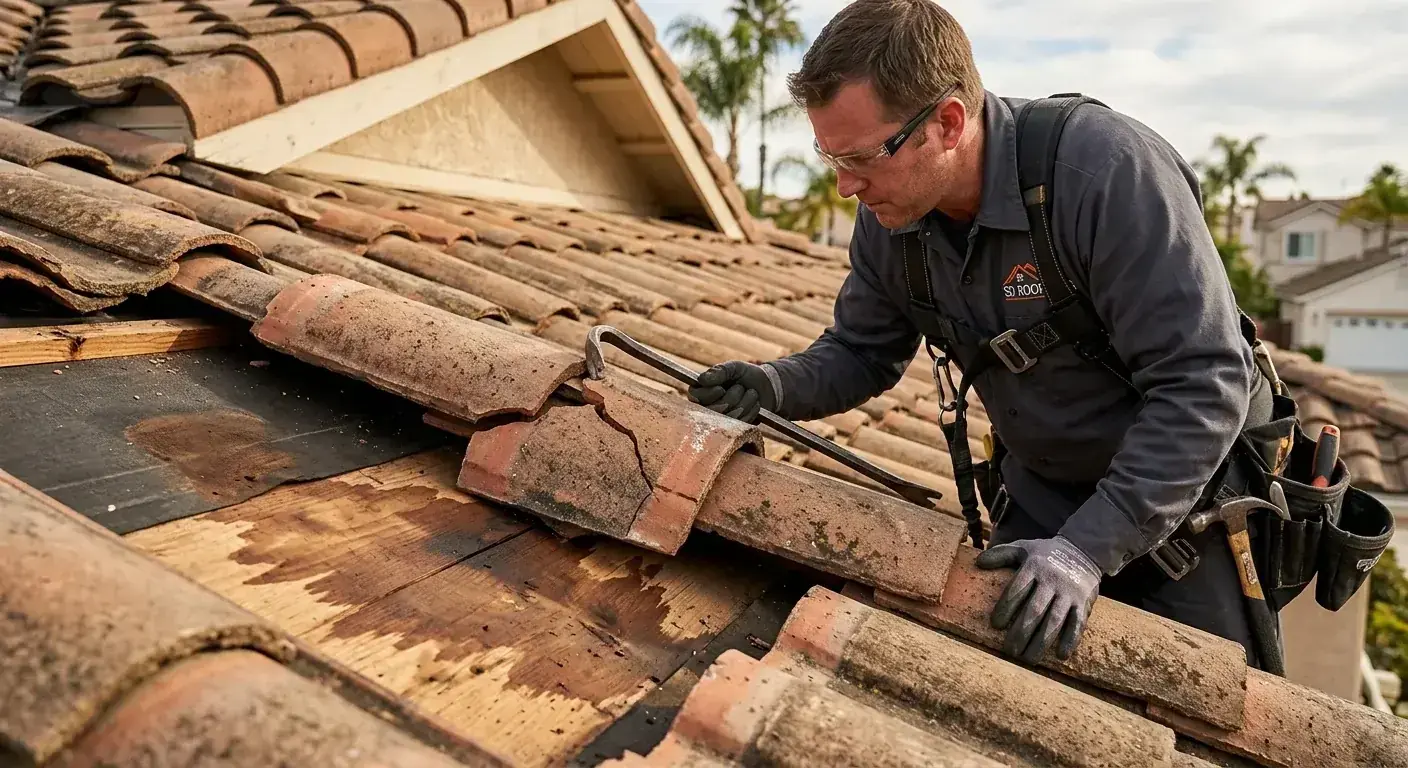
| 3 | Tile slip and broken tile | Foot traffic from other trades | Tile and sometimes underlayment |
| 4 | Solar mounting feet | Unflashed L-feet from older arrays | Panel detach and reflash |
| 5 | Skylight flashing | Aged curb kit and clogged diverter | Reflash or unit swap |
| 6 | Valley metal | Rusted galvanized channel | Strip and reset the valley |
| 7 | Eucalyptus and pine debris | Dams in valleys and gutters | Clear, then keep a cadence |
| 8 | Aged tile underlayment | Felt past its service | Lift-and-relay, not a dab of cement |
| 9 | Old mounts and clips | Dish, camera, holiday clips | Remove and patch |
| 10 | Failed field material | End-of-life covering | Replacement conversation |
Homes within about a mile of the ocean often see flashing and valley metal go first. Inland valleys often see rubber boots go first. We will not attach 2026 dollar ranges to any row. Those belong on a written bid for the address.
1. Pipe boot and vent flashing failure
Every plumbing vent and many bath fans use a flange with a rubber or thermoplastic collar. On a south or west slope, UV cooks that collar. The split is hard to see from the driveway.
Signs: A round ceiling stain under or a few feet down-slope of a vent. Same spot on heavy rain.
Fix: Replace the boot. Lead-flashed or long-life EPDM collars beat roofing cement on a dead boot. Cement is a short stall.
2. Step flashing or counter-flashing corrosion
Where the roof meets a chimney, dormer, or wall, step flashing weaves with the courses. Counter-flashing locks into the wall. Galvanized metal in salt air corrodes. Sealant in the reglet opens.
This shows up in Coronado, Imperial Beach, Ocean Beach, La Jolla, Encinitas, and Cardiff more than in Ramona.
Signs: Stain near a wall or chimney. Sometimes only on wind-driven rain.
Fix: Strip, replace with a metal the bid names (often painted aluminum or stainless), reset counter-flashing. Chimneys may need masonry work at the reglet.
3. Tile slip and broken tile from foot traffic
Concrete and clay tile are not walkways. HVAC, solar, dish, and chimney crews crack tiles. The leak can wait a season or two.
Signs: Stain after a service visit, even years later. Cracked, slid, or rotated tiles.
Fix: Replace broken pieces. On 1920s-1940s Spanish Revival in Mission Hills, Kensington, and Mission Beach, matching clay is the hard part. Ask the bidder how they will match, in writing.
Related: tile roofing.
4. Solar mounting foot leaks
Many 2010-2018 arrays used sealant at L-feet instead of a flashed kit. The lag becomes a leak. Decking can rot before the ceiling shows it.
Signs: Stain under or down-slope of the array. Water can travel along the deck and drop at a wall.
Fix: Detach the affected module row, pull the foot, install a flashed mount, repair deck if needed. The independent roofer should say who handles panel reset.
Fuller write-up: do solar panels damage your roof.
5. Skylight flashing breakdown
Factory flashing kits age. The curb-to-roof seal, upper apron, or rear diverter fails. Mid-century homes in Mission Hills, Hillcrest, and Kensington often still have 1970s-1980s kits.
Signs: Stain around the well, drip at the interior frame, wet that looks like condensation but tracks to the curb.
Fix: New flashing kit, or a new unit if the frame is done. Ask the bid to separate glass, curb, and roofing.
6. Valley flashing failure
Two slopes meet. Water concentrates on the valley metal. Galvanized open valleys rust through. Then water is under the covering.
Signs: Stain in the room under the exterior valley. Often heavy rain only.
Fix: Strip back, replace the metal, reset the covering. Not a tube of caulk.
7. Eucalyptus and pine debris dams
Mission Hills, Kensington, Talmadge, La Mesa, Spring Valley, Lemon Grove, and some Coronado streets sit under heavy canopy. Debris packs valleys and gutters. Water is forced under laps.
Signs: Stain after a long rain or an atmospheric river. Visible piles in valleys from a second-story window.
Fix: Clear, add splash protection if the geometry needs it, and trim the canopy if the tree is the real dam. Fall, before the first hard rain, is the practical window.
8. Improper or aged underlayment
On tile, the covering can look fine while the felt or later underlayment is finished. One broken tile then has no second layer.
Signs: Several unrelated stains in one season. Recent patches that fail again. Crumbling felt when a tile is lifted.
Fix: Lift, replace underlayment, relay tile. That is a system job. See 2026 tile roof replacement cost context for process, not a copied price.
9. Improper penetrations from past service work
Dish brackets, antennas, cameras, holiday clips. Each screw is a path. Sealant does not last.
Signs: Stain with no chimney or vent above it. Old hardware on the roof.
Fix: Remove the hardware, patch or replace the covering, check the deck around the holes.
10. Failed roof field material
This is what people assume. It is the last place to look if boots and flashings are sound. Widespread granule loss, many tile fractures, or a blistered membrane usually means the covering is at the end of its life, often with underlayment gone too.
Fix: Replacement conversation, not a patch. See repair versus replace and new roof cost guide for decision structure. We still will not invent a county price.
How microclimates shuffle the order
| Region | Often first | Why |
|---|---|---|
| Coast (Coronado, IB, OB, La Jolla, Del Mar, Encinitas, Cardiff, Carlsbad, Oceanside) | Step flashing, chimneys, valleys | Salt on galvanized metal |
| Inland valley (Poway, Escondido, San Marcos, Vista, El Cajon, Scripps Ranch) | Pipe boots | Attic heat and UV on rubber |
| East County and mountain (Ramona, Alpine, Jamul, Julian, Lakeside) | Displaced tile, lifted edges | Santa Ana gusts and debris |
| Mature-tree neighborhoods (Mission Hills, Kensington, Talmadge, La Mesa) | Valley dams | Eucalyptus and pine |
| Homes with older solar | Mounting feet | 2010s penetrations |
Frequently asked questions
What is the most common cause of roof leaks in San Diego?
Start with pipe boots on UV-aged roofs, then flashing at walls and chimneys, then broken tile. The field is usually last. We do not have a measured county percentage to publish. Frequency talk on this page is diagnostic order, not a study.
Can I find a roof leak myself?
From inside, find the highest point of the stain. From the ground, look up-slope for the nearest vent, chimney, skylight, or wall. A zoom photo can show a split boot or a cracked tile. Do not walk tile to confirm it.
Why does my roof only leak in heavy rain?
Marginal flashing can shed light rain and fail when volume or wind pushes water past the remaining seal. That is why an atmospheric river can look like a “new” leak.
Does homeowners insurance cover roof leaks?
Sudden damage from a covered peril is a policy question. Wear and skipped maintenance usually is not. Read your policy and the current California Department of Insurance residential guides. We will not restate Insurance Code holdings here. Overview: does homeowners insurance cover roof leaks in California. This site does not decide claims.
Will a tarp work as a short-term fix?
A tarp that is fastened up-slope and drained correctly is mitigation. A blue sheet with bricks is not. See emergency tarp and emergency roof repair.
How do I find the source of an active leak?
Trace the stain, measure from a known wall or window, inspect that area from the ground, then have a licensed roofer on the slope. Moisture meters and infrared are tools they may use. They are not a DIY kit.
How much does it cost to fix a roof leak in San Diego?
We will not publish boot, flashing, valley, or lift-and-relay dollar ranges. Ask the written quote to name the cause, the repair, and any stop-and-approve extras if decking is wet.
When to call vs. when to wait
Call soon if water is dripping, the stain is growing, you can see daylight from the attic, or tiles and shingles are obviously displaced after a storm.
You can wait for business hours if the stain is old and stable, it has not rained, or you are booking a planned inspection.
For active water, emergency roof repair is the service page. For a planned visit, roof leak repair and roof inspection. Related: repair versus replace and how long a roof lasts in San Diego.