The short answer

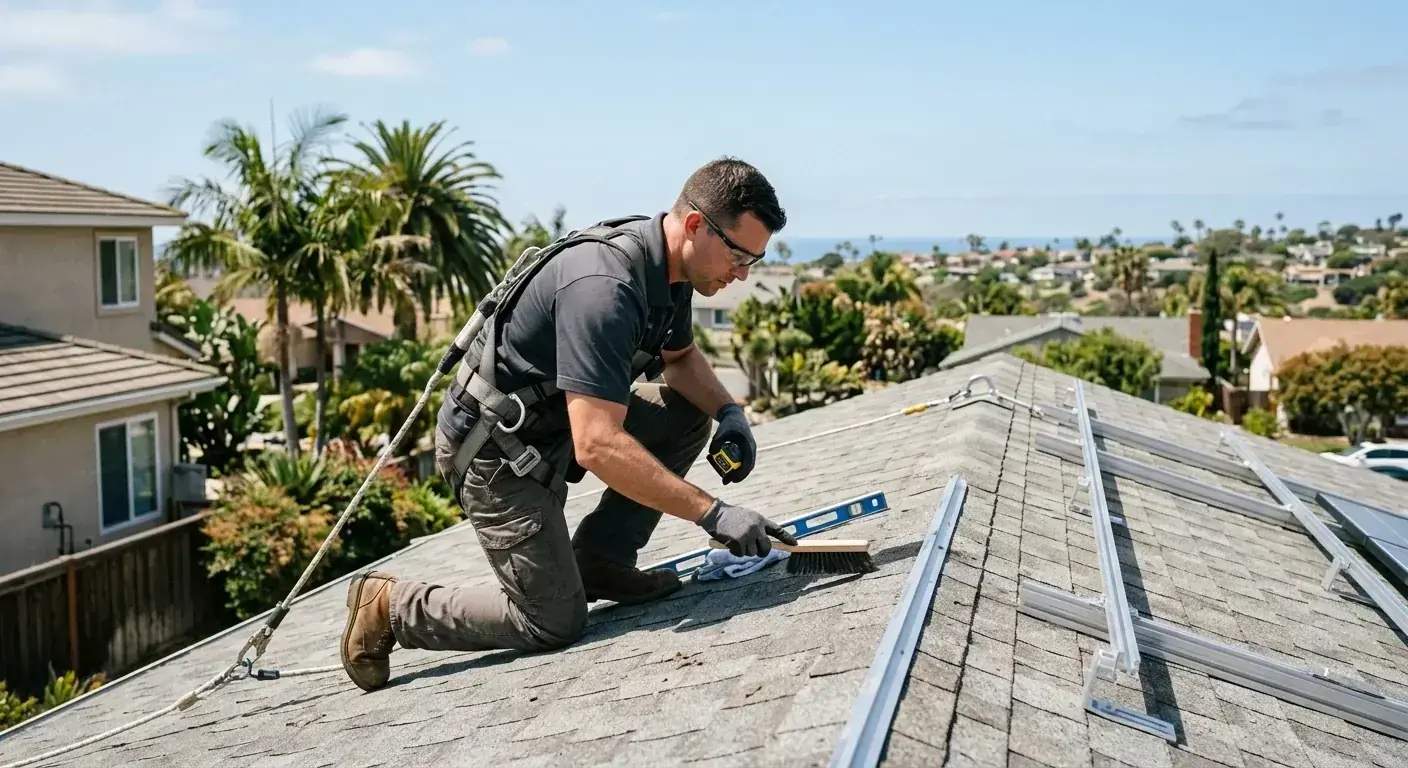
Solar panels don’t damage your roof. The mounting hardware does, when it’s installed wrong or nobody plans for the roof replacement underneath. In San Diego the three failures we see most are mounting-foot leaks, wind uplift on coastal and inland arrays, and underlayment that ages out before the panels do.

Those mounting feet leak 10 to 15 years in. Santa Ana wind walks corner panels loose. And a full tile lift-and-relay runs $4,000 to $9,000 on top of the panel work. The full breakdown on why San Diego homeowners are getting rid of solar panels goes deeper, and if you’re installing fresh, start with how to prepare your roof for solar in San Diego.

Solar is a great long-term investment in San Diego. The state has the highest residential solar penetration in the country, and California Title 24 Part 6 has required solar-ready (and in most cases, solar-installed) construction on new single-family homes since 2020.

But the people selling you solar are not the same people who fix your roof. And the way most arrays get installed in San Diego County, the roof is going to fail before the panels do. That’s a real problem when your roof underlayment has a 25-year life and your panel system is warrantied for 25 years.

Here’s what we actually see on roofs across La Jolla, Encinitas, Poway, Scripps Ranch, and East County, ranked by how often it shows up.

The five ways solar installs go wrong on San Diego roofs

After thousands of inspections on homes with rooftop solar reported by roofers in our network, the failures fall into five categories.

1. Mounting foot leaks (most common)

Every traditional racking system uses a “mounting foot” or “L-foot” lag-bolted into a rafter, sealed with a flashing kit. On asphalt shingle, the flashing tucks under the upper course and over the foot. On tile, the foot lifts the tile and seats into a tile-replacement flashing called a “tile hook” or “comp-out” plate.

When the installer skips the proper flashing kit and relies on roof sealant alone, that seal fails in 8 to 15 years. Sealant is not a roof. By the time it’s leaking visibly through your ceiling, the deck below the foot has been wet for months.

We pull mounting feet on coastal Encinitas and Cardiff homes and find rotted plywood under panels installed less than a decade ago. The panels look fine from the curb. The deck is mush.

2. Underlayment aging out before the panels do

This is the biggest financial trap and almost no homeowner sees it coming.

Your solar panels are warrantied for 25 years. Your tile roof’s clay or concrete tile lasts 50-plus years. But the underlayment beneath the tile, which is the layer actually keeping water out, lasts 25 to 30 years. On a roof that was 10 years old when solar was installed, the underlayment will fail at year 25 of the panels. For more on this, see 2026 tile roof replacement cost in San Diego.

At that point, the only fix is a tile lift-and-relay: remove the panels, remove the tile, replace the underlayment, re-lay the tile, reinstall the panels. The cost in 2026 dollars for a 2,000 sq ft home with a 5-kilowatt array runs $14,500 to $22,000 for the roof, plus $2,500 to $6,000 to detach and reset the solar.

Total surprise expense: about $20,000 on a roof you thought had decades left.

3. Edge uplift after Santa Ana events

San Diego gets two to four serious Santa Ana wind events a year, typically October through February, with peak gusts in inland areas like Ramona, Alpine, Jamul, and Valley Center routinely hitting 60 to 80 mph. The far edges of a rooftop array catch the most uplift force. If the engineer didn’t size the edge attachments correctly, or if the rail spans are too long, the corner panel walks loose.

We see this most in East County and any home above 1,500 feet elevation. The repair is not just resetting a panel. It usually means new flashing, new mounting feet, and inspecting every other foot on the array for fastener loosening.

4. Pipe-boot and penetration leaks the solar installer “didn’t touch”

Solar installs almost always run conduit through a new roof penetration somewhere. That penetration needs a proper boot, flashing, and counter-flashing, exactly like a plumbing vent. A surprising number of installers caulk and call it done.

When the leak shows up two winters later in the ceiling of a hallway 15 feet from any panel, the solar company tells you to call your roofer. The roofer charges $400 to $900 to fix it. The homeowner pays. Nobody mentions that the same installer probably did this on every roof on the cul-de-sac.

5. Warranty conflicts that nobody mentions in the sales pitch

This is the one homeowners never see in the contract. If your roof has a manufacturer warranty from GAF, Owens Corning, CertainTeed, or any other major shingle maker, attaching solar panels with the wrong fastener pattern or the wrong sealant can void it. The warranty fine print typically requires that any roof penetration be made by a certified roofer using manufacturer-approved flashing.

We have read warranty docs where the installer must be a CSLB-licensed C-39 roofer, not a C-46 solar contractor, for the warranty to remain active. The homeowner finds this out 12 years later when they file a claim for hail damage and get denied because the panels were installed by a solar-only crew.

Mounting method risk by roof type

Not every attachment method carries the same risk. The mounting hardware decides whether your roof leaks in year 12 or stays dry for the life of the array. Here’s how the common San Diego methods compare on leak risk, lifespan, and warranty impact.

Mounting methodRoof typeLeak riskTypical lifespanWarranty impact
Flashed L-foot (flashing kit)Asphalt shingleLow25 to 30 yearsPreserves warranty if a C-39 roofer flashes it
Sealant-only lag boltAsphalt shingleHigh8 to 15 yearsOften voids manufacturer warranty
Tile-replacement flashingConcrete or clay tileLow25 to 30 yearsPreserves warranty when tile is swapped for a flashing plate
Tile hook through sealed tileConcrete or clay tileMedium to high10 to 18 yearsRisks voiding warranty if tile is drilled, not replaced
S-5! seam clampStanding seam metalVery low30 plus yearsNo penetration, no warranty conflict
Ballast (no penetration)Flat or low-slopeVery lowRoof lifespanNo penetration, but adds dead load

The pattern is simple. Anything that relies on sealant instead of a flashing plate is the part that fails. On tile, the safest installs replace the displaced tile with an engineered flashing plate rather than drilling through and caulking. Standing seam metal is the lowest-risk roof to put solar on, which is why we tell homeowners replacing a roof anyway to consider it.

Roof warranty void specifics

The warranty conflict is the one nobody reads until they file a denied claim. Most major shingle warranties stay valid only if a qualified roofer makes the penetration with approved flashing. Here’s what voids each common manufacturer warranty in San Diego and what keeps it intact. Always read your own warranty document, since terms change by product line.

ManufacturerWhat commonly voids itWhat keeps it valid
GAFPenetrations sealed by an unlicensed crew, non-approved flashingPenetration by a qualified roofer using GAF-approved flashing
Owens CorningUnauthorized roof modification, sealant-only mountsApproved flashing kit, documented qualified installer
CertainTeedDrilling without manufacturer-approved hardwareApproved mounting hardware, penetration by a certified roofer
Generic builder warrantyAny third-party penetration on a new-construction roofCoordinating the install with the original roofer before drilling

The denial usually surfaces years later. A homeowner files a hail or wind claim, the manufacturer inspects, finds solar feet bolted through with sealant and no approved flashing, and denies the whole roof. The fix that would have cost nothing at install becomes a full out-of-pocket replacement. If your roof is near the end of its life, our breakdown of solar panel removal cost during a roof replacement in San Diego shows what the detach-and-reset actually runs.

”But the solar company guaranteed the roof for 25 years”

This is the part of the conversation that ages badly.

When you get a 25-year roof warranty from a solar installer, ask three questions before you sign:

  1. Is the warranty backed by a third party, or is it the same company that installed the panels? Solar installers in California have a 5 to 8 year median lifespan as businesses. Some of the largest names from 2018 are gone. A warranty from a defunct company is a piece of paper.
  2. Does the warranty cover the cost to remove and reinstall panels when the roof needs repair or replacement? Most do not. They cover the leak. You pay for the panel work.
  3. Does the warranty cover the original roofing manufacturer’s warranty being voided? Almost none do.

Roof warranty conflicts are the silent killer of “free panel install” deals. By year 12, the math no longer works.

When solar genuinely does not damage your roof

We are not anti-solar. Top Pro Roofing has worked alongside good solar installers for years. Solar done right is invisible on the roof for the life of the array. Here’s what “done right” looks like in San Diego.

Roof age and condition before install

Install solar on a roof that has at least 20 years of life left after the install date. For asphalt shingle, that usually means a roof under 5 years old. For tile, the underlayment age matters more than the tile age. A good roofer can pull a tile, inspect the underlayment, and tell you in 15 minutes whether you have 5 years or 25 years left.

If the underlayment is more than 15 years old, replace it before solar. Pay the $14,500 to $22,000 now instead of $20,000 plus inconvenience later.

Flashed-mount hardware (not sealant-only)

Every mounting foot needs a real flashing kit appropriate for the roof type:

  • Asphalt shingle: Quick Mount PV, EcoFasten, IronRidge flashed feet, or equivalent. Look for a flashing plate that tucks under the upper course.
  • Concrete or clay tile: Tile-replacement flashing such as Quick Mount Tile, IronRidge BX, or a tile-hook with a galvanized base plate. The tile that gets displaced is replaced by a flashing plate, not just bolted through and sealed.
  • Standing seam metal: S-5! clamps that grip the seam without penetrating the panel. This is the easiest roof to put solar on if you are buying a new roof anyway.

Roofer-installed flashing on the day of panel install

The single biggest quality differential is whether the flashing work was done by a roofer or by the solar crew. Top-tier solar installers in San Diego sub the flashing to a CSLB-licensed roofer, or have an in-house roofer who handles every penetration. Lower-end installers have the same crew that mounts the panels do the flashing, with predictable results.

Ask your solar installer: who is doing the roof penetrations? If the answer is “qualified installers handle it,” ask whether any of them hold a C-39 roofing license. If the answer is no, hire your own roofer for the day of install.

Coordination on the future panel removal

A reputable solar installer will give you a written “panel-detach service” rate at the time of original install. That rate is locked in for the roof’s expected replacement window. We have seen detach-and-reset quotes range from $50 per panel (great) to $350 per panel (extortion) when the homeowner is calling out of the blue 18 years later.

Get the number in writing on day one. If the company is gone in 18 years, any roofer can detach and reset panels, but expect to pay closer to the high end without a pre-existing relationship.

How much does it cost to remove and reinstall solar panels for roof work?

For a typical San Diego home with a 5 to 7 kilowatt rooftop array (15 to 22 panels), here is the 2026 cost range for panel detach-and-reset during roof work:

  • From the original installer with a service agreement: $50 to $150 per panel, or $750 to $3,300 total
  • From a third-party solar service company: $150 to $250 per panel, or $2,250 to $5,500 total
  • As part of a full roof replacement with a roofing company that subs solar work: $2,500 to $6,000 total for a typical residential array

Add another $500 to $1,200 if conduit needs rerouting or if the inverter must be reset for monitoring.

Title 24, NEM 3.0, and what’s changed in 2026

California’s solar landscape has shifted twice in five years and most homeowners haven’t caught up.

Title 24 Part 6 requires new single-family homes built since January 2020 to have solar installed or have a community solar credit. That’s true in San Diego County and statewide. Translation: if your home was built or substantially remodeled after 2020, your roof was designed around solar from the start. If it was built before, your roof was not.

NEM 3.0 (Net Energy Metering 3.0) took effect April 2023 and cut the per-kilowatt-hour buyback rate for new solar customers by about 75 percent. The economics now lean heavily toward solar plus battery storage rather than solar alone. For our roofing customers, this matters because the array sizes are smaller and battery placement (often in the garage or on an exterior wall) changes how the system is wired into the roof.

SDG&E rate structures have made west-facing arrays more valuable than south-facing in some cases, because peak electricity rates in San Diego now run 4 p.m. to 9 p.m. We see more west-and-south split arrays in 2026 than we did even three years ago.

Specific San Diego County risks by region

Different parts of the county put different stress on a solar install. If your installer can’t articulate which one your roof falls into, you are not getting local expertise.

RegionPrimary RiskWhat to Specify
Coastal (La Jolla, Del Mar, Encinitas, Cardiff, Carlsbad, Coronado)Salt corrosion on rails, mounts, and fastenersAluminum rails, stainless or marine-grade fasteners, sealed conduit penetrations
Inland Valley (Poway, Escondido, San Marcos, El Cajon)UV-driven sealant failure, attic temps above 140°FHigher-grade EPDM flashing seals, ventilated attic check before install
East County (Ramona, Alpine, Jamul, Lakeside, Julian)Santa Ana wind uplift, fire zone code (CBC Chapter 7A)Edge clamps rated for 95 mph design wind, Class A fire rating maintained, WUI compliance
HOA-heavy (Scripps Ranch, Carmel Valley, Rancho Santa Fe)HOA design review denial, all-black panel mandatesAll-black modules, micro-inverters or hidden inverters, HOA approval before contract

Frequently asked questions

Does solar void my roof warranty?

It can. Manufacturer warranties from GAF, Owens Corning, CertainTeed and others typically require any roof penetration to be made by a certified roofing contractor using approved flashing. If your solar installer is not licensed for roofing work, the warranty may not survive the install. Check your roof’s warranty document before signing a solar contract.

Should I replace my roof before installing solar in San Diego?

If your roof has less than 15 years of useful life remaining, yes. A new shingle roof costs $14,500 to $22,000 in 2026. Removing and reinstalling a 5-kilowatt array later costs $2,500 to $6,000. You will spend the money once if you replace the roof first, and twice if you don’t.

Can a roofer repair a leak with solar panels still installed?

Some leaks, yes. Anything under the array requires detaching and removing panels to access. We charge our normal repair labor plus the panel detach-and-reset rate. Most coastal-zone leaks from mounting feet require panel removal because the leak is at the foot itself.

Who is liable when solar panels cause roof damage?

In California, the contractor who made the roof penetration is liable for damage caused by that penetration. If the solar installer holds only a C-46 solar license and not a C-39 roofing license, courts have ruled they were operating outside their license scope for the roofing portion of the work. Document who did the penetrations at install. The CSLB license lookup shows what each contractor is licensed for.

Are there San Diego installers who handle both the roof and the solar?

Yes, and it’s the recommended approach. Look for either a roofing contractor with an in-house C-46 solar division, or a solar company that subs the roof penetrations to a C-39 licensed roofer with documented training on flashing kit installation. We connect homeowners with vetted San Diego County roofers who coordinate with reputable solar installers and handle the roofing side of the install.

Does Title 24 require solar on every new roof in San Diego?

Title 24 Part 6 requires solar on new single-family homes built or permitted after January 1, 2020 in California, including all of San Diego County. There are exemptions for shaded roofs and small roofs. Major remodels that touch more than 50 percent of the roof can also trigger the solar requirement, depending on the jurisdiction.

The bottom line

Solar does not damage your roof. Bad installs damage your roof. A panel array sitting on a roof for 25 years is fine if the flashing is right and the underlayment was rated for the same lifespan as the panels.

If you’re shopping for solar in San Diego, the single most important question to ask is who is making the roof penetrations and what flashing kit they are using. If the salesperson doesn’t know, you are buying from the wrong company.

If you already have solar and you’re worried about leaks, schedule an inspection. A qualified roofer can usually tell you in one visit whether your roof is going to outlast your array or fail well short of it.

Need a second opinion on a solar install or planning a solar-ready roof replacement? Get a free roof inspection from Top Pro Roofing. We have walked thousands of roofs across San Diego County, and we will tell you straight whether the panels are doing what they’re supposed to do.