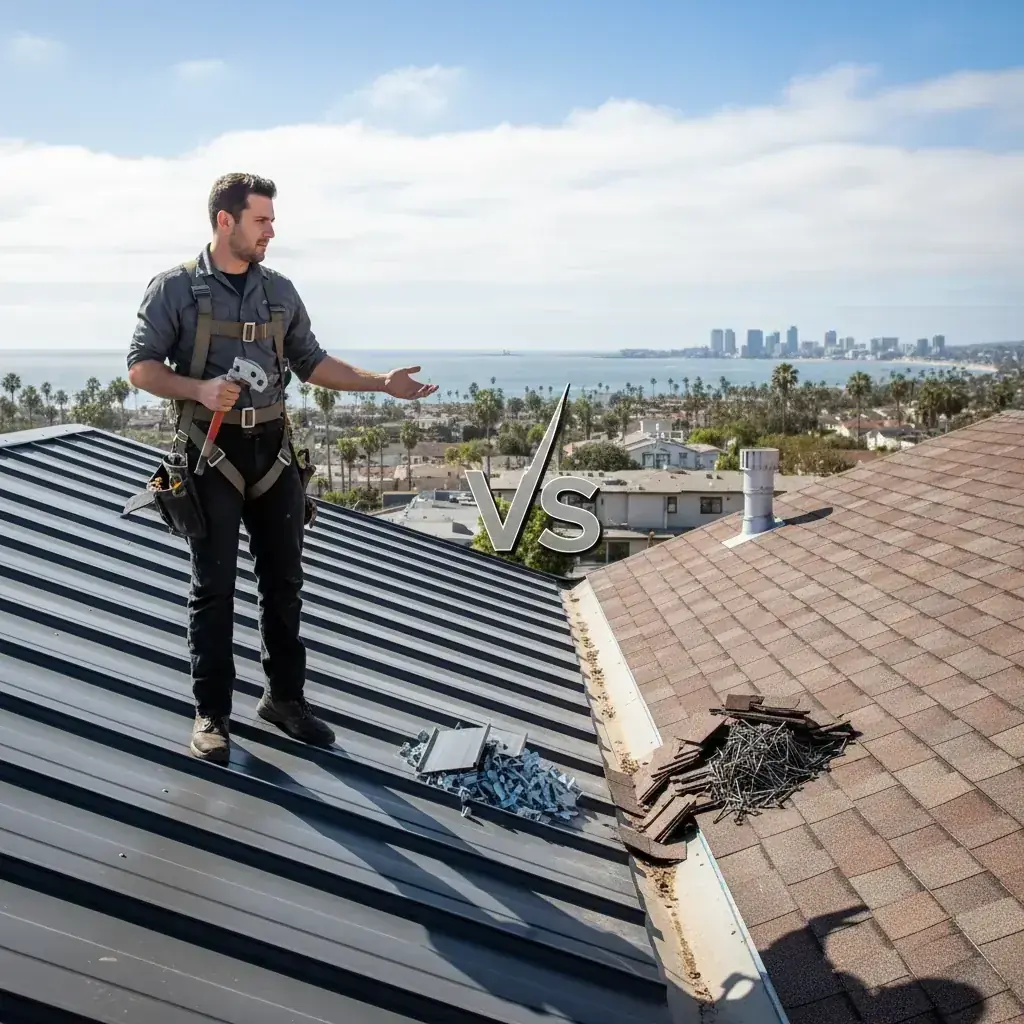
This page is the 50-year architectural shingle vs metal decision. It is not the 30-year vs 50-year shingle decision. Those two shingle tiers stay two products on a bid. Here the fork is asphalt system vs metal system.
The “50-year” stamp is a warranty class, not a stopwatch. Metal (usually standing seam in this comparison) is a different assembly: different attachment, different failure modes, different HOA and solar questions. We will not invent a county-wide year table or a cost-per-year spreadsheet. Ask a matched C-39 for both options on this roof. Top Pro Roofing SD refers. We do not install. Call (760) 750-5557.
Coastal homes in Coronado, Del Mar, and Encinitas, inland homes you plan to keep, WUI parcels, and any house pairing with solar should put metal on the table. Tight first check, short stay, or a CC&R that bans exposed metal push you back to a named premium shingle, not to mixing the two jobs.
Which lasts longer, 50-year shingles or metal?
Metal systems are built for a longer service runway than asphalt mats when they are specified and installed for the exposure. That is the category difference. It is not a promise that your metal roof hits a printed year, and it is not a promise that a 50-year shingle dies on a calendar date.
What we will not do: publish “25 to 32 vs 40 to 70” as if it were a lab result for San Diego. UV, salt fog, Santa Ana wind, ventilation, and fastening decide remaining life more than the wrapper. Divide a bid by an invented year and you get an invented answer. Compare two complete assemblies on the same measured roof instead.
A premium shingle still wins on the first check, on many HOA color matches, and on a house you plan to sell soon. Metal wins when you will own the house long enough to use the longer runway, when HOA allows it, and when salt, fire, or solar make asphalt the weak link.
What “50-year” actually means in the fine print
Read the PDF, not the bag.
Proration starts early. Many “50-year” or limited-lifetime shingle warranties are full material only for an early window, then step down. Labor and tear-off are often outside the base warranty. A late-life claim can be a small material credit, not a new roof.
Materials, not the system. The base warranty covers the shingle. Underlayment, flashing, ridge vents, and starter are separate, with shorter coverage. An enhanced system warranty usually needs a manufacturer-certified installer and that brand’s accessory line.
Transfer rules matter at resale. Many shingle warranties allow one transfer if paperwork is filed inside a short window after sale. Metal system warranties often transfer on different terms. Compare the PDFs, not a rumor.
Wind ratings assume the fastening pattern. A high published mph number assumes the listed nail count, placement, and a sealant strip that actually cured. Santa Ana events inland are a fastening and layout question, not a bag slogan.
For the two-shingle-tier version of this warranty talk, stay on 30-year vs 50-year shingles. Do not collapse that page into this one.
| Warranty element | Premium “50-year” shingle | Standing seam metal (ask for the actual spec) |
|---|---|---|
| Stated term | 50 years / limited lifetime language | Substrate term and paint/finish term are often separate |
| Full coverage window | Often a short non-prorated period, then steps down | Read the panel and finish documents separately |
| Labor | Rarely in the base warranty | Only if a system warranty says so |
| Transfer | Often once, with a filing deadline | Often different; confirm |
| Installer condition | Certified installer + accessories for enhanced coverage | Certified installer + approved underlayment is common |
Treat warranties as defect coverage with conditions, not as a 50-year dry-attic guarantee.
Standing seam metal: four products, not one “metal roof”
Aluminum is the coastal conversation. Salt fog that attacks steel fasteners does not rust aluminum the same way. Ask about the finish system and fastener spec, not only “aluminum.”
Galvalume steel (aluminum-zinc coated steel) is a common inland and mid-county spec. Ask how far the house sits from salt air and what fasteners the quote uses. Coastal exclusions live in the finish warranty.
Painted galvanized steel is the budget steel path. Once the coating is cut, corrosion can start. Ask why this, vs Galvalume or aluminum, on this street.
Copper and zinc are architectural metals with long service lives and a different bid class. We will not invent a multiplier vs steel. If the house is a custom or historic job, ask for that product named, not “metal.”
Paint chemistry matters in high UV. PVDF / Kynar-type finishes are the usual premium ask. If a quote does not name the finish, ask why.
Cost: how to compare without a fake spreadsheet
Metal costs more on day one on most San Diego houses. We will not invent installed totals or a cost-per-year table. Those numbers change with square count, tear-off layers, slope, penetrations, and who is bidding.
Ask for two complete columns on one proposal:
| Line | 50-year-class shingle | Standing seam (or the metal system you actually want) |
|---|---|---|
| Product name | Named laminate | Named panel, gauge, finish |
| Measured squares | Same roof | Same roof |
| Tear-off and deck repair allowance | Stated | Same honesty |
| Underlayment and flashing | Named | Named |
| Solar plan | How panels come off and go back | Clamp vs penetration method |
| Warranty PDFs | Attached | Attached |
A second asphalt cycle later is a real future cost if you stay. It is not a number we will invent here. Metal vs shingles cost comparison and metal vs shingle roof stay the money pages. This page stays the system choice.
Someone selling in a few years is often wrong to buy the metal premium themselves. Someone staying, in salt or WUI, with solar, is asking the right question by putting metal on the bid.
Climate: why San Diego is not “any roof lasts forever”
Santa Ana wind. Inland canyons (Ramona, Alpine, Jamul) see strong dry offshore events. Shingles depend on sealant plus nails. Standing seam uses concealed clips. Ask how each bid meets uplift on this geometry.
Salt air. Coronado, Cardiff, Encinitas, Solana Beach, Del Mar. Granules, fasteners, and flashings take the hit on asphalt. Aluminum is the usual metal ask. Galvalume can be in play farther inland. Painted steel near the water needs a hard look at the warranty.
UV. Inland Ramona, Alpine, Poway, Valley Center. Asphalt ages in the sun. Color and ventilation matter. Metal still needs a finish that holds color.
Title 24 cool roof. On a qualifying reroof, listed reflectance and emittance (or SRI) apply by climate zone and slope. Both CRRC-listed shingles and listed “cool” metal can qualify. Not every product does. Confirm before you order. See cool roof Title 24.
Fire ratings (Class A, B, C) are assembly ratings, not a street guess. Inland WUI coverage is large. How long a roof lasts in San Diego is the aging overview without turning this page into that one.
Fire: both can be Class A; ember behavior is not the same
Premium asphalt and standing seam can both achieve Class A in a tested assembly (ASTM E108 / UL 790). The rating is the assembly, including underlayment, not the photo.
Metal does not ignite from ember contact the way a combustible covering can. That matters in CAL FIRE Very High Fire Hazard Severity Zones (much of Ramona, Alpine, Julian, Jamul, parts of Poway, Rancho Santa Fe, Scripps Ranch). Carriers and WUI rules change. Ask your carrier what they will write on asphalt vs metal on this parcel. Do not treat a blog as a binder.
HOA: metal is a political document as much as a product
Many associations wrote “no exposed metal” when they meant barn rib. Some will approve a low-profile standing seam in a matte, non-reflective finish and still reject a corrugated look.
Verify before you fall in love with metal:
- Scripps Ranch (many tracts: shingle or tile)
- Carmel Valley (sub-HOA dependent)
- 4S Ranch (often tile or shingle)
- Rancho Bernardo, Rancho Penasquitos (varies)
- Custom-home associations: ask in writing
Coastal beach architecture is often more used to metal. CC&Rs still control. Best roof types for Southern California homes is neighborhood context, not a substitute for your packet.
Solar
Panels last a long time. Asphalt often does not outlast a full solar cycle on a roof that is already aged. Metal can, if the covering is specified for that stay. Standing seam can take non-penetrating clamps (S-5 and similar). That is a leak-path conversation, not a slogan. If solar is in the next decade, put that on both columns of the bid. We will not invent a removal-and-reset price.
Resale
Remodeling magazine Cost vs Value tracks asphalt reroofs at a national/regional recovery rate. It does not give you a San Diego metal premium you can take to an appraisal. A newer metal roof shows up in listing copy and in inspection comfort, especially on the coast and in high-fire areas. It rarely pays you back dollar for dollar vs a newer shingle roof on a short stay.
Roofing now and selling soon: the financial case for metal is weak. Planning to stay: metal is in play.
When to pick each
Pick a 50-year-class shingle when:
- You plan to sell within a short window
- HOA guidelines prohibit the metal look you want
- The first check has to stay in the asphalt range, and the alternative is a thinner 30-year-class line (quote both shingle tiers; that is the other page)
- You must match a strict neighborhood aesthetic
- Fire and salt are not driving the file
Shingle process: asphalt shingle roofing, asphalt vs architectural.
Pick standing seam (or another named metal system) when:
- You plan to stay long enough to use it
- Coastal salt (aluminum often preferred)
- Very High Fire Hazard Severity Zone
- Solar now or within the next stretch of ownership
- HOA allows it, or there is no HOA
Metal roofing is the product and install path. Shingle-look metal (stone-coated or stamped) is a third look if the HOA bans vertical seam but will take a shingle profile. That is metal roofs that look like shingles, not this page.
FAQ
Does a “50-year” shingle last 50 years in San Diego?
Almost never as a warranty-equals-life story. Realistic service depends on ventilation, slope, color, and exposure. The label is coverage language. See the 30 vs 50 page for the two asphalt tiers.
Is a metal roof louder in the rain?
Not as a rule on a residential assembly over solid deck and underlayment. The loud barn story is open framing without a deck. Ask how this house is built.
Will a metal roof attract lightning?
Height and path to ground matter more than covering. Do not treat metal as a lightning magnet.
Can I install metal over existing shingles?
Sometimes, within layer-count and structural limits. California and local amendments cap how many coverings you can stack. Tear-off still exposes deck damage and resets underlayment. Ask the matched roofer which path they will warrant.
Does metal make the house hotter?
Listed cool-color metal can reflect more sun than a dark shingle. Confirm the listing for Title 24, not a color chip.
Maintenance?
Asphalt: inspections, debris, sealant at penetrations, then replacement at end of life. Metal: inspections, debris, fastener and sealant checks, finish as a separate later decision. Get a written maintenance note on the bid.
Will insurance cost less with metal?
Ask the carrier. Some WUI programs treat Class A and non-combustible coverings differently. Do not assume a discount.
Bottom line
Keep two decisions distinct. 30 vs 50 is which asphalt product. 50-year shingle vs metal is which system. The wrapper year is not 50 years of a dry attic. Metal is the longer-runway system when stay, HOA, salt, fire, and solar line up. A short stay or a hard “no metal” CC&R keeps you on a named premium shingle.
If you want both options on one measured roof, call (760) 750-5557. We connect you with a licensed local roofer. Top Pro Roofing SD does not install, set prices, or issue warranties.
Sources: