Pick the profile before you pick a terracotta color. Color is a second decision. Profile sets the street look, the weight on the framing, the flashing details, and how hard a cracked tile is to match later. Top Pro Roofing SD refers licensed C-39 roofers. We do not install. Call (760) 750-5557.
Which clay tile profile should I pick?
Match the street first.
- Two-piece mission or barrel on 1920s-1930s Revival homes in Kensington, Mission Hills, and North Park.
- S-tile when you want that Spanish look with fewer pieces.
- Flat or low-profile on newer stucco tracts in Carmel Valley, San Marcos, and eastern Chula Vista.
What a tile profile is
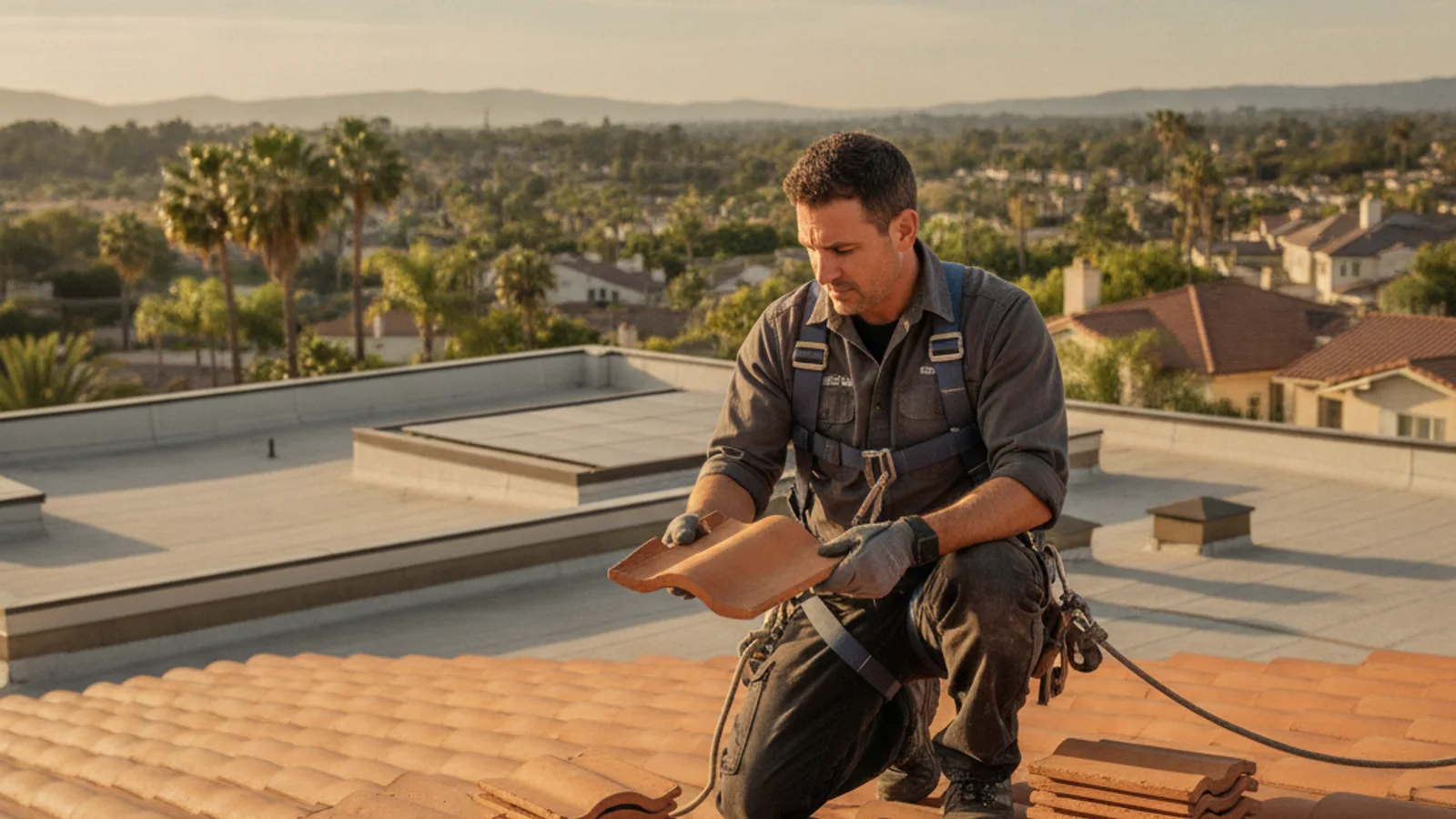
Profile is the shape of the tile in cross-section and how one tile locks to the next. That shape decides the shadow line from the curb, how water is channeled, how much of the tile’s own weight lands on the structure, and how courses meet valleys, hips, and penetrations. Two clay tiles in the same color can behave like different materials on the same house.
San Diego County is full of clay tile because the architecture invited it. Spanish Revival and Mediterranean-influenced homes from the 1920s through the 1930s in Kensington, Mission Hills, and North Park went up with barrel tile. Postwar and mid-century tracts across the inland valleys picked up lower-profile tile later. Newer stucco subdivisions in Carmel Valley, San Marcos, and eastern Chula Vista lean toward flat and low-profile shapes. The profile that looks right on your street is usually the profile the street was built with.
Clay versus concrete is a separate material question. Both get made in overlapping shapes. If you have not settled that first, our concrete versus clay tile comparison covers the material side. This piece is about the shapes.
Profile comparison at a glance
| Profile | How it reads from the street | Piece count / height | Where it usually belongs | Service note |
|---|---|---|---|---|
| Two-piece mission / barrel | Deep, irregular Spanish shadow | Most pieces, most height | Older Revival and custom work | Walk only on load-bearing points |
| S-tile (one-piece Spanish) | Similar from a distance, more regular close up | Fewer pieces than two-piece | Mediterranean look without two-piece install | Still a walk-with-care roof |
| Flat / interlocking | Crisp, linear, contemporary | Tight course shadow | Newer stucco and transitional houses | Cleaner around dormers, skylights, solar |
| French interlocking | Mostly flat face with a raised rib | Historical middle ground | Older homes where full-flat looks wrong | Built to shed on lower pitches |
| Low-profile / shallow wave | Mild Mediterranean, less height | Lower piece count than barrel | Tracts from the last few decades, HOA match | Confirm the maker’s pitch limit |
Confirm the manufacturer’s minimum roof pitch for the profile you pick. Deep barrels and flatter interlocking shapes do not share the same limits. On any lower-slope section, confirm the specified underlayment for that pitch. Tile is a water-shedding surface, not a waterproof membrane. The tile buys the underlayment time. It does not replace it.
Two-piece mission and S-tile
Two-piece mission is the oldest and most sculptural of the group. A pan sits in the flow path. A half-round barrel cover caps the joint between pans. The deep, irregular shadow is what people picture as a Spanish tile roof. It is the profile on the county’s older Revival houses and on custom work that imitates them. It uses more pieces per square than anything else here. Because the covers stand proud of the pans, it puts more material and more height on the roof.
S-tile, sometimes sold as single-piece Spanish, compresses that look into one extrusion. The S-curve gives you a barrel and a pan in a single tile that interlocks with its neighbor. It reads similar from the street at a distance. There are fewer pieces to set. Up close and in low sun, the shadow is more regular and shallower.
Where the two profiles separate is service. Barrel and S-tile roofs are walkable only by people who know where the load-bearing points are. A tile that cracks under a boot is the start of many tile-roof leak calls. Broken tile, slipped tile, and failed mortar at hips and ridges are the recurring items. Our guide to clay tile roof repair in San Diego covers how those get addressed without making the problem bigger.
Flat, French, and low-profile tile
Flat tile is a planar tile, usually interlocking, with a crisp linear roof and a tight shadow at each course. It suits contemporary and transitional architecture. It is the profile most often chosen when a homeowner wants tile’s durability without a Mediterranean read. Flat clay tile also lays out more cleanly around dormers, skylights, and solar arrays, because there is no barrel to interrupt.
French tile, sometimes called French interlocking, is the historical middle ground. It is largely flat across the face with a raised rib or channel and an interlocking edge. The pattern was developed to shed water on lower pitches. On the right older home it looks correct in a way full-flat tile does not.
Low-profile tile is the broad category newer subdivisions use: a shallow S or gentle wave that keeps some Mediterranean character while cutting height and piece count. If you are in a tract built in the last thirty years and your HOA requires a match, this is probably what is already on the roof.
Weight is a structural question before it is a style one
Clay tile weighs substantially more than asphalt shingle. The amount varies by profile and manufacturer, so the number that matters comes off the product’s own data sheet, not a blog figure. Ask the AHJ whether a covering change needs a permit, structural verification, or new sheathing over skip sheathing. Do not treat a blog as the City’s current trigger.
Permit, weight, and sheathing rules are set by the AHJ for that address. A Poway, El Cajon, or Escondido address gets confirmed with that jurisdiction, not with a countywide blog rule.
Practically, a shingle-to-tile conversion is a bigger project than swapping like for like. An engineer or the building department may need to sign off that the existing framing carries the new load. Older homes with skip sheathing usually need new sheathing as part of the job. Ask the AHJ how many existing layers must come off before a new covering. Our tile roofing service page explains how roofers in the referral network scope that work. A written roof inspection is the cleanest way to find out what your framing and deck are currently carrying.
The underlayment is the real service item
Fired clay tile is chemically stable. It does not rot, corrode, or lose granules. What ages out is everything under it: underlayment, fasteners, flashing at valleys and chimneys, and mortar at ridges and hips. When a tile roof starts leaking after decades of quiet service, the underlayment is the usual answer.
That is what makes a lift-and-relay possible, and it is a different project from a replacement. The existing tile is removed and stacked, the old underlayment and flashing come off, new underlayment and flashing go on, and the original tile goes back down with breakage replaced. You keep the roof’s appearance and the tile you already own. Our lift-and-relay guide covers when it is the right call and when the tile is too far gone to reuse.
Warning signs that preserve the option: interior stains under an intact-looking tile field, slipped or displaced tiles, debris and organic buildup in the pans, and daylight or damp at the underside of the deck. Our post on tile underlayment failure signs walks through what to look for. Catch it while the tile is sound and you are relaying. Wait, and you may be buying a new field of tile.
Matching a discontinued profile on an older home
Tile lines get discontinued. Molds change. Colors shift between production runs. A 1929 Kensington barrel roof or a 1960s low-profile tract roof often has no current product that matches it. On a partial repair that is a real problem, because a patch in the wrong profile is visible from the street for the life of the roof.
Roofers who work tile regularly handle it a few ways. They pull matching tile from a low-visibility elevation, a rear slope or a garage roof, and use the new mismatched tile there instead. They source salvage from reclamation yards that stock discontinued regional profiles. Or they blend a close-match tile across a larger area so the transition reads as variation rather than a repair. If your home is a designated historical resource or sits inside a historic district, work on the roof covering triggers permitting attention in the City of San Diego regardless of scope. Confirm that designation before anyone starts.
One habit pays off for every tile owner: keep the spares. When a tile roof is installed or relayed, leftover tiles are the only guaranteed match you will ever have. Stack them somewhere dry and out of the way, and tell whoever works on the roof next that they exist.
When to call us
Tile work needs a licensed C-39 roofer. Profile matching, structural verification for a heavier covering, and any lift-and-relay are outside a general handyman scope. Walking a tile roof without knowing where to step is how a small repair becomes a large one. Top Pro Roofing SD is a referral service. We do not inspect, install, or warrant roofs. Call us at (760) 750-5557 and we will connect you with a licensed local roofer.