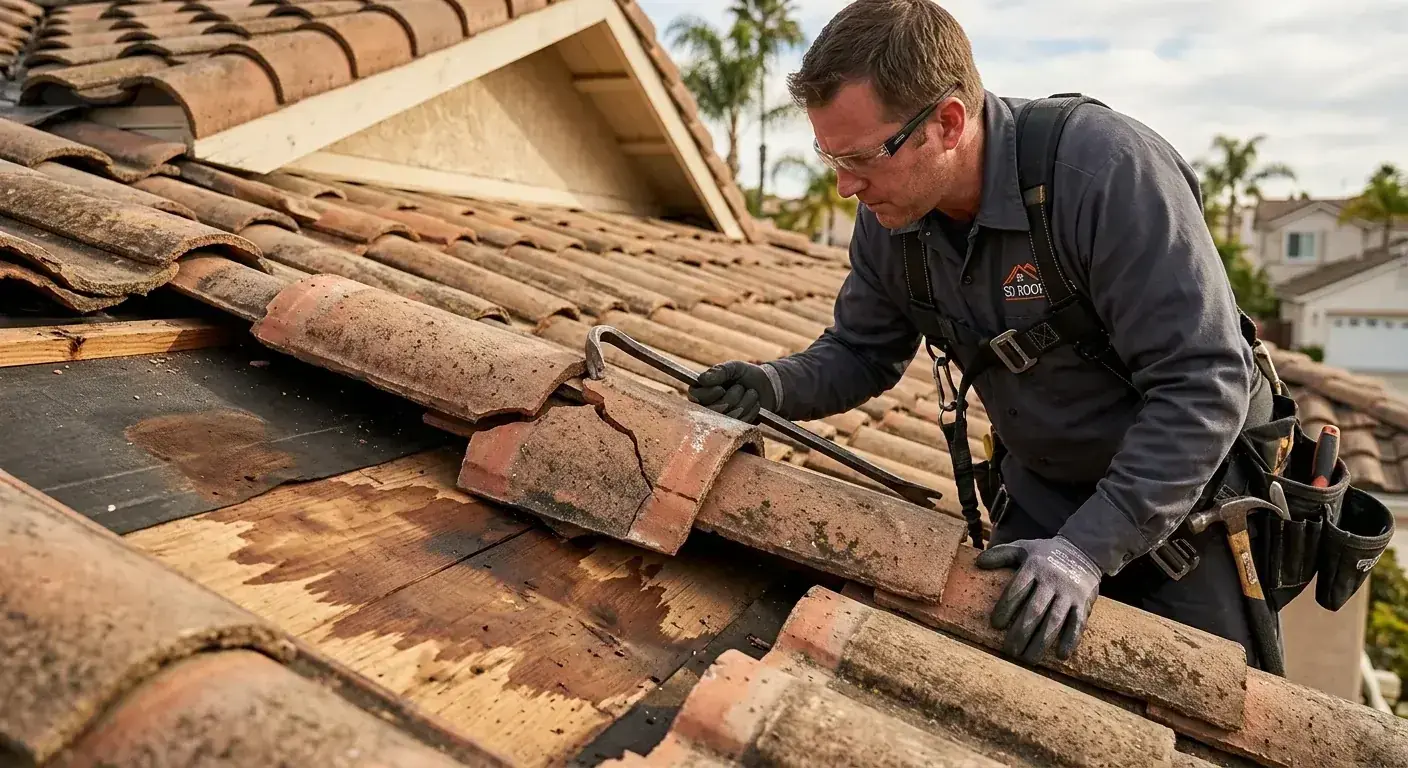
TL;DR
- From the ground: slipped or missing tiles, cracked units at hips and ridges, moss in valleys, a wavy ridge, and attic stains or daylight at the deck.
- Clear gutters and valleys before the rainy season. Stay off the tile. Do not pressure wash.
- A real tile roof maintenance program names visit count, photos, debris work, and underlayment tracking. “Annual look” is not a scope.
- The tile body often outlasts the sheet under it. Plan for lift-and-relay when the felt is tired, not when the field still looks new from the street.
- Top Pro Roofing SD refers. We do not install. Call (760) 750-5557.
A San Diego tile roof is not a “set it and forget it” covering. Encinitas marine layer, Mission Hills eucalyptus in the valleys, and inland UV all ask for different checks. The work is still the same family: keep water moving off the roof, catch broken units early, and treat the underlayment as the timer.
If you only keep one rule: do not walk the field, do not pressure wash, and do not skip the attic just because the tile still looks fine.
What you can see from the ground
Twice a year, walk the perimeter with a phone and binoculars. Same angles each time so you can compare.
- Slipped or missing tiles. A dark gap or a unit that has slid down the course. Wind and a failed fastener are the usual story.
- Cracked or chipped tiles. Hairlines are easy to miss. Check hips, ridges, and anything over a valley.
- A sagging ridge. Mortar bedding failed, or the ridge board is tired underneath.
- Moss, lichen, or debris in valleys. Encinitas, Leucadia, and Cardiff hold moisture against tile and the sheet below.
- Daylight or staining. Look up at the eave from the yard. Then a flashlight in the attic after the first real rain.
Do not get on the roof to “just look.” Walking clay, and often concrete, cracks units underfoot. The Tile Roofing Industry Alliance and manufacturer warranties treat that as owner damage. If it needs a closer look, that is a specialist visit.
Semi-annual and post-storm work
Before the rainy season (late October here) and after it (early April):
- Gutters and downspouts. Palm fronds, jacaranda, and pine needles. Scoop, then a low-pressure hose. Not a pressure washer.
- Valleys. A debris dam sends water sideways under tile. From a ladder at the eave, a soft brush on a pole or a blower. Stay off the field.
- Attic. Daylight, staining, or fresh moisture after the first storm. The sheet often shows here before a ceiling stain.
- After wind or a measurable rain. Tiles in the yard, new soffit marks, fresh debris piles.
Coastal streets often need a third gutter pass in late winter. Marine moisture plus January rain loads eave metal faster than inland tract streets.
What a professional tile inspection should include
A five-minute curb look is not an inspection. Ask for time on the roof (with walking pads or a roof ladder) and in the attic, plus photos.
- Underlayment. Lift tiles on south and west exposures. Brittleness, tears at fasteners, exposed asphalt.
- Fasteners. Galvanized nails corrode near the coast. Stainless or copper lasts longer in salt air. Ask what they found.
- Flashing. Vents, chimneys, skylights, wall steps. Common leak sources on any tile roof.
- Ridge and hip mortar vs foam-and-fastener systems on newer installs.
- Valley metal. Galvanized pans rust. Then the sheet is the only waterproofing in that run.
- Broken-tile count. A handful on a tract roof is common. A large field of cracks often means prior foot traffic (solar, satellite, HVAC).
- Deck. Sound the plywood while tiles are up. Soft spots mean the leak has been there.
Ask how many tile roofs they inspect in a year, whether they carry matching tile, and whether you get a written photo report. Verify the C-39 at the CSLB license check before anyone is on your roof.
Cadence is condition, not a blog clock. New-looking inland tile can wait longer between visits than an older felt roof in Bird Rock. After a known leak, or when the last inspection named failed felt, mortar, or flashing, tighten the schedule. The inspection report is what tells you maintenance vs lift-and-relay.
Walking on tile (pros only)
The homeowner rule is stay off. The exceptions are trained crews.
If a technician must be on the field: step on the lower third of each tile (supported by the unit below), walk across courses rather than along them, use a roof ladder or pads on steep runs, and replace anything cracked before they leave.
Put solar, HVAC, and satellite access in writing: how they protect tile, and who pays for cracked units. A crew that treats tile like shingles is a flag.
San Diego patterns, not a one-size inspection
| Area | What shows up often | What the visit should emphasize |
|---|---|---|
| La Jolla, Bird Rock, Pacific Beach | Fastener corrosion, pull-through | Metal grade, coastal flashing |
| Encinitas, Leucadia, Cardiff, Solana Beach | Moss in valleys, tired felt | Debris, underlayment lifts |
| Carlsbad, Oceanside coast | Slipped tiles on the windward face | Fasteners and windward courses |
| Carmel Valley, Scripps Ranch, 4S Ranch | Tract felt aging together | Age of sheet vs look of tile |
| Rancho Santa Fe, Fairbanks Ranch | Cracks from tree and landscape traffic | Walking pads, matching clay |
| Mission Hills, Kensington, North Park | Failed mortar at hips and ridges | Mortar vs mechanical ridge |
| Escondido, Poway, San Marcos | Dust in valleys after Santa Anas | Valley clearing |
| Ramona, Alpine, Julian | UV on the sheet, freeze where it actually freezes | Sheet condition, freeze-thaw on porous concrete |
The common causes of tile roof leaks post is the leak-path map. Older Spanish clay repair is clay tile roof repair. Underlayment symptoms: underlayment failure signs.
What a tile roof maintenance program should include
Searchers looking for a “tile roof maintenance program” in San Diego are usually buying a standing agreement, not a one-off leak call. Ask for this in writing.
A real program names: visit count (often once or twice a year), a photo report, valley and gutter debris work, resetting slipped tile, resealing exposed fasteners and penetrations, and minor flashing touch-up. Storm priority is common. Some programs credit part of the fee toward a later repair. None of that is a price. Compare scopes.
Four separators:
- Written scope. Tasks, visit count, exclusions. “Annual inspection” is not a scope.
- Photo report every visit. Dated photos are how you see change.
- Underlayment tracking. Tile can look new while felt is done. The program should record sheet type and condition, not only broken units.
- No pressure washing. Anyone who sells high-pressure washing as care is selling damage.
A program does not make felt last forever. It tells you when lift-and-relay is the honest next job. We do not invent annual fees. Compare written programs the same way you compare reroof bids.
Lift-and-relay vs “keep washing it”
When the sheet is tired and the tile is sound, the mid-life job is lift-and-relay: stack tile, new underlayment and flashings, deck repairs as needed, relay the original field. That is tile roofing, not a new tile order.
Wait until the deck is rotten and you lose the cheaper path. Maintenance is what keeps the intervention on the sheet, not a full tear-off of still-good tile.
Cost context without a blog total: tile roof replacement cost and tile roof cost. Ask for two columns on one roof: lift-and-relay vs new tile.
FAQ
Can I pressure wash a tile roof? No. High pressure lifts mortar, drives water onto the underlayment, and erodes older clay. If the roof is mossy, ask a roof cleaner about a low-pressure soft wash and a biodegradable solution. Most San Diego tile roofs go long stretches between washes.
How often should a professional inspect? By condition and exposure, not a universal year chart. After storms, after other trades walk the roof, and when the attic starts telling on the sheet. Buy a written report, not a sidewalk glance.
Can I replace a broken tile myself? You can buy a tile. Setting it without cracking neighbors, matching the batch, and seating it under the existing fastener is the job. A botched DIY is a leak. Hire a tile specialist.
Should I walk the roof to clean gutters? No. Ladder and scoop, or a gutter service working from the perimeter. If the gutter needs roof access, hire a tile crew, not a general handyman.
What is the first sign the underlayment is failing? Staining on the underside of the deck, from the attic. Daylight at penetrations is later. A wet ceiling is late. A flashlight twice a year is the cheap diagnostic.
Get connected with a tile specialist
Wrong foot traffic, a pressure washer, or an inspection that never lifts a tile will cost more than a skipped gutter. Top Pro Roofing SD matches San Diego County homeowners with independent C-39 tile roofers for inspections, cleaning, broken-tile repair, and lift-and-relay. We do not do the work. Call (760) 750-5557 or request an estimate.
Related: tile roofing, roof inspection, roof repair.
External: Tile Roofing Industry Alliance, NRCA steep-slope guidance, CSLB license check.