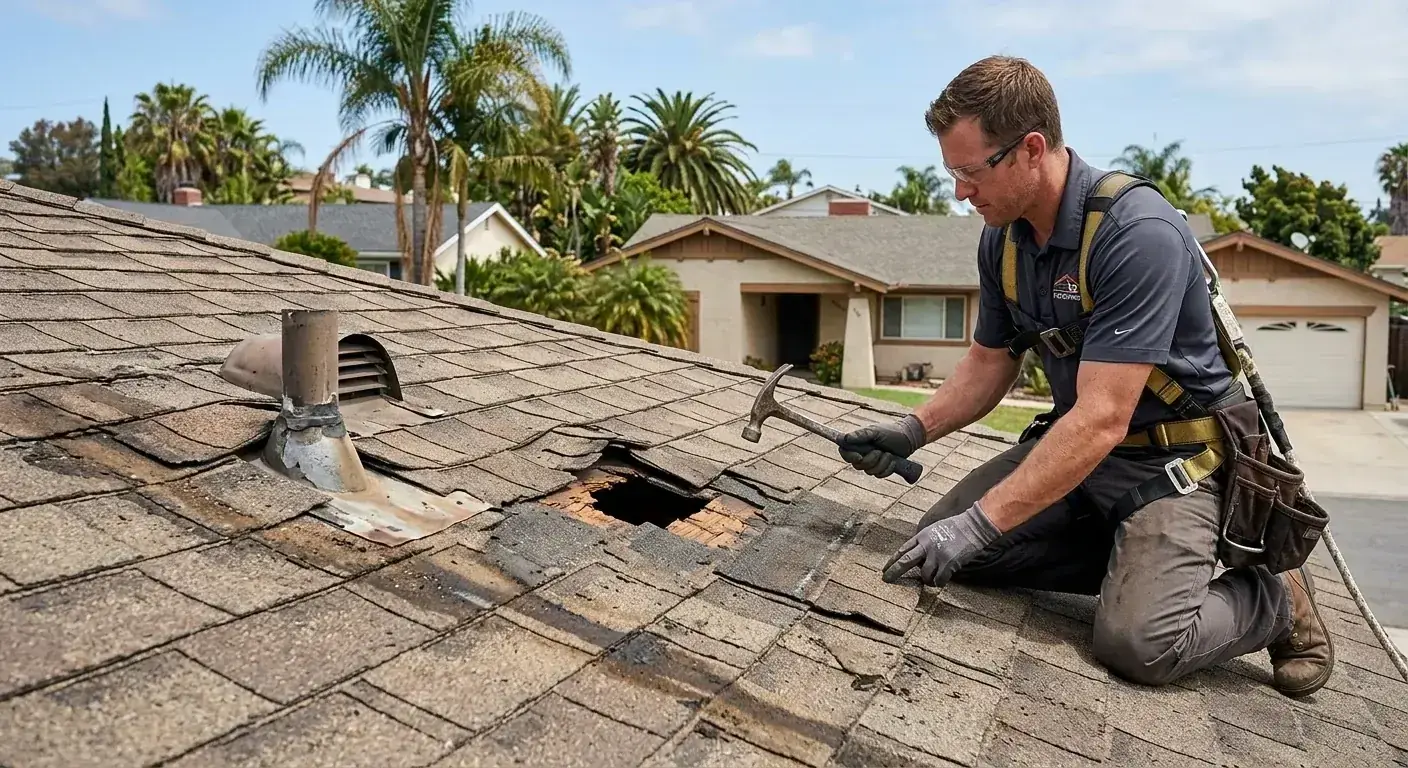
You are weighing repair vs replacement, not hunting a county-wide remaining-life table. One isolated stain is often a penetration. Several of the signs below, especially on a roof that is already old for its covering, is when a licensed C-39 should walk it and write what they saw.
Top Pro Roofing SD is a referral service. We do not inspect, we do not reroof, we do not set replacement prices, and we do not certify roofs. Call (760) 750-5557. Ask the matched roofer for a signed condition report if you need a document. A sales estimate is not that product. Inspection vs free estimate.
A 20-year shingle in coastal Coronado and the same product in Ramona do not age the same. Tile that looks perfect from the street can have underlayment that no longer sheds water. Those differences are why a ground photo is not a remaining-life stamp.
Signs at a glance
| Sign | What you see | What it often means | Urgency |
|---|---|---|---|
| Age vs covering | Covering is old for how this climate treats it | System may be past useful life even if it still “looks OK” | Plan a licensed walk |
| Heavy granule loss | Sand-like piles in gutters, bare asphalt patches | Mat is taking UV | Schedule soon |
| Multiple leaks | Stains in different rooms, not one recurring spot | System-wide failure more than one patch | Do not keep stacking caulk |
| Sagging ridge | Dip or wave in the ridge from the street | Deck or framing, not a shingle swap | Call a licensed roofer |
| Attic daylight | Pinpoint light through the deck with lights off | Gaps or holes in decking | Call right away |
| Salt-air corrosion | Rust from drip edge, step flashing, or boots near the coast | Metal has already been failing | Inspect, do not wait for winter |
| Tile slip or breakage | Shifted, rotated, or many broken tiles | Fasteners, battens, or underlayment movement | Inspect |
| Silent underlayment | Tile looks fine, leaks start anyway | Waterproof layer aged out | Tile lift, not a ground guess |
| Curling shingles | Edges lifting, cupping, or clawing | Asphalt has gone brittle | Time-limited remaining life |
| Insurance or escrow demand | Non-renewal, bind hold, or a certification request | Someone else is asking for a signed document | Ask what they will accept |
| Solar mounting leaks | Stains under several feet, rust at mounts | Sealant-only feet often fail as a set | Do not patch one foot and stop |
| Wind after Santa Anas | Lifted shingles or displaced tile inland and East County | Cumulative wear on an aging roof | Inspect after the event |
This is a checklist for a conversation with a C-39, not a score we can certify.
1. The covering is old for this climate
You do not need a surface symptom if the install date is already late for the material and the microclimate. Ask the inspector to compare age, covering, and what they can actually see. Do not treat a blog year band as a manufacturer warranty.
Coastal marine layer and salt treat metal and felt differently than inland UV in Poway, Escondido, and El Cajon, or wind and elevation in Ramona, Alpine, and Julian. Tile itself can last a very long time while the underlayment does not. Full lifespan context, still not a guarantee: how long a roof lasts in San Diego.
2. Heavy granule loss (asphalt)
Granules shield the asphalt mat. Once they are gone, UV works the mat hard.
- Gutters: a few granules after a storm can be normal. Cup-fulls are not.
- Downspout outlets: sand-like piles on the ground.
- Roof field: bare dark patches. South and west slopes inland (Poway, Escondido, Ramona, El Cajon) show this first.
Once you can see it from the ground, remaining life is limited. Related: what deteriorates asphalt shingles here.
3. Leaks in different parts of the roof
One leak is a repair conversation. Three different stains on an older roof is often a failing system. Patches keep shrinking in value.
On tile, this pattern often means the underlayment has been past life for a while. Leak diagnosis: what causes roof leaks in San Diego.
4. Sagging ridge or a wavy deck
Stand across the street. A dip in the ridge, or slopes that look structurally sagged rather than designed, is a deck or framing issue. Replacing a few shingles does not fix that.
Older neighborhoods (Mission Hills, Kensington, Hillcrest, North Park, Talmadge, Old Town) with lighter original framing plus long moisture exposure are where this shows up. Treat it as structural until a licensed inspection says otherwise.
5. Daylight through the attic deck
Lights off, daytime. Pinpoint light through the field of the deck, not at intended ridge or gable vents, means gaps or holes. Repair of the covering alone will not close those.
6. Coastal salt-air corrosion on flashings and fasteners
Within about a mile of the ocean, galvanized steel flashings and fasteners fail faster than inland. Aluminum and copper last longer in that air. Look from the ground in Coronado, Imperial Beach, Ocean Beach, La Jolla, Del Mar, Encinitas, Cardiff, Carlsbad, and Oceanside:
- Rust streaking down fascia from drip edge
- Corroded step flashing at walls
- Chimney counter-flashing bleeding rust
- Pipe-boot metal flanges rusted through
- Gutter fasteners failing
If you can see that from the sidewalk, water has often been using those details for more than one winter. The field can still look fine.
7. Tile efflorescence, slip, or widespread breakage
- Efflorescence. White chalk. Moisture moving through tile. Cosmetic on younger tile; a saturation clue on older.
- Slip. Tiles rotated or walked down-slope. Fasteners, battens, or underlayment movement.
- Many broken tiles across the field. Impact resistance or movement, not one dropped tool.
- Exposed underlayment under a missing tile is an active path.
8. Underlayment failure under tile you cannot see
The tile and flashings can look acceptable while felt or aged synthetic underneath no longer sheds water. You cannot confirm that from the street. A licensed roofer lifts sample tiles.
If the tile roof is decades old with original felt, get a real inspection, not a driveway opinion. The usual repair path is lift, new underlayment, relay. That is still not a number we will invent. We also will not call it a certification.
9. Curling, cupping, or clawing shingles
- Curl: lower corners lift off the course below.
- Cup: center dips, edges rise.
- Claw: edges curl down.
All three mean the asphalt has lost flexibility. Worst on inland south and west slopes. Visible shape change means remaining life is short. Granule loss and age are still the more common San Diego tells; curl is not the only one.
10. Insurance or escrow paperwork, not a roof symptom
A non-renewal letter, a bind hold, or a demand for a roof certification is a recipient asking a licensed issuer to sign remaining-life or condition language. That is not a document Top Pro Roofing SD can issue.
Ask the carrier, lender, or escrow officer what they will accept. Then ask the matched C-39 whether they will inspect, repair if needed, and sign that wording. Roof certification for a home sale. Certification cost (no fake table). Claims context: does homeowners insurance cover roof leaks in California.
11. Solar leaks at several mounting feet
Stains under or down-slope of an array, plus rust at several feet, often means a sealant-only install aging as a set. Patching one foot on a field of the same hardware is usually wasted money. Either re-flash the feet properly or fold detach-and-reset into a reroof conversation. Do solar panels damage your roof.
12. Repeated Santa Ana damage inland and East County
Ramona, Alpine, Jamul, Julian, Lakeside, Poway, Escondido, and San Marcos take wind that the coast often does not. After an event, look for lifted shingles at ridges and rakes, displaced tile, ridge-cap failure, mortar cracks on tile ridges, and granule scour on the windward slope.
One event can be a repair. The same pattern every season on an old covering is a replacement conversation. Santa Ana wind roof damage.
How the mix shifts by region
| Region | Common replacement trigger | Check first |
|---|---|---|
| Coast (Coronado through Oceanside) | Flashing corrosion and underlayment | All metal details; tile lift if it is tile |
| Inland valleys (Poway, Escondido, San Marcos, Vista, El Cajon, Scripps Ranch) | UV shingle wear and granule loss | South and west slopes |
| East County / mountain | Wind plus freeze-cycle tile breakage | Windward ridges and rakes after events |
| Older tree neighborhoods (Mission Hills, Kensington, Talmadge, La Mesa) | Debris dams and deck deflection | Valleys and the ridge line |
| HOA tile tracts (Scripps Ranch, Carmel Valley, Rancho Santa Fe) | Hidden underlayment on “perfect” tile | Lift inspection, not curb appeal |
What you can do from the ground
Stay off the roof. Phone zoom or binoculars:
- Walk the perimeter in good light.
- Photograph all four exposures.
- Zoom ridges, hips, valleys, chimneys, skylights, vents, and metal.
- Look in gutters and at downspout splash for granules.
- Attic, daytime, lights off: daylight, stained rafters, discolored insulation.
Then book a roof inspection if anything is off. That walk is still not a certification from us.
Call now vs wait for a planned walk
Call a licensed roofer now if you see
- A ceiling stain that grows across storms
- Attic daylight through the deck
- Sagging ridge
- Leaks in different rooms
- A carrier, lender, or escrow demand for signed roof language
Schedule a planned inspection if you see
- Heavy granules, curl, tile slip, coastal flashing rust, or a covering that is old for its climate
Annual look is enough when
- Early granules, minor flashing wear, one boot, and no other signs, in the middle of expected life
FAQ
Repair or replace?
Ask the C-39 to price both on the same roof when both are honest. Compare remaining covering life they will put in writing against a repair that does not touch the rest of the system. We will not invent a 20 percent rule. Repair vs replacement.
Can I judge this from the ground?
You can collect photos. You cannot certify remaining life. Do not walk tile. If the photos look wrong, get a licensed walk.
How much does a new roof cost here?
We will not publish per-square-foot bands or a 2,000-square-foot total. Ask for a written takeoff. Context without treating this page as a rate card: new roof cost in San Diego.
Does an HOA inspect my roof?
Some associations whose CC&Rs require tile look at transfer or architectural review. Many others only flag obvious deferred maintenance. Ask your association, not a blog. Do not treat a whole city as tile-required.
Will the seller disclose roof age?
California sale paperwork is a conversation with your agent and, if needed, counsel. Read the current Civil Code disclosure forms with them. This page does not restate seller-disclosure holdings. A buyer who wants remaining-life language usually needs a separate licensed inspection or certification from a C-39, not from this brand.
What is an escrow roof inspection?
Often a walk plus a signed remaining-life or condition statement the lender, insurer, or buyer asked for. Duration, wording, and whether they will sign at all depend on what they saw. We do not issue that paper. Roof certification for a sale.
How long does replacement take?
Sequence and weather, permits, and HOA packets move the calendar. How long replacement takes.
Bottom line
If several of these signs line up, get a licensed written report before another winter. For cost context if replacement is the honest path, use the cost guide above. If repair is still honest, use the repair-vs-replace guide. For a match: La Mesa, El Cajon, Encinitas, Escondido, Chula Vista, Carlsbad, Oceanside, Poway, Ramona, and the rest of the county.
Call (760) 750-5557. We connect you with a vetted local roofer. We do not certify roofs.