If water is coming through the ceiling, start with containment, then photos, then a licensed independent roofer. Do not wait to “see if it stops.” Top Pro Roofing SD is a referral service. We do not climb roofs, we do not hold a C-39, and we do not guarantee same-day or after-hours arrival. Call (760) 750-5557 if you want a match. Crew timing is that contractor’s, especially after a county-wide storm.
Read the current live California Department of Insurance Residential Property Claims Guide and your policy. This page will not restate notice windows, photo duties, or other claim holdings.
The first hour, in order
- Contain the inside. Buckets under drips, towels around the edges, electronics and furniture out of the splash zone. If the ceiling is bulging, poke a small drain hole over a bucket so the panel does not drop as one sheet.
- Document everything. Photos and video, inside and outside from the ground, plus a weather screenshot. Do this before you throw things away.
- Tarp the roof only if it is safe. Daylight, dry walking surface, a spotter, and experience on roofs. Otherwise wait for a licensed contractor.
- Call a licensed roofer. Ask what they can actually do on this weather, tarp vs dry-weather repair, and what they will put in writing.
- Notify the insurer. Read your duties-after-loss section and the current live CDI guide. This page will not restate a statutory hour or Insurance Code 2071 holding.
Related: emergency roof tarp guide, storm-damaged roof first 48 hours, emergency roof repair.
| Step | Goal | Tools |
|---|---|---|
| 1. Contain inside | Stop water spreading | Buckets, towels, screwdriver, drop cloth |
| 2. Document | Build the claim file | Phone camera, notepad |
| 3. Tarp roof | Slow more water if it is safe | Tarp, 2x4s, roofing nails, ladder |
| 4. Call a licensed roofer | Get mitigation and a later dry inspection | Phone, address, photos |
| 5. Notify insurer | Start the claim clock your policy actually uses | Policy number, photos |
Step 1: Contain the inside
The first minutes are damage control, not diagnosis. You are not finding the entry point yet.
Move stuff first. Pull furniture, rugs, electronics, and paper away from the drip. Water travels sideways in a ceiling cavity, so the wet area is often wider than the stain.
Place containers. Put a towel in the bucket to cut splash. Lay another towel or a drop cloth around it.
The ceiling puncture. A bulge is pooled water on the drywall. A small hole at the low point, over a bucket, drains that pool on purpose. You are trading a small hole for a dropped panel.
Electrical. If water is near a light, fan, can, or outlet, kill that circuit at the breaker. Do not test the fixture. If you cannot isolate it, kill the main.
If the ceiling is sagging across several feet, water is on electrical, or leaks show in more than one room, get people out of that area. Call 911 if anyone is in immediate danger. Then call a licensed roofer. We can try to match one. We cannot promise who is free.
Step 2: Document everything
This is the step people skip. Adjusters work from what you can show. More: what not to say to a roof insurance adjuster.
| What | Why it matters |
|---|---|
| Wide shot of the room | Scope and context |
| Close-up of every drip | Count and pattern |
| Video across the ceiling | Details still photos miss |
| Damaged items | Contents support |
| Exterior from the ground | Roof condition at time of loss |
| Gutters and downspouts | Overflow changes the story |
| Weather screenshot | Ties the leak to an event |
| Start time notes | First question on the claim call |
Do not throw items away yet. Photograph them first. Tossing damaged goods before they are in the file is a common fight with the adjuster.
Weather screenshot. The National Weather Service San Diego office publishes radar. Capture the time the leak started as best you can.
Step 3: Tarp the roof, if safe
A tarp is mitigation, not a repair. Done poorly, it channels water, tears in wind, or puts you off a ladder.
Do not climb if:
- It is raining or the roof is wet
- It is dark
- The pitch is steep (many San Diego roofs are at or above 6:12)
- You have no spotter
- The damage is at the eave or ridge edge
- You have never been on a roof
- It is tile or slate (broken pieces are a matching problem, and walking cracks more of them)
If any of those apply, skip to the call. A trip to the ER is not a roof strategy.
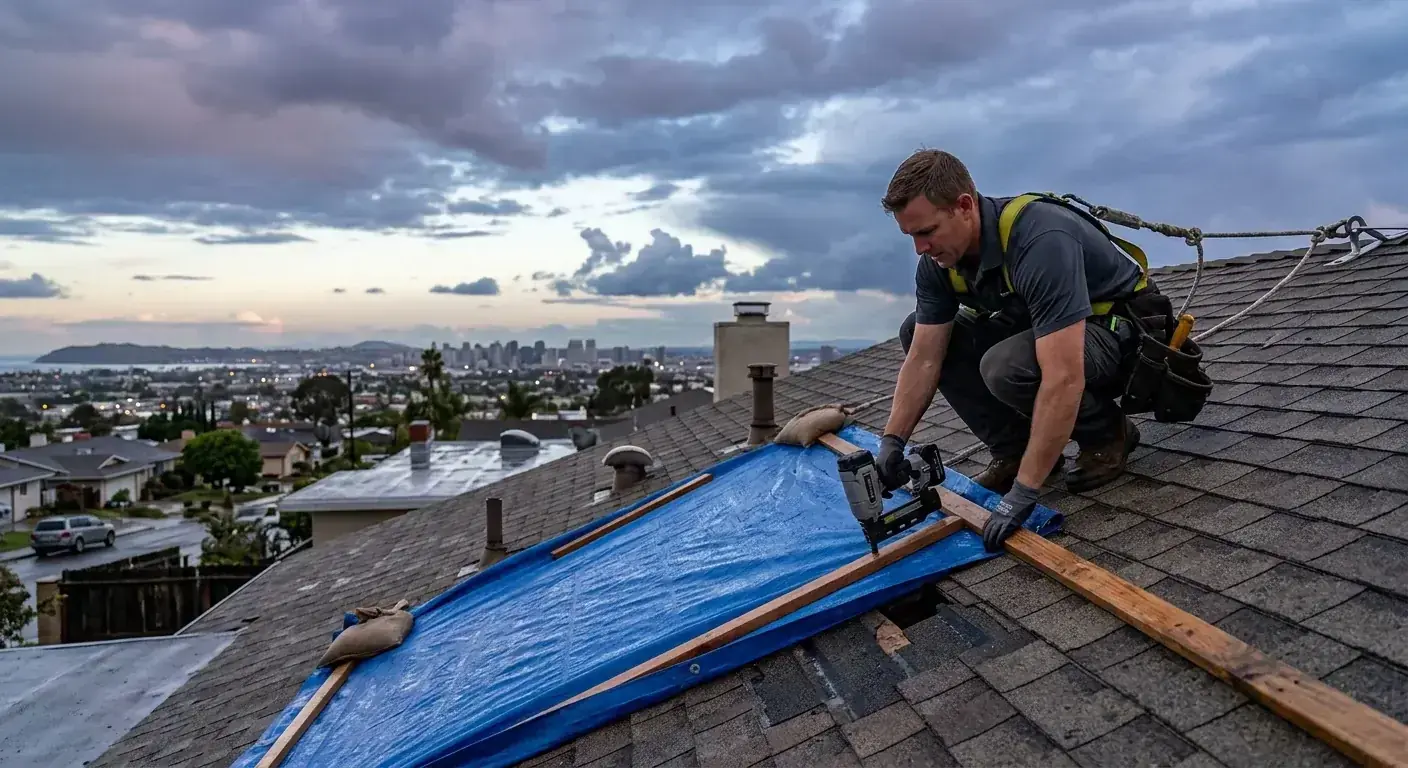
The 2x4 method, if you are going up in safe conditions:
Do not pin a tarp with bricks. Wind gets under it.
- Use a heavy poly tarp that extends well beyond the damaged area on every side, and uphill of the entry.
- Lay the upper edge upslope of the damage.
- Wrap that edge around a 2x4 and nail through the wood and tarp into the deck, spacing nails along the board.
- Repeat at the bottom edge.
- Add side boards on a wide tarp.
Yes, that puts nail holes in the roof. A licensed roofer should seal or replace that area when the real repair happens. If this makes you hesitate, stay off the roof.
Step 4: Call a licensed roofer
Not every drip needs a night visit. A light stain you can bucket through a known storm can wait for daylight if the ceiling is not sagging and electrical is dry. A heavy leak, sagging drywall, water on electrical, or an empty house you cannot watch is urgent.
When you call, have:
- Address and gate code
- Roof type if you know it (shingle, tile, flat, metal)
- Approximate roof age
- Where water shows inside
- Whether anything is already tarped
- Photos ready to send
Ask whether the first visit is tarp-and-document or an attempted repair. Many first visits in active rain are tarp visits. Permanent work on a soaked deck is how you buy a second leak.
We do not publish a price for emergency response. Ask the contractor. Related service page: emergency roof repair.
Step 5: File with the insurer
Read your policy and the current live CDI guide. This page will not restate Insurance Code 2071 holdings, notice windows, or a blog’s 72-hour invention as law. Photograph, keep receipts, then call.
Before you call:
- Policy number
- Photos and video organized
- Start time and weather
- Whether you already paid for mitigation
What to say. Facts only. When it started, what is wet, what you did, that a licensed roofer is being called. Do not guess that the roof “has been bad for years.” Cause is the adjuster’s job.
Coverage rules: does homeowners insurance cover roof leaks in California, does insurance cover roof replacement, California Department of Insurance.
Keep receipts for tarps, fans, a hotel if you had to leave, and dehumidifier rental. Whether those reimburse is a policy question.
Mistakes that spread the damage
| Mistake | What happens |
|---|---|
| Waiting out the storm with no containment | Drywall, insulation, and framing stay wet; mold risk rises after a day or two of wet material |
| Interior caulk in the ceiling drip | Water still enters at the roof and travels until it finds another exit |
| A handyman patch with no diagnosis | The next storm reopens the same path |
| Throwing out damaged items before photos | Contents fights |
| Cleaning stains before photos | Scope arguments |
| Climbing a wet roof | Falls |
| Waiting weeks to notify the insurer | Delayed-notice arguments |
Interior sealant feels useful. The roof is still open. Water then runs the joists into a wall or a second room.
When it is a get-out-of-the-room problem
- Ceiling sagging more than a couple of inches, or across a wide span
- Water on electrical, or a burning-plastic smell
- Leaks in multiple rooms with no shared roof feature
- New cracking or popping from the ceiling during the leak
- Brown water with a sewage smell (that is plumbing or a sewer stack, not a typical roof entry)
Get people out of that space. Kill power if you can do it safely. For life safety, call 911. Then call a licensed contractor. We can try to refer. We do not staff an overnight crew from this number.
San Diego patterns
Atmospheric rivers. Compressed winter rain, and events like the August 2023 remnants of Hurricane Hilary, find aged sealant, nail pops, and brittle underlayment. Roofs that “never leaked” can open hours into sustained rain because the assembly was built for lighter, shorter storms.
Santa Ana wind. October through January winds lift shingles, crack tile, and pull flashing with no rain in the moment. The leak shows in the next storm. If a strong Santa Ana hit in the last couple of months, look at that before you assume “just rain.” More: Santa Ana wind roof damage.
After a big storm. Licensed emergency roofers book up. Calling early is still the right move. It is not a promise that someone arrives tonight. Causes and tracing: what causes roof leaks in San Diego, how to find a roof leak.
FAQ
How long before wet drywall becomes a mold problem?
Mold can colonize wet drywall and framing within about a day or two in a warm house. That is why you contain and dry now, not after the storm week ends. We will not invent a remediation invoice.
Should I shut the water main?
No. A roof leak is rain. The main is plumbing. Kill the electrical circuit if water is near fixtures.
Is a small hardware-store tarp enough?
Only if it extends well past the damage on every side and upslope of the entry. A small sheet over a large field just dumps water at the edge.
My deductible looks close to the visible damage. File anyway?
Talk to your agent. Opening a ceiling often shows wet insulation and stained framing the stain did not show. We will not tell you the claim math.
I rent. Who pays?
The building envelope is the landlord’s. Contents are often renter’s insurance. Notify the landlord in writing, document like a homeowner, and do not pay for structural work without written approval unless more damage is the alternative. Landlord and tenant roof repair.
Can we stay overnight?
If the ceiling is not sagging, electrical is dry, and you can empty buckets, many people stay. If those flip, leave. Hotels fill during county storms. Decide before midnight.
Why is the stain far from the hole?
Water follows rafters and insulation to the lowest exit, often a can light or a register. Patching the stain from inside almost never closes the roof.
What happens when you call this number
We ask how bad it is, what you already did, and whether anyone is in danger. Then we try to connect you with a licensed independent roofer. Structural danger is a 911 issue first. We do not guarantee a night dispatch, a tarp crew in a set number of hours, or that the first visit is a permanent repair.
First visits in rain are often tarp-and-document. The dry-weather return is when they find the actual entry, which is often not the ceiling stain. You should get a written diagnosis and a quote from that contractor, not from us.
Most of the cost of a roof leak is what the water touched, not the flashing. Contain, photograph, stay off a wet roof, then call.
If water is in now, contact us or call (760) 750-5557. We refer. We do not install.