Slate is a rare residential covering in San Diego County. Clay and concrete tile already occupy the premium look on most Spanish and Mediterranean streets. Natural slate is a different product: quarried stone, a specialist crew, and a weight conversation the framing has to survive. Synthetic “slate” is a composite look-alike that usually behaves more like a heavy architectural product than like stone.
Top Pro Roofing SD is a referral service. We match you with an independent C-39. We do not install slate, set prices, or engineer the house. Call (760) 750-5557. We will not invent per-square or whole-house totals, permit fees, or engineering adders. Those belong on a measured proposal and, when required, on stamped drawings.
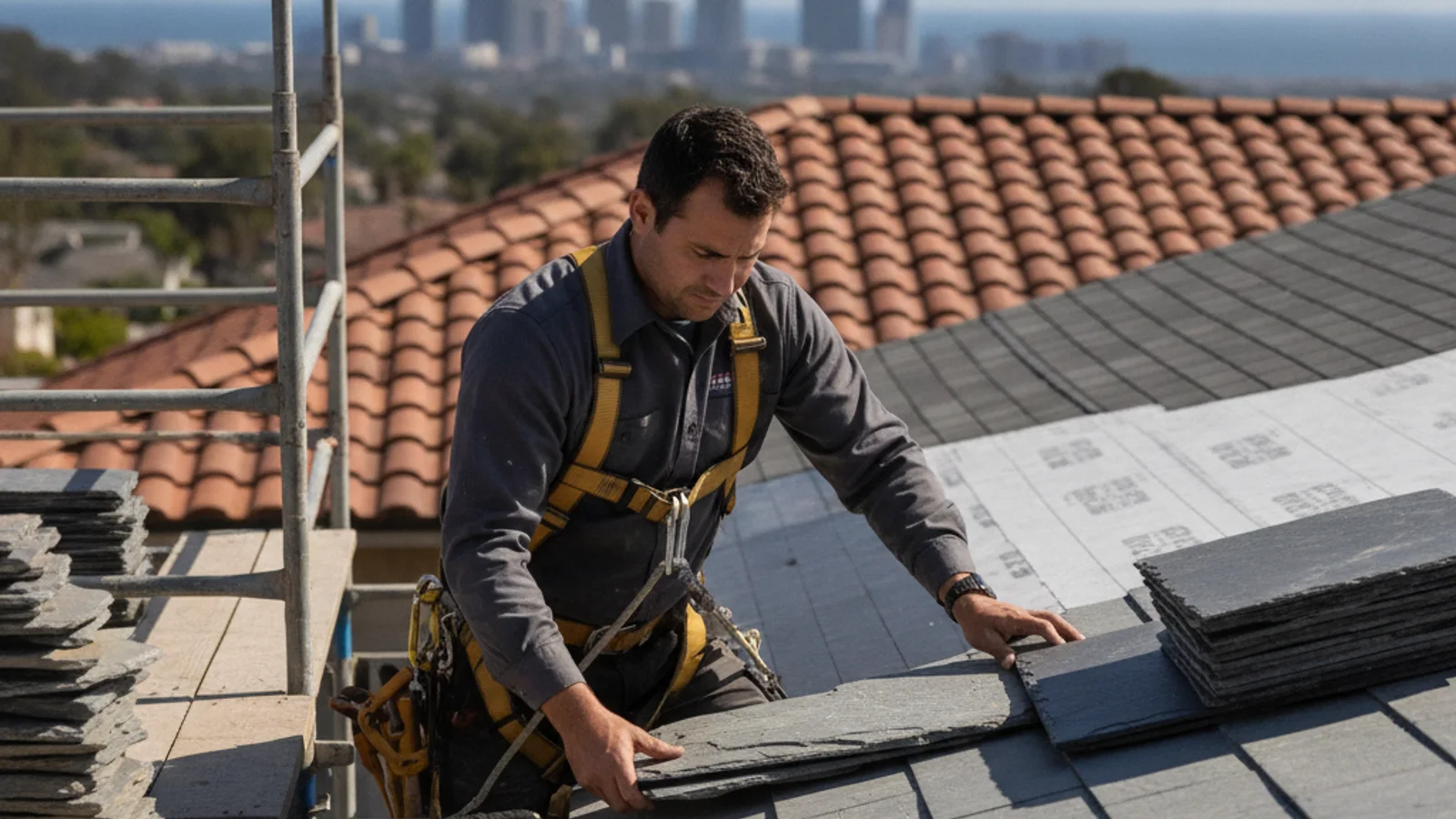
TL;DR
- Natural slate and synthetic slate share a name. They do not share weight, crew, or listing paperwork.
- Ask whether existing framing was designed for this load before anyone orders stone.
- Inside the City of San Diego, replacing a lighter covering with a heavier one can trigger structural verification under Information Bulletin 123.
- Clay tile is often the closer local analog if the goal is a long-life heavy roof the county already knows how to inspect.
- Compare line items. A single round number is not a slate quote.
Why slate is rare here
Most San Diego roofs were built around composition shingle or around tile. Tile is already a heavy covering. Natural slate can overlap that range or exceed what a mid-century composition or shake house was framed for. The first cost driver is not the pretty sample board. It is whether the rafters and connections can take the proposed dead load, including seismic review in this region.
Under City of San Diego roof-covering rules, start with Information Bulletin 123. Read the current bulletin. Ask the AHJ whether this heavier covering needs structural verification. Other cities and the unincorporated county write their own counters. Ask the matched C-39 to put the proposed product weight on the bid.
The labor pool is the second driver. Tile and shingle crews are common in the county. Natural slate installers are not. Limited availability shows up as schedule and as a labor line, not as a blog multiplier we can print.
Where slate actually appears: historic fabric in La Jolla, Coronado, and Mission Hills where the stone is the point; custom work in Rancho Santa Fe and Fairbanks Ranch; additions that have to match existing slate. It is not a typical Chula Vista tract upgrade.
Natural slate vs synthetic slate
These two products share a marketing word.
Natural slate is quarried stone (North American and European sources show up on specs). Color and thickness vary by quarry. Installation is nailing through stone without cracking it, plus detailing at valleys, dormers, and copper or other flashings. Longevity claims belong on the quarry and installer documents, not on a year band we invent. The limiting layers on a long-lived stone roof are often underlayment and flashing, which you cannot see once the slate is down. Specify those as if you will not disturb the field for decades.
Synthetic or composite slate is manufactured, often from polymer or rubber-blend recipes. Bid names you may see include DaVinci, Brava, and CertainTeed Euroshield. Ask for the listed fire assembly, UV and wind documentation, and the actual weight. Many synthetics are light enough to avoid the heavy-covering structural path that natural stone triggers. That is a framing question, not a slogan. Lifespan is the manufacturer’s written term plus how the underlayment and flashings are detailed in this climate.
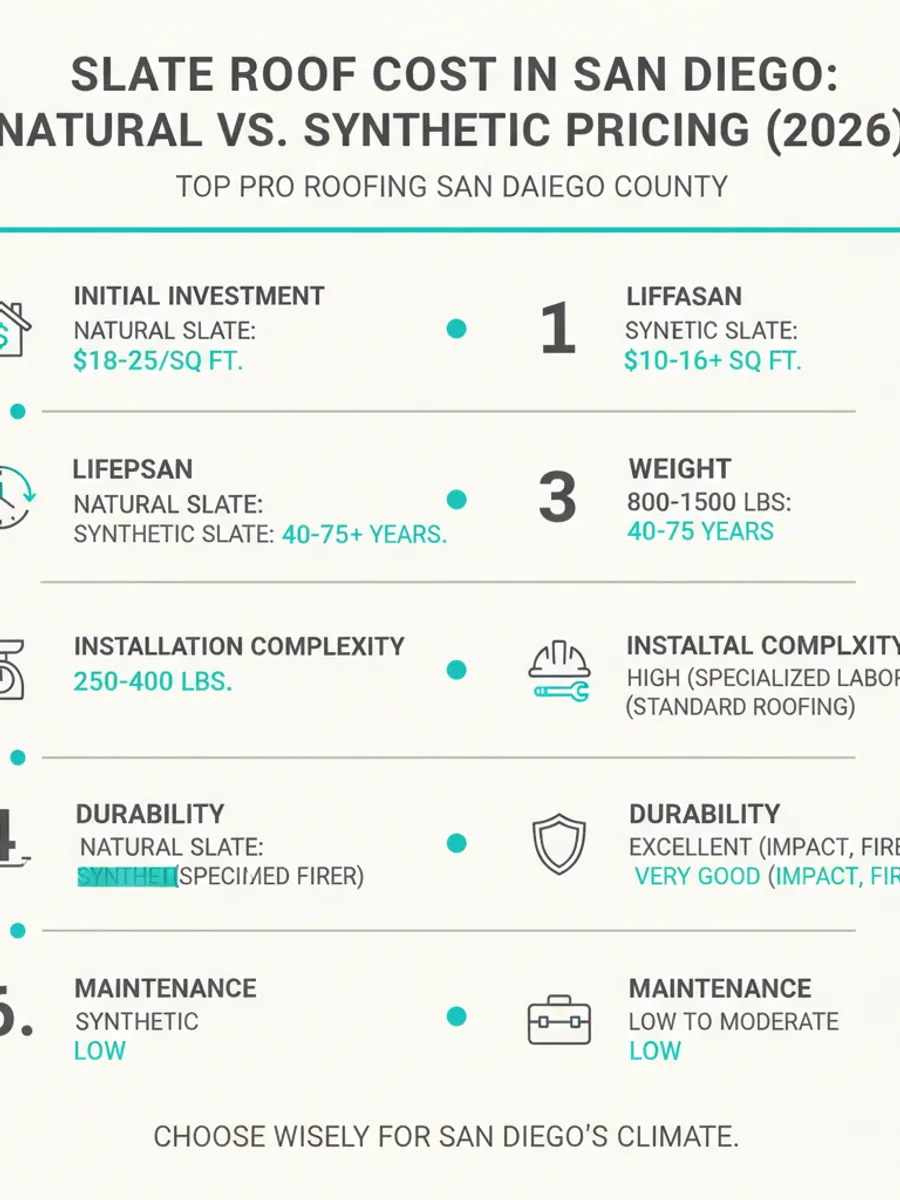
How to compare slate, synthetic slate, and clay tile
For a typical San Diego house, put three columns on one sheet. Do not paste national dollar cells into those columns.
| Question | Natural slate | Synthetic slate | Clay tile (local analog) |
|---|---|---|---|
| What is on the roof | Quarried stone, named quarry and grade | Named composite product and profile | Named clay, one-piece or two-piece |
| Weight / framing | Product weight in writing; engineering if the AHJ requires it | Product weight; often closer to composition than to stone | Many local houses already carry tile; still ask on conversions |
| Who can install it | Specialty slate crew | Broader metal/composite pool, still product-trained | Wide local tile pool, still ask for clay experience |
| Fire listing | Assembly, not “stone is fireproof” | Listed Class A assembly if the lot is mapped WUI | Tile can be Class A as a covering; assembly still matters |
| When it is the honest job | Historic match, original heavy framing, long ownership | Look of slate without stone load | Spanish/Mediterranean fabric the street already speaks |
If you are comparing slate to clay because both are “premium and long life,” clay is the covering San Diego inspectors and crews already live with. See tile roof cost in San Diego and tile roof vs metal.
Broader 2026 bid reading: new roof cost. Another long-life option: metal roof cost.
What drives the final number on a San Diego slate project
Roof complexity. A simple hip or gable is not a Victorian with dormers and custom copper at every transition. Slate cutting time is a labor line. Ask for a roof map, not heated square footage.
Grade and source. Pennsylvania, Vermont, Welsh, and Spanish slates are not interchangeable. Thickness and color consistency move material cost. Name the quarry and the grade on the bid.
Tear-off. Composition tear-off is one job. Clay tear-off is slower. Existing slate, rare in La Jolla and Coronado, may include salvage. Salvage only counts if the bid says how many pieces will be reused and who owns breakage.
Structural upgrades. Get the framing question answered before you fall in love with a sample. If the engineer requires sistering or a different covering, synthetic slate or clay may be the job that can actually be permitted. We will not invent an engineering dollar range.
Underlayment and flashings. On natural slate, the membrane and metals have to last with the stone. Ask for product names. Coastal lots still need metals that belong in salt air.
Ask the AHJ whether this reroof needs a permit. Natural slate packages are often more than a like-for-like covering swap because of weight. Confirm with the department on the address. City of San Diego: start with Information Bulletin 123 and read the current bulletin. Do not restate exemption classes here.
Fire. Mapped WUI lots still want a listed assembly. Stone is not a substitute for the listing. Fire-code roof requirements.
When slate makes sense, and when it does not
Slate makes sense when historic character is non-negotiable, when the house was originally built for heavy materials, when ownership is long, and when a specialist crew is available on your calendar.
It is a poor fit when the existing framing cannot take the load without a project you did not want, when a high-quality synthetic or clay tile already solves the look, or when the only “slate” on the bid is a nickname for a composite no one listed.
If you are restoring a designated resource in Coronado or La Jolla, historic review can control color and profile. If you are in a newer tract home, synthetic slate or tile is usually the conversation that can close.
Frequently asked questions
How much does a slate roof cost in San Diego?
The installer sets the number after measuring roof area, naming the product, and stating whether engineering is in scope. We will not publish an installed range. Compare two written bids on the same map.
Do most San Diego homes need structural work before natural slate?
Many composition and shake houses were not framed for stone. Homes already carrying clay tile may be closer. That still warrants a structural look. City of San Diego has an explicit weight trigger for certain covering changes. Other jurisdictions differ. Do not guess from a neighbor’s roof.
Is synthetic slate worth it instead of natural slate?
For most San Diego homeowners who want the look, synthetic slate avoids the stone-weight path and uses a wider contractor pool. Natural slate wins on historic authenticity and on whatever longevity the quarry and installer will put in writing. Compare documents.
How does slate compare to clay tile in San Diego?
Clay is the closer local analog for longevity-minded heavy roofs. It is widely stocked, widely installed, and familiar at inspection. Slate has a flatter, layered stone texture. Clay has the Mediterranean language of much of the county. Neither is a price we invent.
Is a permit required for slate roofing in San Diego?
Ask the AHJ. Natural slate often adds structural drawings. We will not invent permit fees. Do not treat a full reroof as automatically permitted or automatically exempt.
How long does natural slate last in this climate?
San Diego does not freeze-thaw the way colder slate markets do. UV, fasteners, underlayment, and flashings still age. Ask the matched roofer and the manufacturer what they will stand behind. We will not invent a century figure.
Exploring slate, synthetic slate, or clay for a San Diego home starts with framing, complexity, and a named product. Call (760) 750-5557 and we will connect you with a local independent roofer. We do not install.
More materials context: best roof types for Southern California homes and roof replacement.