TL;DR
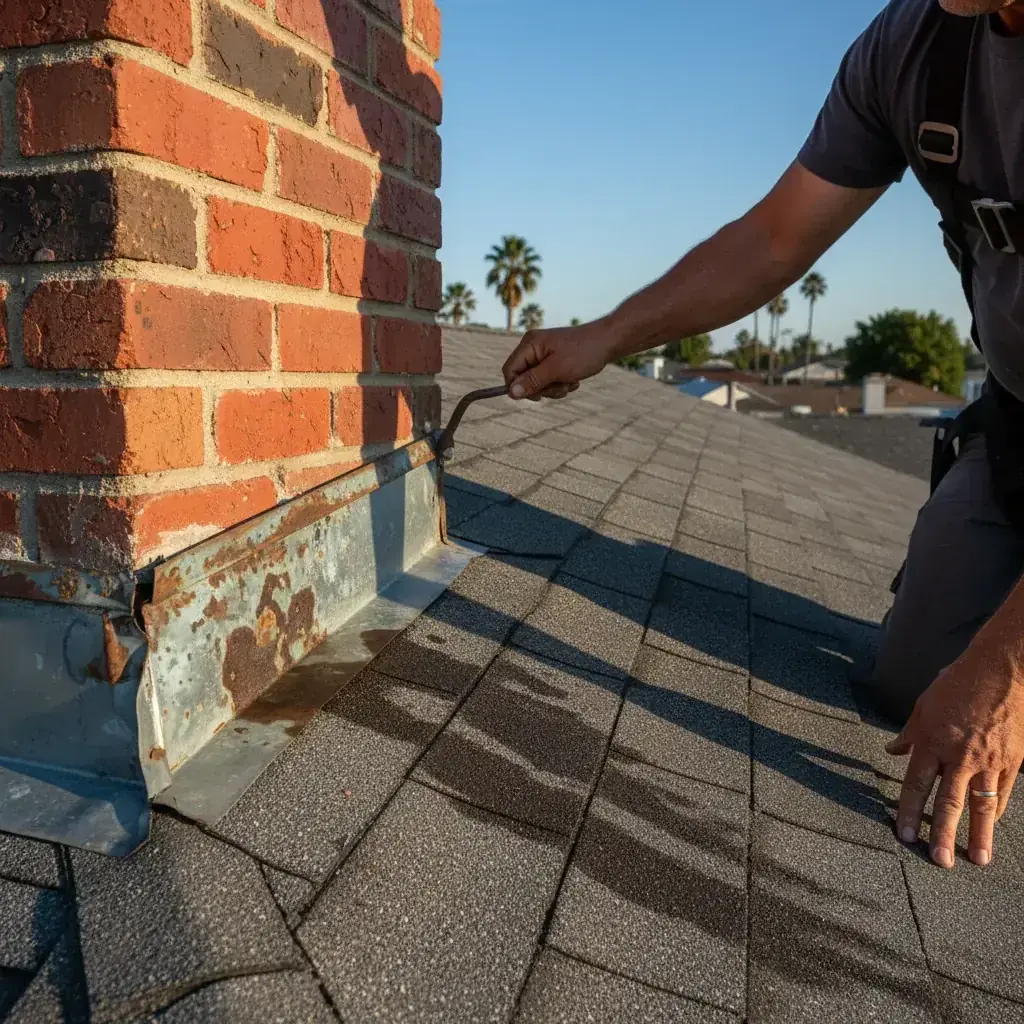
Step flashing is a series of small L-shaped metal pieces interleaved between shingle courses wherever a sloped roof runs into a wall. Each piece sheds water onto the shingle below it. It is one of the common leak sources in San Diego after pipe boots and chimney details, and a sealant-only visit is not that repair.
Coastal homes from Coronado through Encinitas often see galvanized step flashing perforate years earlier than inland runs. A repair that never lifts shingles is caulk. A repair that lifts shingles, removes the old metal, checks the sheathing, adds membrane, installs overlapped new pieces, and reseats the shingles is the actual assembly. Top Pro Roofing SD is a referral service. We do not install flashing. Call (760) 750-5557 to match with a licensed independent local roofer. Ask them to write the six steps below into the scope. Do not hire from a dollar figure alone.
How step flashing actually works
Each piece is a small rectangle of metal, commonly about 5 by 7 inches, bent at a 90-degree angle. The horizontal leg sits on a course of shingles. The vertical leg runs up the wall behind the siding or stucco counter-flashing. The next shingle course covers the horizontal leg. The next piece overlaps the one below it, commonly by at least 2 inches.
The result looks like a staircase climbing the wall. Water that hits the wall runs down, hits a step, and kicks out onto the shingle. It should not sit on the wood sheathing because the metal stays under the next shingle up.
This is what makes step flashing different from many other flashing details. It is not a glued bead. It works because of overlap and geometry. Done right, service life follows the metal and the shingles around it, not the caulk tube.
Where step flashing lives
- Wall-to-roof transitions. A garage attached to a taller house, or a covered patio against the back wall.
- Dormer sides. Each angled dormer wall has a stepped run.
- Chimney sides. Step flashing runs the sides. The front and back use different details.
- Plumb-wall risers. A roof that butts a parapet, knee wall, or stair-step wall.
Cape Cod and traditional two-story builds in Carmel Valley, Scripps Ranch, La Mesa, and Mission Hills tend to have more of these intersections per square foot than a simple mid-century ranch. Spanish-style tile homes often use counter flashing into stucco and still rely on stepped metal underneath. Tile work is not the same lift as shingle work. Say so in the request for quote.
| Where it lives | Typical failure point |
|---|---|
| Wall-to-roof at a step-down | Bottom corner where step meets wall and shingle |
| Dormer sides | Mid-run where galvanized perforates first |
| Chimney sides | Top course where counter flashing terminates |
| Plumb-wall risers | Behind stucco patches that trapped moisture |
Why step flashing fails in San Diego
Salt-air corrosion of galvanized metal. Many older homes used G90 galvanized step flashing. Zinc is sacrificial. Salt aerosol near the coast eats that coating faster than inland air. Coronado, Imperial Beach, Ocean Beach, La Jolla, Cardiff, and Encinitas commonly show perforation that you cannot see from the ground. It shows when shingles get lifted. For the broader corrosion pattern, see coastal roof salt damage.
Sealant aging. Some production installs skipped individual steps and used continuous L-flashing with caulk. Polyurethane has a published service life that UV in San Diego can cut short. Once the bead cracks, water finds the gap.
Improper original install. Pieces butted end to end instead of overlapped, or face-nailed through the front of the shingle below, put holes in the water path. Both can pass a glance inspection because they are hidden. Both leak later.
Wind. Santa Ana winds and winter storms can lift shingles and expose the metal to UV. Wind can also fold a vertical leg that siding no longer holds.
How to diagnose a step-flashing leak
- A water stain on the ceiling or upper wall within a few feet of where the roof meets a higher wall outside.
- Stains that appear after sustained rain, not a brief shower.
- Bubbling paint or warped baseboard at the second-floor base of an interior wall under a roof-to-wall transition.
- Soft stucco or rotted siding at the bottom of a wall where it meets the lower roof.
Pipe boots and skylights often leak quickly under a short shower. Step flashing often needs a longer wet period. If the stain shows only after a heavy storm, this detail belongs on the inspection list. See what causes most roof leaks in San Diego.
What real repair looks like
If a contractor’s scope skips any of these, the leak can return.
- Lift back the shingles in the affected run without breaking every tab.
- Strip the old metal. Pull face nails and treat those holes.
- Inspect the sheathing. Stained or soft OSB or plywood gets cut out and replaced. That finding must have a written process, not a surprise invoice with no photos.
- Install new ice-and-water membrane up the wall behind the flashing, lapping the course below.
- Install new step flashing with overlap, nailed only through the top of the vertical leg, not through the horizontal leg into the deck.
- Reset the shingles with new sealant tabs and replace any that broke.
A visit that takes a few minutes with a caulk gun is not those six steps. Labor time depends on run length, pitch, siding or stucco, and how many shingles break. Ask for hours or a crew day in writing if you need a schedule. We will not invent a dollar range for a short run versus a long wall.
Material options without a fake price column
Ask the independent roofer which metal they will install, in writing, with thickness or gauge.
| Material | Why it comes up in San Diego | Compatibility note |
|---|---|---|
| Galvanized G90 steel | Common original metal; coastal chloride shortens the coating life | Fine inland if the rest of the roof is galvanized; weaker near salt |
| Aluminum | Does not rust like galvanized in salt air; common with asphalt shingles | Do not mix with copper; galvanic corrosion will eat the aluminum |
| Stainless steel (304) | Used on critical coastal runs that you do not want to open twice | Confirm fastener and adjacent-metal compatibility |
| Copper | Long service life when the rest of the roof already uses copper | Match existing copper valleys, saddles, or gutters |
For most asphalt-shingle homes, aluminum is the frequent recommendation from contractors who work the coast, because it avoids galvanized perforation. That is a product conversation, not a promise from this referral site. If copper already exists on the same roof, match copper or use stainless. Mixing aluminum and copper is the failure. More on coastal metal: will salt damage a metal roof.
If the shingle roof above the flashing is near the end of its life, repairing only the metal can be wasted labor when a reroof will open the same wall again. Talk through sequence with the same contractor. Line-item thinking for flashing families is in our roof flashing repair cost guide. Treat that guide as a checklist of scopes, not as a bid.
Why caulk-over never works as a substitute
A handyman sees a gap or rust along the wall line and runs polyurethane or roofing tar across the top edge, sometimes across the shingle course too.
The leak is often underneath, where pieces corroded through or never overlapped. Sealing the top can trap wind-driven water. Polyurethane on asphalt can bond for a while, then crack as shingles move in UV. When a licensed roofer later lifts the run, dried sealant can tear shingles that would have reseated.
If anyone offers a step-flashing repair without lifting shingles, get another written scope.
How to read a step-flashing repair quote
Look for: shingle lift-back, metal removal, sheathing inspection, ice-and-water membrane, new flashing material and gauge, shingle reseating, sealant only where counter-flashing needs it (not as the step itself), and disposal. A one-line “repair flashing leak” is not a scope.
Workmanship terms come from the independent contractor, not from Top Pro Roofing SD. Ask for the covered run, the term, and what voids it. A company that offers no written labor terms on a woven-metal repair is telling you something.
The Contractors State License Board publishes the C-39 roofing classification. Read the current live text. Verify the license before you sign. The license number should appear on the quote.
The National Roofing Contractors Association publishes flashing guidance in the NRCA Roofing Manual. A contractor who can explain overlap and nailing from that tradition will sound like this article, not like a caulk special.
Where San Diego homes show trouble first
Coastal salt zones: Coronado, Imperial Beach, Ocean Beach, La Jolla, Cardiff, Encinitas, Solana Beach, Del Mar. Treat old galvanized as unknown until someone lifts a course.
Older neighborhoods with original galvanized: Mission Hills, North Park, Kensington, La Mesa, parts of Hillcrest and South Park. If you bought a mid-century house and the field was replaced without opening the walls, the metal may still be original.
Two-story production homes in Carmel Valley, Scripps Ranch, Rancho Bernardo, and 4S Ranch sometimes used continuous L-flashing with sealant instead of individual steps. Those need a retrofit of real steps, not a bead.
FAQ
Can I repair just one piece? Rarely. If one piece has corroded, neighbors in the same run are usually close. Lifting for one piece is most of the labor of doing the run.
Do I need to replace the shingles too? Not always. Sound shingles can be lifted and reseated. Some breakage is normal. Brittle, sun-baked shingles may not survive the lift. The contractor should say that before work, not after.
Will insurance cover it? Wear and corrosion are often treated as maintenance, not sudden accidental damage. Storm-tied wind damage is a different claim path. Read the current live California Department of Insurance guidance and your policy. This page will not restate Insurance Code 2071 holdings. We do not speak for your carrier.
How long does the repair take? Ask the contractor for a written schedule. A longer run with siding or stucco takes more of the weather window. Marine layer and rain close that window because underlayment should not sit exposed overnight. Ask the contractor for a weather plan.
Should I upgrade from galvanized? Near the coast, many contractors prefer aluminum or stainless so you are not opening the same wall again soon. Inland, some owners stay with G90 if the rest of the roof is galvanized. Put the choice in the scope. We will not invent an “add 25%” surcharge.
Can these leaks cause structural damage? Yes, given time. Slow leaks can rot wall sheathing and plates before anyone notices. Do not ignore stains.
Will a general home inspection catch it? Sometimes they note rust or gaps. They usually cannot lift shingles. If you are buying a coastal house, a separate roof inspection with a lift-and-look on flashed walls is the way to see the metal.
What to expect when you call us
When you call (760) 750-5557 about a suspected step-flashing leak, we match you with a licensed independent San Diego roofer. Ask that roofer for a written inspection that includes wall-to-roof transitions, photos under lifted shingles where they can do so without damage, and a scope that names the six repair steps. We do not guarantee a free inspection, a fixed schedule, tarp timing, or a warranty length. Those terms belong to the contractor who signs the job.
For related details, see chimney flashing repair and roof flashing leak repair. Service overview: flashing and vent repair.
If a stain shows after big storms, or a water mark sits where a low roof meets a tall wall, get a licensed look. Step flashing is repairable. Leaving it is how sheathing quietly fails.