An accessory dwelling unit roof is new construction or an alteration under the permit that covers the ADU. It is not a miniature copy of a main-house reroof blog. Title 24, fire listing, ventilation, solar, and HOA matching each have an owner: the authority having jurisdiction (AHJ) for that address, the energy consultant, and (if you have one) the association.
Top Pro Roofing SD refers licensed independent C-39 roofers. We do not pull ADU permits, interpret the municipal code, or set prices. Call (760) 750-5557. You contract with the matched roofer. Confirm licenses on the CSLB lookup.
We will not publish installed-cost bands, per-square-foot averages, or permit-fee tables. Those numbers move by city, size, access, and the current fee schedule. Ask the building counter and the contractor.
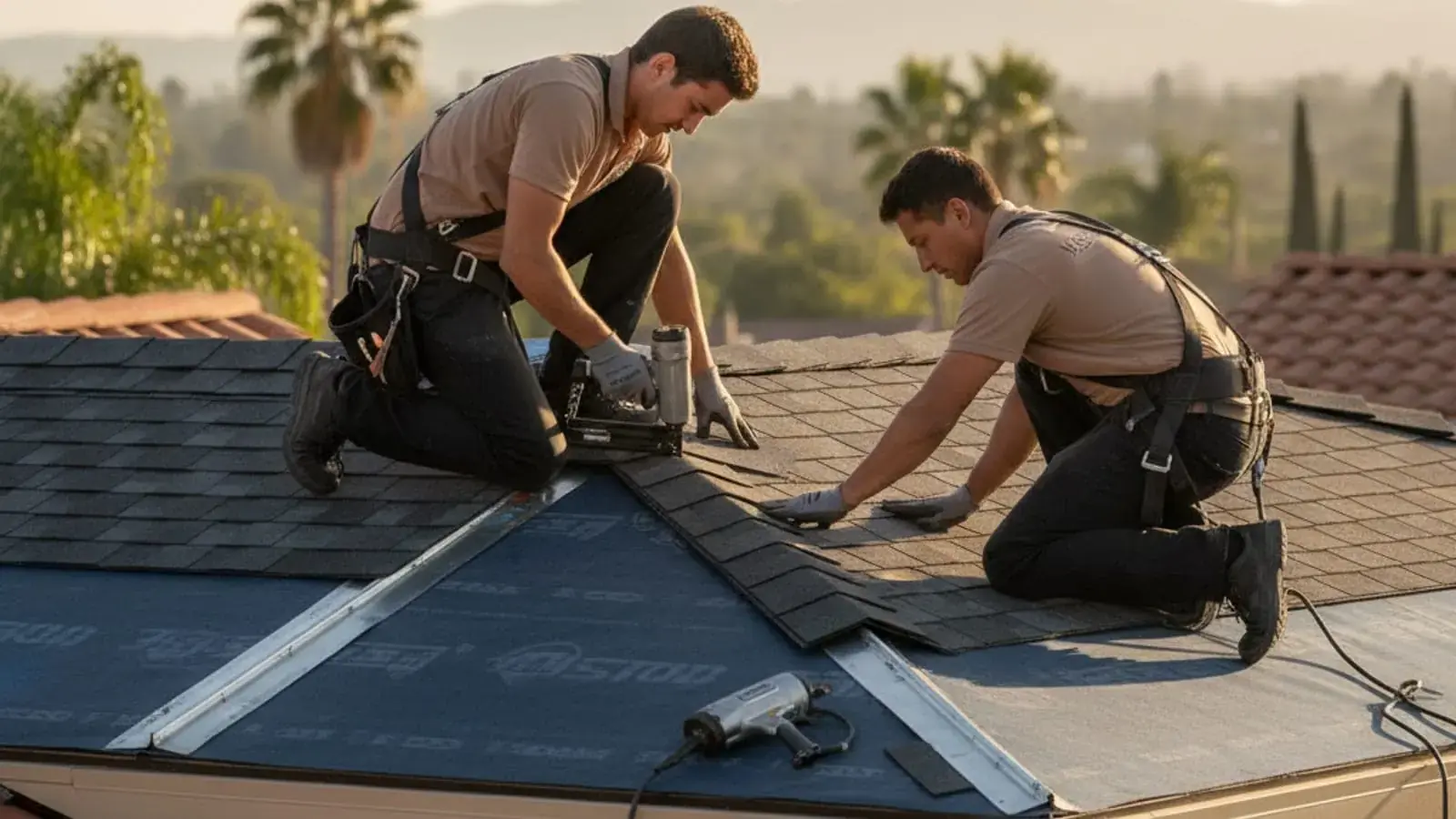
Confirm the AHJ before anyone orders tile
San Diego County is not one roofing counter.
- City of San Diego Development Services: sandiego.gov
- Unincorporated county: PDS
- Other cities (Chula Vista, Escondido, Carlsbad, National City, and the rest) each publish their own ADU handouts
State ADU statutes and local bonus programs change. Do not treat this page as the current planning checklist. Pull the ADU bulletin for that city, then have the architect or permit runner confirm roof notes on the approved set.
The roof is usually inspected as part of the ADU building permit, not as a standalone reroof permit. Sheathing nailing, underlayment, and final still have to pass. Ask the inspector’s list for that permit type. Do not assume City of San Diego cards match Escondido.
Title 24: energy, not a material catalog
New ADUs often follow California’s energy standards the way other new dwellings do, unless the energy professional documents an exception. Cool-roof prescriptive values depend on climate zone and slope. Look up the CEC climate zone for this address. Do not copy a zone number from this blog. Confirm the zone on the CF-1R (or current equivalent) for that project. Do not treat Title 24 as a default covering catalog.
Asphalt often needs a CRRC-listed cool shingle to hit the prescriptive path. Many tile products pass on listed properties. Metal depends on color and coating. None of that replaces the forms. Detail: Title 24 cool roofs. Current rulebook: energy.ca.gov.
Attic or vaulted-cavity R-value and ventilation follow the California Residential Code path on the drawings. On a small ADU with a cathedral ceiling, baffles and intake have to be built before drywall. That coordination is the framer, the energy consultant, and the C-39, not a blog R-value.
Fire listing and WUI
Roof covering fire classification (Class A, B, or C) is an AHJ and product-listing question. Do not treat Class A as a countywide fact for new dwellings. Read the adopted code and the product ESR.
Wildland-Urban Interface overlays can add California Building Code Chapter 7A items where the local map applies. Maps and Chapter 7A material live with Cal Fire / OSFM and the local fire AHJ. Confirm whether the parcel is inside a WUI or very high fire hazard zone before locking a vent product. Do not treat Chapter 7A as automatic. Material context: wildfire-resistant roofing. Mountain and inland notes: mountain roof considerations.
Solar: detached new ADU vs conversion
The California Energy Commission publishes current Title 24 photovoltaic rules. Read the live text for new low-rise residential construction and any listed exceptions. A new detached ADU often lands in that conversation. A garage conversion that does not add new conditioned roof area often does not. Attached additions sit in between. This page does not restate those holdings.
That split is exactly why the AHJ and the energy consultant have to speak. Do not order panels from a blog sentence. If PV is required, the roof plan needs fire setbacks, attachment layout, and an underlayment that can last with the array. See do solar panels damage the roof and preparing a roof for solar.
Even when PV is not required on day one, solar-ready structure, underlayment, and conduit stubs are cheaper in the open wall than as a retrofit. Ask the designer to show those notes. Do not invent a “marginal cost.”
HOA matching
State law limits an HOA’s ability to block an ADU. It does not erase architectural standards. If the main house is clay barrel, the committee can still require the ADU to match profile and color.
Pull the CC&Rs and the design packet before framing. Photograph the existing roof. Put manufacturer, profile, and color code in the submittal. Verbal nods get reversed. Planned communities (Carmel Valley, Scripps Ranch, Rancho Bernardo, and similar) will have a form. One worked example: Carmel Valley HOA roof requirements.
Detached vs attached: the roofing difference
A detached ADU is its own structure. Pitch and material can be whatever code and the HOA allow. Full energy and often PV rules apply as new construction.
An attached ADU usually ties into the existing roof. Inspect the main-house covering before the new valley lands. If the house roof is at end of life, combining scopes is a sequencing decision, not a discount we will invent. Valley metal, underlayment up the existing plane, and a dry-in that the inspector can see are the leak-sensitive details. San Diego rain is long, not snow-heavy. A weak valley still leaks.
Junior ADUs that stay inside existing volume may add no new roof. If the existing roof is untouched, there is no new covering to specify. Confirm that on the permit, not by skipping the inspection.
Covering tradeoffs when you do have a choice: best roof types for Southern California. Full replacement path on the house: roof replacement.
Why small roofs are priced differently (without a number)
Mobilization, dumpsters, and safety setup do not shrink with the footprint. Backyard detached units can block boom access. A small plan has more eave and flashing per square of field. Those are reasons two bids diverge. They are not a per-square-foot figure for this page.
| ADU form | Roof question to put on the drawings |
|---|---|
| Garage conversion, no new roof | Confirm the existing covering is out of scope |
| Detached new | Energy forms, fire listing, solar path, HOA match |
| Attached addition | Tie-in details, valley, and remaining life of the house roof |
| Junior ADU, interior only | Usually no new covering; confirm on the permit |
| Two-story detached | Access, staging, and inspection sequence |
Frequently asked questions
Does an ADU roof have to match the main house?
Code usually does not require a match. Many HOAs do. Even without an HOA, matching is a resale and neighbor issue, not a CSLB rule.
Is solar required on every new ADU?
No. Detached new units often trigger the residential PV rules. Conversions and small or shaded roofs may qualify for exceptions. Your energy consultant and the AHJ confirm that for the permit.
Can I use a different material than the house?
Often yes under the building code. The HOA and the coastal or historic overlay may still say no. Ask both.
How long does the roof take?
Ask the C-39 for working days after a dry-in-ready deck. Tile, inspections, and solar coordination stretch the calendar. We will not invent a two-to-four-day rule.
What is the cheapest code-compliant covering?
Whatever listed product meets Title 24, the fire listing, ventilation, and the HOA. Architectural cool shingle is often the low-cost code path when the association allows it. If the HOA requires tile, that path is closed. No dollar floor on this page.
Does the ADU roof need its own permit?
Usually it is inside the ADU building permit. Confirm with the AHJ. Do not start covering without the inspection sequence in writing.
The house roof is worn out. Replace it with the ADU?
Often that is the clean sequence: one mobilization, one tie-in, one dumpster window. Compare a combined proposal to two separate ones. We do not promise a combined discount.
If you need a C-39 to read an ADU roof plan or to bid a tie-in, call (760) 750-5557. We match homeowners with licensed local roofers. We do not interpret the municipal code for the city.