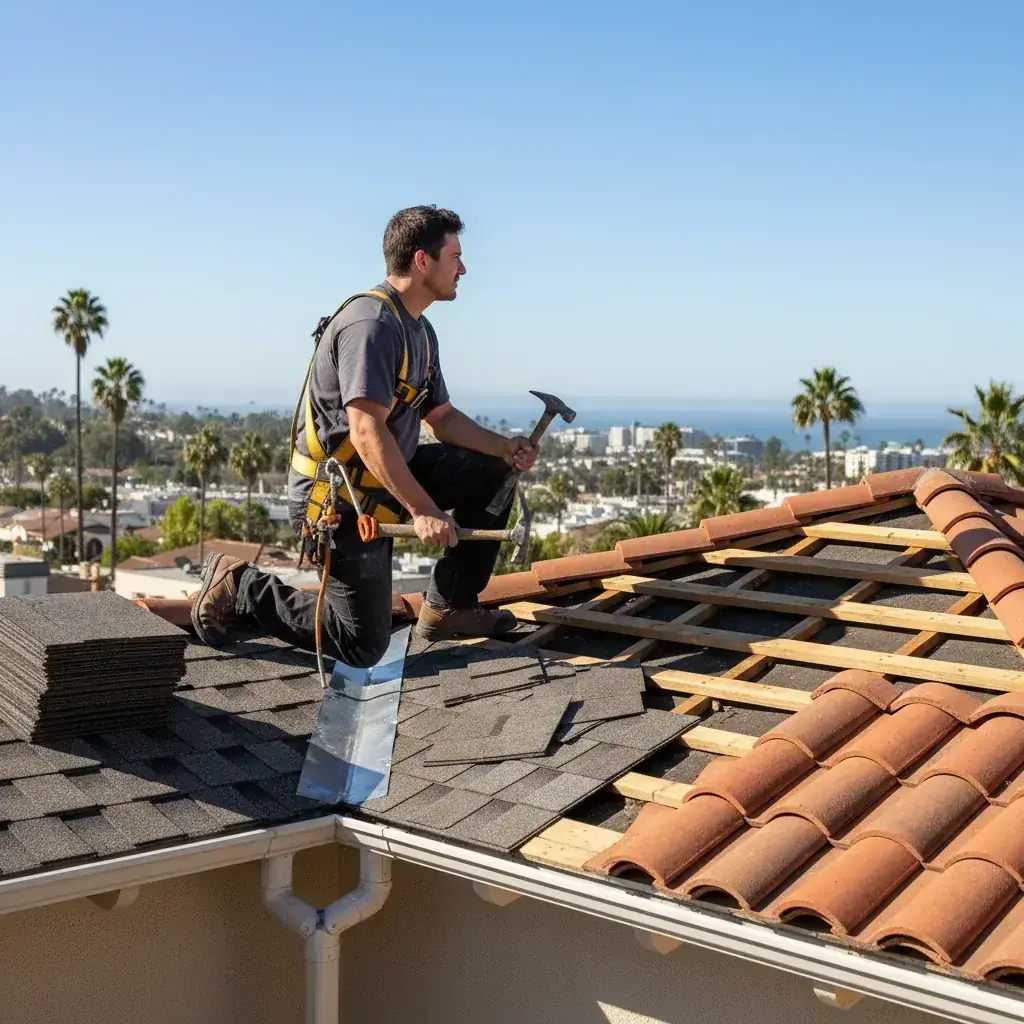
Tile roofs in San Diego look right on Spanish Revival and Mediterranean streets, and they last a long time. They also come with real downsides: higher first cost than asphalt, serious weight, an underlayment clock that is shorter than the tile, and fewer crews who know how to walk and flash it. None of those is automatically a veto. Together they decide whether tile still fits this house.
Top Pro Roofing SD is a referral service. We match homeowners with vetted local C-39 roofers. We do not sell tile and we do not publish a 2026 price sheet. Call (760) 750-5557.
San Diego is tile country. Carmel Valley, Scripps Ranch, Rancho Santa Fe, Mission Hills: clay barrel or concrete S-tile is the default. Fire rating, salt-air tolerance, and HOA rules all push that way. Sales copy still skips the parts that generate winter leak calls.
When tile is still the right call
Tile is usually the honest choice when:
- Your HOA requires it (much of Carmel Valley, parts of Carlsbad and Encinitas, Scripps Ranch, Rancho Santa Fe, La Costa)
- The house is Spanish Revival, Mediterranean, or Mission, and shingle would look wrong at resale
- You plan to own for decades and want fewer full replacements
- You are within a couple of miles of the coast, where salt shortens asphalt life
- The structure was built for tile (common on 1985-and-later production here)
Tile is not the obvious default when:
- The house was built before 1980 for asphalt and has not been checked for extra dead load
- You plan to sell in a few years
- The HOA allows architectural asphalt and the budget is tight
- The roof is steep and cut up (hips, valleys, dormers), which adds tile labor faster than shingle labor
Side-by-side: tile vs shingle and tile vs metal.
Downside 1: First cost is higher than asphalt
Tile install is a heavier, slower job than architectural shingle on the same footprint. Clay is usually above concrete. Cut-up roofs (valleys, chimneys, dormers) widen the gap because cutting and flashing tile does not scale like shingle.
We will not invent installed totals, per-square-foot bands, or a “2x to 3x” dollar multiplier presented as a rate card. Ask for written numbers on the same square footage, pitch, and access for tile and at least one alternative.
Cost reading: tile roof cost and 2026 tile replacement. Those pages are bid guides, not our invoice.
The long-ownership case for tile is lifespan and fewer full tear-offs. Many owners do not stay that long. The premium is real money now. The matched roofer should say so on paper.
Downside 2: Weight and structure
Approximate installed dead load (industry ranges, not a quote):
| Material | Weight (lb per sq ft) |
|---|---|
| Architectural asphalt shingle | about 2 to 3.5 |
| Standing-seam metal | about 1 to 1.5 |
| Concrete tile | about 8 to 11 |
| Clay tile | about 9 to 12 |
On a typical 2,000 sq ft roof, that is thousands of pounds more than shingle. It is not a car parked on the ridge, but it is a permanent load the rafters have to carry.
This tends to cost extra when:
- Pre-1980 asphalt houses with 2x4 or 2x6 rafters at 24 inches on center may need sistering or purlins before tile
- You are jumping from concrete to a heavier clay
- Solar is going on an already-tile roof (dead load plus live load during work)
- A prior owner went tile to shingle, and the inspector wants proof the structure can go back
Most county and city desks want an engineer involved when the house was not originally designed for tile. We will not invent an engineer-letter fee. Ask the building department and the engineer.
Newer production in the last 40 years is often already tiled. Older stock in Mission Hills, La Mesa, Encinitas, and Pacific Beach is where this surprise shows up.
Downside 3: The underlayment trap
This is the one that blindsides people.
The tile can last 50 to 100-plus years. The sheet under it cannot. Felt in this sun is a mid-life product. Synthetics last longer, still not “forever.” When that layer fails, the tile can look fine while the roof leaks. The work is a lift-and-relay: tiles off, new underlayment, tiles back.
That is a large fraction of a new-tile job in labor, not a cheap patch. We will not invent a lift-and-relay total. Budget for it as a planned mid-life project, not a shock at year 28.
| Roof type | Mid life | Later |
|---|---|---|
| Asphalt shingle | Full replace | Replace again |
| Concrete or clay tile | Lift-and-relay (tile often reused) | Another lift-and-relay; some tile may need replacing |
Three traps:
- Brochures said “100-year roof.” They meant the fired clay, not the felt.
- You cannot see failed underlayment from the street. The first sign is often a storm leak.
- Many “tile leak” calls are underlayment at end of life. Patching one winter leak does not reset the sheet.
Signs: tile underlayment failure. Process: lift-and-relay.
If you are buying a 1990s original-tile house, assume the sheet is the question, not the barrel color.
Downside 4: Fragile under foot
Tile carries even weather load. It cracks under a point load. A shoe in the middle of a barrel is the usual break.
Do not walk your own roof. Painters, solar crews, satellite techs, and HVAC techs crack more San Diego tile than weather does. A cracked piece is not only cosmetic. Water hits the underlayment through the break. Common tile leak causes.
Matching discontinued clay colors is its own headache. Salvage, or stealing a few pieces from a hidden slope, is normal tile-trade practice. Clay tile repair.
Put tile-safe walking in writing on every other trade’s work order. Foam pads, designated paths, not a shortcut across the field.
Downside 5: Coastal slip and fastener rust
Within about two miles of the water (Imperial Beach, Coronado, Ocean Beach, Pacific Beach, La Jolla, Del Mar, Solana Beach, Encinitas, Carlsbad), salt eats galvanized nails and wires. Tiles can slip. A slipped tile in a Santa Ana is a driveway or a neighbor problem.
Specify at install (and at lift-and-relay):
- Stainless or copper fasteners, not galvanized
- Copper ties on steeper slopes
- Synthetic underlayment, not felt that holds moisture against the fastener
- Stainless or copper flashing at valleys, hips, ridges, and penetrations
Older roofs often did not get that spec. If you are 25-plus years in and near the beach, fastener corrosion is part of why a lift-and-relay is not optional.
Downside 6: HOA rules cut both ways
A tile mandate protects the street look. It also traps you at replacement. You cannot switch to a lighter or cheaper assembly without a variance that often fails.
Your options in a hard tile CC&R:
- Re-tile to a matching profile and color
- Apply for architectural review
- Sell
If the structure also needs help, you are paying structure and tile, then planning the next lift-and-relay. Carmel Valley HOA roofs. Rancho Santa Fe tile.
Downside 7: Fewer true tile crews
Tile install, repair, and lift-and-relay are not shingle with extra steps. You need people who know where to step, how to cut hips and valleys, how to source discontinued profiles, and that the underlayment is the roof.
There are far more asphalt crews in the county than tile crews who do that well. That shows up as longer non-emergency waits, more expensive mistakes (caulk on a crack instead of a swap), and patches that leak in year three.
Verify tile experience, not only a C-39. Ask how many lift-and-relays they finished last year, which manufacturers they buy, and for a recent in-progress job, not only a pretty finish photo. License check: CSLB. Same C-39 as shingle. The license does not prove tile skill.
We connect you with roofers who do tile. You still check the license and the references.
Downside 8: Solar is messier
Solar is common here. On tile it is harder than on shingle.
- Standoffs need tile-compatible flashing or hooks. That is a tile person plus a solar installer, not a guess.
- Walking the field during install cracks tiles. Repair quality varies. Exposed underlayment while you wait is a leak window.
- A later lift-and-relay means panels off and back on. That is a separate bill. Ask before you sign the solar contract.
If you are 20 years into original underlayment and shopping solar, do the sheet first, then the array.
What people actually regret
Not a survey of “hundreds of customers.” The pattern we hear on referral calls:
| Rank | Downside | Why it stings |
|---|---|---|
| 1 | Underlayment | Sold a century roof, then a mid-life lift-and-relay |
| 2 | Solar plus lift-and-relay | Panel removal was not in the solar paperwork |
| 3 | Specialist access | The usual shingle company will not touch it correctly |
| 4 | Other trades on the roof | Cracks found after the next rain |
| 5 | First cost | Expected, still a large check |
| 6 | Structure | Mostly pre-1980 surprises |
| 7 | HOA | Usually known at purchase |
| 8 | Coastal slip | Older galvanized installs near the water |
The brochure stopped at “lasts 100 years.” That is the marketing failure, not the clay.
When tile is still worth it
HOA requires it, house was designed for it, you are staying 20-plus years, the style would suffer with shingle, you are in salt air, or wildfire rating matters (tile is Class A as an assembly when installed that way). Then you pay the premium, plan the lift-and-relay, hire tile people, and keep other trades off the field.
When to consider switching at replacement
If the HOA allows it:
- Selling in under about seven years and you want a smaller first check
- Structure is already complaining (bowed rafters, drywall cracks at load points, doors that stick)
- You have already done more than one lift-and-relay and the original tile is widely cracked
- You do not want another 25-year cycle on the next owner
- Inland fire country where metal (also Class A) gives rating without the weight
Tile vs metal and tile vs shingle.
How to shrink the downsides you already have
- Never let anyone on the roof without tile-safe method in the work order
- Inspect from the ground with binoculars after storm season. Do not climb.
- Plan the lift-and-relay as a mid-life line item, not a surprise
- Hire for tile proof, not a generic “roofer” ad
- Stainless or copper if you are near the coast and the roof is open
- Do not pressure-wash. Tile maintenance
FAQ
What’s the best alternative if I do not want tile?
Standing-seam metal is the closest on fire, lifespan, and salt, at much lower weight. Architectural asphalt is the budget path outside associations whose CC&Rs require tile and outside the near-coast salt belt. Same comparison posts as above.
Can I switch from tile to shingle?
If the HOA permits it. Labor is usually faster and the load drops. You trade shingle’s shorter San Diego life for a smaller first invoice. Long stay vs short stay changes which bid wins. No invented savings number.
What if I want to set it and forget it?
Standing-seam metal is the usual “no lift-and-relay” answer. Class A, handles salt, the panel is the waterproofing. HOA acceptance is patchier than tile. Confirm CC&Rs before you fall in love with a metal sample.
Is the tile premium worth it over decades?
Sometimes, if you stay long, the house is in a tile street, and you budget the underlayment cycle. Over a short ownership, often no. Run both bids. We will not invent a 50-year savings figure.
Can I walk my own tile roof to clean gutters or hang lights?
No. Stay off it. Falls and extra cracks are the usual result. Hire it and specify tile-safe access in writing.
Why do tile leak repairs cost more than shingle?
Lift, stack, and reset without breaking neighbors. Matching discontinued tile. Tile-experienced labor is scarcer. That is time and sourcing, not a secret surcharge. We will not invent hourly rates or a “simple leak” dollar band.
Are there HOA workarounds?
Sometimes lightweight concrete or composite that mimics clay, or dark standing seam from the street. Variances can work with an engineer’s letter that the structure cannot carry tile. Asphalt is almost never approved in a hard tile CC&R. Read the CC&Rs. Ask the architectural board before you bid.
Get a real quote
Get written numbers for tile and at least one alternative on the same house. The contractor measures, looks at structure, and lists options. No pressure from us. We do not do the work.
Contact or call (760) 750-5557.
Sources
- Tile Roofing Industry Alliance installation manuals
- NRCA steep-slope manual for underlayment and steep-slope practice
- ASTM C1167 (clay roof tiles)
- CAL FIRE Class A roofing context
- CSLB license check
Related: tile vs shingle, tile vs metal, tile cost, underlayment signs, lift-and-relay, tile leaks, tile maintenance, concrete vs clay, tile roofing, roof replacement.